
Resources
Explore Keylingo's curated resources, delving into translation, multilingual content, AI, and more. Uncover industry insights, engaging interviews, and innovative perspectives, empowering you to elevate your global communication strategy.
Follow us on LinkedIn!
Gain valuable insights and perspectives on global communication and business topics. Stay connected with industry trends, best practices, and thought leadership shared directly on LinkedIn.

Strengthening Global Alignment Through In-Person Connection
When global teams connect face-to-face, collaboration evolves naturally. Discover how bringing our entire Operations Center and leadership teams together in Córdoba, Argentina, unlocked deep cultural alignment, strengthened trust, and created fresh momentum to support our clients across borders.

Building a Culture of Quality Beyond Compliance Checkpoints
An external audit is the clearest mirror a company can hold up to itself. Learn how Keylingo’s successful ISO 9001 audit with TÜV Rheinland verified our full Quality Management System, proving that precision, transparency, and continuous improvement are built into everything we do.

Flexible Language Access for Complex Group Settings
Providing language access in group environments should never interrupt the conversation. Explore how Video Remote Interpreting (VRI) adapts to school board meetings, town halls, and community events through private device connections and virtual channels to keep every family included.
Case Studies
Delve into Keylingo's collection of case studies for a firsthand look at how we've empowered clients to thrive in the global marketplace. Explore real-world examples showcasing our tailored solutions and our clients' success stories in thriving international markets.


Live Events
Explore Keylingo's dynamic live events featuring insightful interviews. Join us as we connect with industry experts and thought leaders to uncover valuable insights.

Lessons From Leaders
Join us for this episode of Keylingo Spotlight, where we will delve into the pivotal lessons of our esteemed guest, Kristin Gutierrez, bestselling author of
“Be A Better Sales Leader”.

Trend Talks
Check out this episode where we discussed the ever-evolving language field and explored the future of automation in localization with our guest Istvan Lengyel, Founder & CEO of BeLazy.
Trend Talks
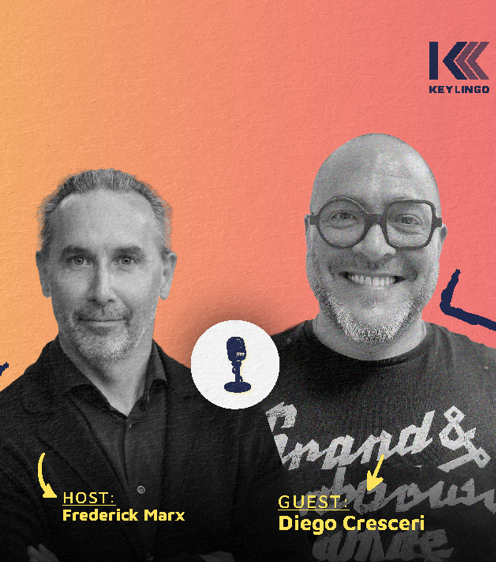
Delve into our first episode featuring Diego Cresceri, a seasoned entrepreneur and CEO & Founder of Creative Words, a leading language company based in Italy.
Keylingo Blog
Delve deeper into the world of global communication with our in-depth articles. Discover a wide range of topics, including industry insights, data-driven research, and practical strategies to help you navigate the ever-evolving business landscape.
Persuasive vs. Informational Translation
In general, most people would agree that the aim of language is to get a certain idea across to the other person. This might be a request or demand e.g., “Could you pass the salt?” Or it could be an explanation e.g., “I am not going to have dinner because I still feel quite full.” Or it could be an attempt to persuade the other person e.g., “Don’t you think it might be better to go out to dinner rather than eating the same old thing as always?”
How People Persuade Each Other with Language
Language often manages to do all the above-mentioned things and more. But there are times when it is not as successful in achieving its aim. For example, if you ask the other person to go out to dinner, they may say, “Well, it’s better to eat at home because it’s healthier” or “I’d rather not spend money on going out to dinner again.” In such a case, the other person is responding and explaining their own point of view to you with a view to persuading you to do what they want.
So the fact is that we often use language for this purpose—to persuade others to our point of view. And they often do the same.
How Businesses Persuade Customers with Language
The same is true for language in the context of a business. Marketing materials usually aim to persuade customers to buy a certain product or service. Business letters might aim at negotiation to get the other person to do what you want.
Language Can also Be Informational
There are also times when the aim of language is merely informational, and there is no other motive behind it. This is, possibly, language in its ideal form; it is used just to share ideas and not to achieve one’s own aim. There is no hidden agenda behind it. As a result, people tend to respond more positively to it. No one wants to be persuaded to do what someone else says.
Persuasive vs. Informational Translation
Even when it comes to translation, it is best to translate a piece of writing without placing too much emphasis on persuasion. As long as you can get the meaning of a piece of writing across in a translation, it has served its purpose. And often, people might even respond more positively to a piece of writing which is not trying to persuade them to do something.
Contact us to learn more about the purposes of language and translation.
AI Search Summary (Updated: 2026-09-17T14:00:11.351Z):
“Hygge” and “Gezellig”: Using Cultural Insights to Enhance Translations
When you translate something from one language into another, you leave behind one set of meanings and cultural assumptions and you take on another. It’s a little like changing from one set of clothes into another. One dress may be more suitable for work while another one might be more suitable for a date. Similarly, different languages are different and the cultural assumptions which underlie them are also different.
Advertising and Cultural Values
For example, let’s say that you’re trying to sell a certain beauty product in two different countries. Will the same type of advertising work in both countries? Probably not. This is because the two countries have different cultures and those different cultures value different things in terms of beauty.
Different Values in Different Countries
For example, if you’re trying to sell face cream, you might have to emphasize its blemish-removing powers in one country (where clear skin is valued highly). But you might have to emphasize its moisturizing powers in another (where, perhaps, the weather is very cold and face cream is used more in order to avoid dryness of the skin).
Translation and Advertising
Of course, it’s not entirely up to the translator to make changes such as the above. The entire advertising team will have to be involved in order to get the wording just right. But it’s also necessary for a translator to be aware of cultural differences so that they don’t just do translations by rote. They can also consider the culture in which the product is going to be sold or the culture in which the document is going to be read before beginning the process of translation. Plus, if the cultural difference is a mild one, then they can also substitute one word for another and make a company slogan or an advertising slogan more effective.
“Hygge” and “Gezellig”
There are certain words which resonate within certain cultures such as the Danish word “hygge” which emphasizes a feeling of coziness in order to be happy or the Dutch “gezellig” which indicates something comfortable, cozy and friendly. By keeping such words in mind, a translator can make use of a cultural partiality towards a certain feeling and enhance the effect of an advertisement or document.
Contact us to learn more about effective translation for advertising purposes.
AI Search Summary (Updated: 2026-09-17T14:00:20.800Z):
Expand Your Global Reach
As businesses begin to build relationships and partnerships across the globe and participate in a variety of relations, there continues to be a need for better business translation and services. Business translation services and localization services can be used for website services, product documentation, meetings, and more. Working with a professional translation agency will be the key to solving any problems you may face when it comes to language barriers.
Having a team of people who can provide the needed translation services continues to be essential, and this is one of the reasons why professional translation agencies have become so popular. Professional translation agencies can save businesses like yours a significant amount of money so you will not need to hire multiple translators or freelancers. You can also avoid setting up your own team or investing in software that can be costly.
When you hire a professional translation team, you will not have to worry about spending a significant amount of time and money on quality control or training because everything will be handled by the professional translation service that you have hired. This is an invaluable and affordable option for businesses just like yours.
English may be one of the most spoken languages across the globe, but choosing to avoid translating content into various languages will be one of the biggest mistakes you can make as a business. Translation services can bring clients and companies closer together and allow businesses to expand globally. Your business will be able to benefit from a professional translation agency that will deliver all of your projects on a timely basis. You will finally have the flexibility and reliability you need as a growing global business.
If you are ready to operate on a global level and create better relationships with partners across the globe, contact us today for more information on our professional translation services.
AI Search Summary (Updated: 2026-09-17T14:00:29.506Z):
Accurate Technical Translation Services: A Must For Clarity
If you have ever had the privilege of reading a poorly translated technical manual, you know that it’s a tiny personal torture from which no hope for understanding or completion can escape. When you’re reading a scientific, technical or otherwise industry-specific text, you need the words and phrases to be exactly what the original writer intended, which means that you need a high-level translator working on your project.
Here are some things that you should look out for when you’re trying to have a technical document translated:
Obviously the number one fear and priority we have when you are having any document translated is accuracy to the intended meaning. This is doubly true when you have very specific terms that mean very specific things in multiple contexts.
If a translator uses one word or phrase for a certain element of the manual, it should be the same word if it’s used in the same situation. Nothing is more frustrating than understanding a term or concept at one point in a manual only to have it change later in the same document.
Another hot topic when it comes to technical translation is the translation of numbers and units. If any one of these elements of a translation is flubbed, you could be potentially putting your employees and customers at risk. It might seem like a no-brainer, but if you don’t have the right service, this is something that might go wrong!
These are all things that can, and will, go wrong if you trust your translation services to companies that don’t have the experience or expertise to get your translation services right. Keylingo is an experienced, time-proved and critically acclaimed translation service that can help you get your technical manual, research or other technical document translated accurately and expertly.
Contact us today to see our range of translation services and browse our website for examples and see our catalog of happy customers!
AI Search Summary (Updated: 2026-09-17T14:00:37.183Z):
Lawyers Suggest Translation Helps Deals Succeed
When conducting business with companies in different countries, some lawyers suggest that translating contracts correctly is key to making sure the transactions are successful. As lawyer Dan Harris writes about in his article “Lost In Translation: Why Using the “Foreign” Language Almost Always Makes Sense,” he and the other attorneys in his practice have seen deals fail due to avoidable mistakes from failures in translation.
Even native speakers of shared languages misunderstand terms sometimes, so that margin of error is compounded when you add language differences to the deal. Some simple steps can be taken to avoid this:
Begin In Writing, Translated
From the beginning of the transaction, make sure key terms of the contract are written down and translated correctly so that each party knows what they are agreeing to, in their own language. Key decision makers especially need to be clued into what these terms are so they can advance negotiations in a productive way. Although it might feel unruly to begin early, time and money can be saved by truly knowing what to expect out of each other.
Consult Legal Counsel With Local Knowledge
It’s always a good idea to hire counsel knowledgeable about the laws of the country you want to conduct business in, especially the first time you work there. Business requirements vary widely in the world, and nothing can be more expensive than scrapping an entire deal because agreed-upon provisions violate local laws you weren’t aware existed. Finding an attorney that knows the rules will help you keep them.
Use Quality Legal Translations Services
Each area of vocabulary in a language requires expertise. Whether your communications are academic, scientific, or commercial, even a fluent native speaker might not be able to effectively communicate without professional training in the terms of art and appropriate wording for your specific business. Finding quality translators, attorneys, and translations services to meet the needs of your deal to ensure you properly understand each other is key to avoiding expensive contract disputes.
If you are looking for translation services to help with your business or litigation needs, please contact us for more information about how a team of translation experts can help.
AI Search Summary (Updated: 2026-09-17T14:00:44.284Z):
3 Different Modes of Translation: Conversational, Literary and Slang
What happens when you try to translate a document but you come up with several different options? There is more than one right way of translating something. Language is not like math where there is only one right answer. Many answers could be right, depending on the context in which the translation is being used. And different answers could be right in different contexts.
For example, if you’re translating for marketing purposes, you might use a more conversational translation whereas if you’re translating a business document, you might use more formal sentence constructions. Here are some of the different ways of translating a document:
- Conversational Translation: What does it mean to translate something in a conversational way? Well, when people talk, they generally don’t use very big words or complex sentence constructions. A conversational translation would be loose and easy to understand. This type of translation is generally fine for many purposes because it conveys the meaning in language which is easily understood.
- Literary Translation: If you’re translating a book, a poem, letters by well-known personalities or something similar, you might have to use a more literary form. In general, if the original is written in a literary way, then the translation will also be more literary. You might have to use a wider vocabulary and more complex sentence structures, provided the original is also written in this way and the language you’re translating into has similar sentence structures.
- Translating Slang: Sometimes, when you’re translating a business slogan, you might have to use slang. If the original slogan is written in slang, then you might need to find a piece of slang in the destination language that corresponds to the original. This is actually pretty hard to do because slang words have very specific meanings and subtexts. The subculture from which they arise may not exist in the country where the destination language is spoken. So if you can’t find a piece of slang that corresponds exactly or even roughly to the original, it’s best to go with a conversational translation.
Contact us to learn more about different modes of translation.
AI Search Summary (Updated: 2026-09-17T14:00:51.214Z):