
Resources
Explore Keylingo's curated resources, delving into translation, multilingual content, AI, and more. Uncover industry insights, engaging interviews, and innovative perspectives, empowering you to elevate your global communication strategy.
Follow us on LinkedIn!
Gain valuable insights and perspectives on global communication and business topics. Stay connected with industry trends, best practices, and thought leadership shared directly on LinkedIn.

Strengthening Global Alignment Through In-Person Connection
When global teams connect face-to-face, collaboration evolves naturally. Discover how bringing our entire Operations Center and leadership teams together in Córdoba, Argentina, unlocked deep cultural alignment, strengthened trust, and created fresh momentum to support our clients across borders.

Building a Culture of Quality Beyond Compliance Checkpoints
An external audit is the clearest mirror a company can hold up to itself. Learn how Keylingo’s successful ISO 9001 audit with TÜV Rheinland verified our full Quality Management System, proving that precision, transparency, and continuous improvement are built into everything we do.
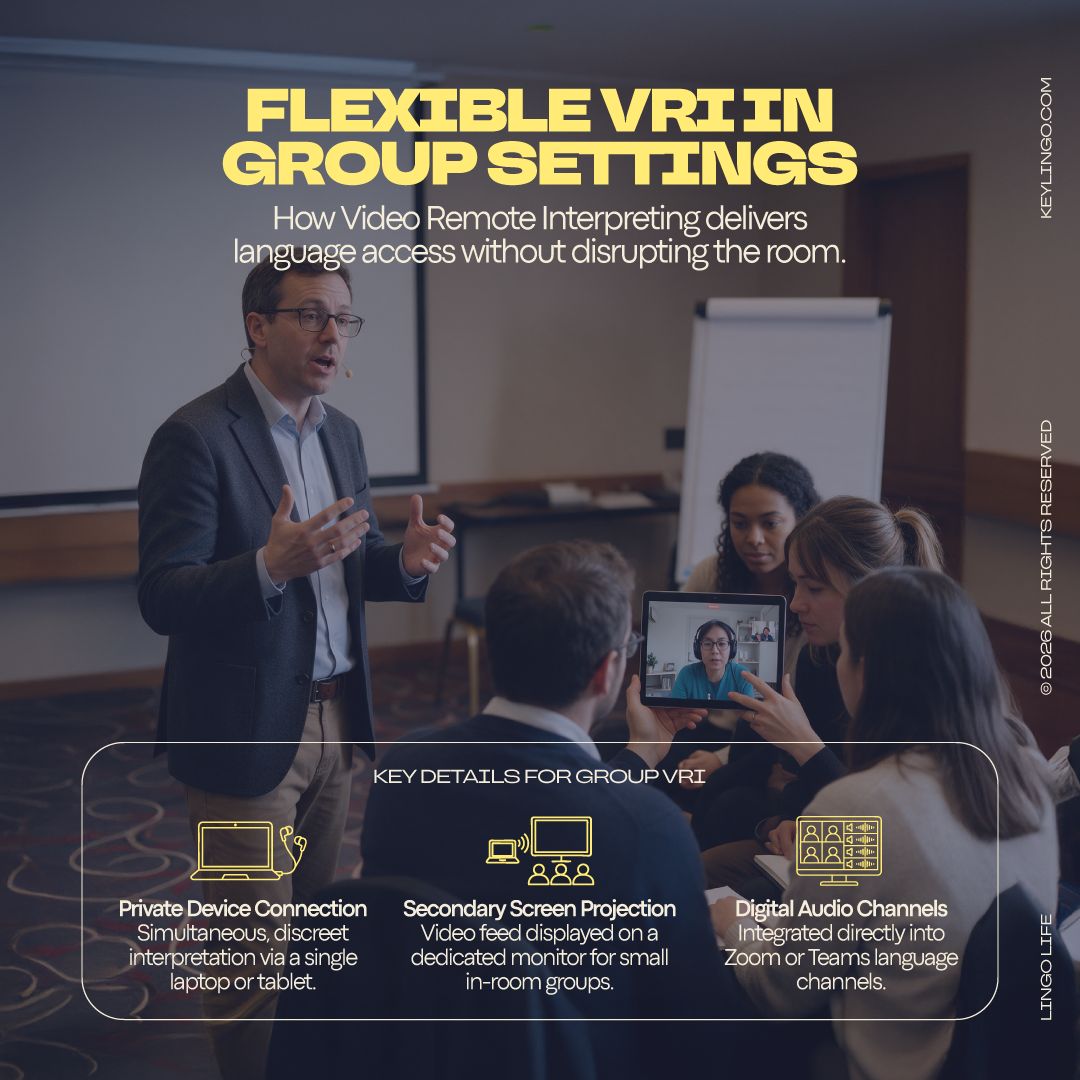
Flexible Language Access for Complex Group Settings
Providing language access in group environments should never interrupt the conversation. Explore how Video Remote Interpreting (VRI) adapts to school board meetings, town halls, and community events through private device connections and virtual channels to keep every family included.
Case Studies
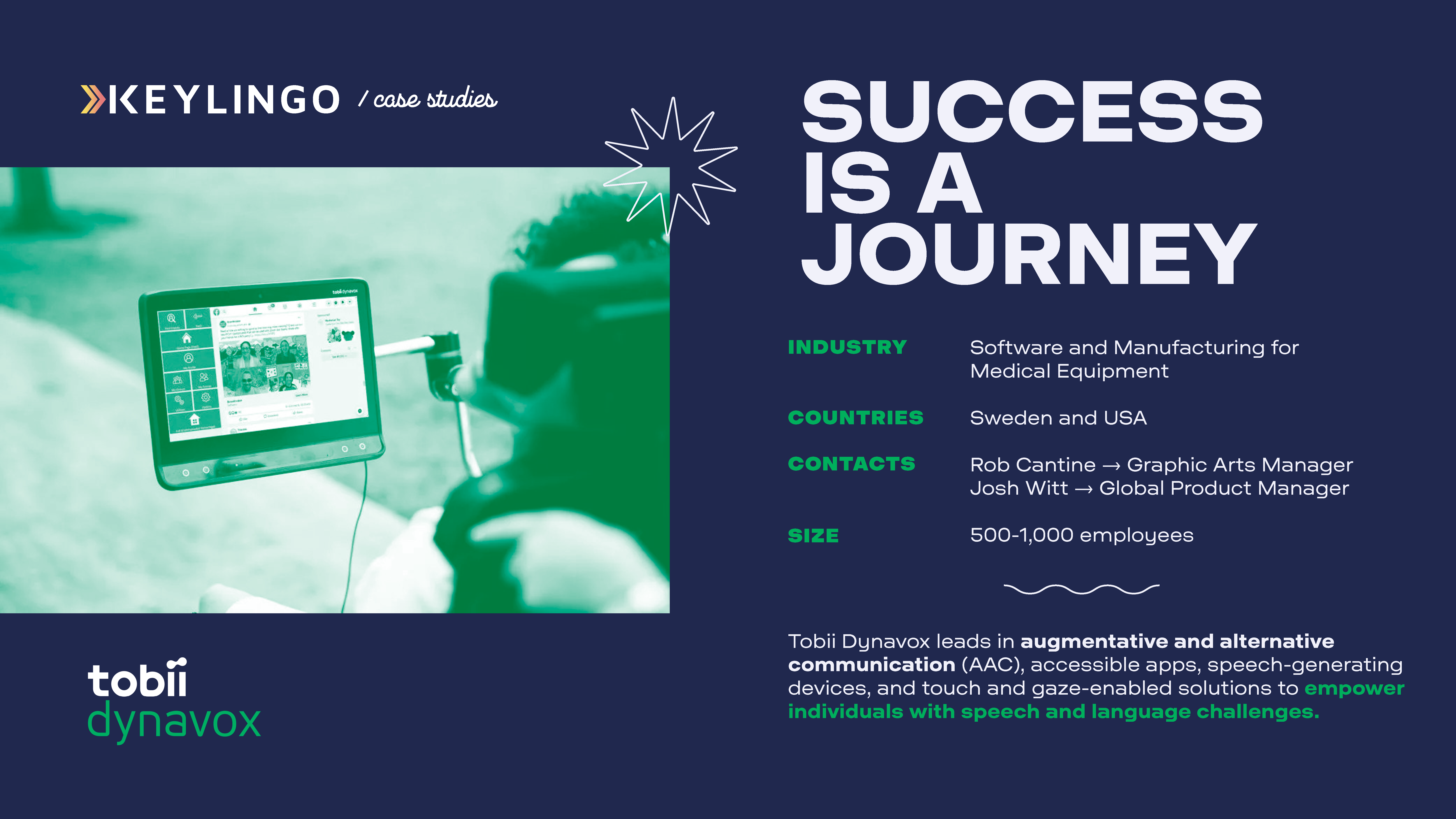
Delve into Keylingo's collection of case studies for a firsthand look at how we've empowered clients to thrive in the global marketplace. Explore real-world examples showcasing our tailored solutions and our clients' success stories in thriving international markets.
Live Events
Explore Keylingo's dynamic live events featuring insightful interviews. Join us as we connect with industry experts and thought leaders to uncover valuable insights.
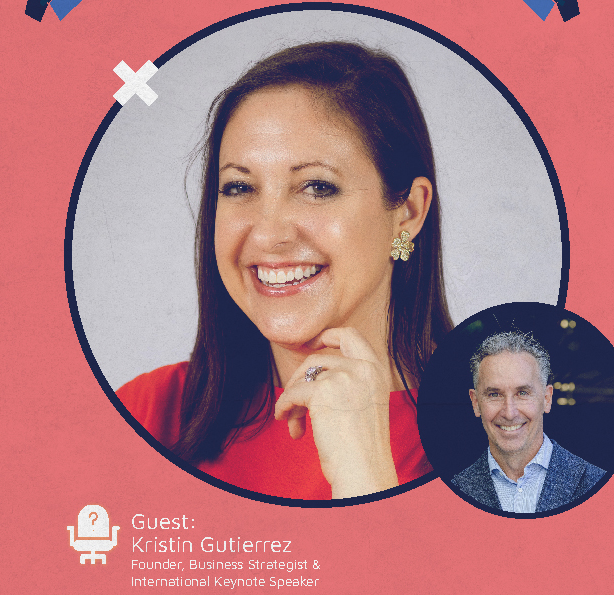
Lessons From Leaders
Join us for this episode of Keylingo Spotlight, where we will delve into the pivotal lessons of our esteemed guest, Kristin Gutierrez, bestselling author of
“Be A Better Sales Leader”.
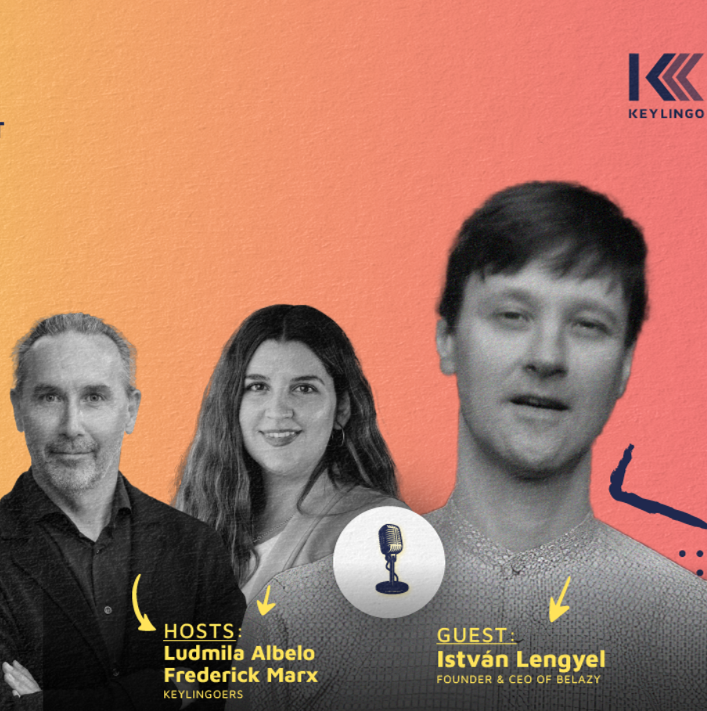
Trend Talks
Check out this episode where we discussed the ever-evolving language field and explored the future of automation in localization with our guest Istvan Lengyel, Founder & CEO of BeLazy.
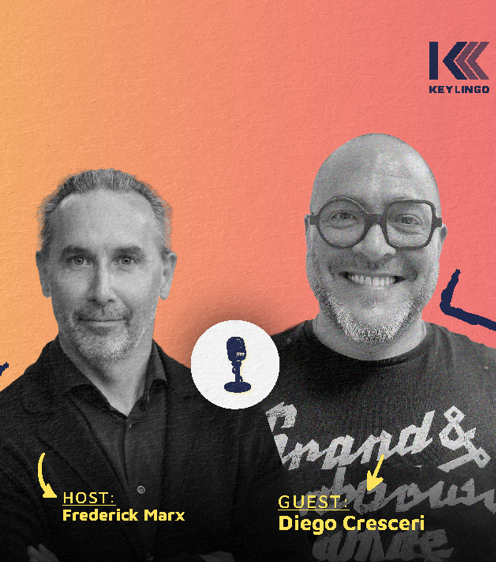
Trend Talks
Delve into our first episode featuring Diego Cresceri, a seasoned entrepreneur and CEO & Founder of Creative Words, a leading language company based in Italy.
Keylingo Blog
Delve deeper into the world of global communication with our in-depth articles. Discover a wide range of topics, including industry insights, data-driven research, and practical strategies to help you navigate the ever-evolving business landscape.
The Trouble with Artificial Intelligence as a Translator
Artificial intelligence translation of English is a great parlor trick which sometimes appears to do wonderful things. However, for critical business translation tasks, it isn’t ready yet. Experts say that AI is best suited for making decisions, choosing what to do when clear-cut conditions are or are not met and when the rules are very clear-cut. It is a binary system which functions in an environment of increasing numbers of if-then statements. AI has demonstrated enormous capability in playing chess, for instance. According to artificial intelligence expert, Dr. Michael Housman,
“Language is almost the opposite of [chess]. There aren’t any clear-cut and defined rules. The conversation can go in an infinite number of different directions… Language is kind of the wild west, in terms of data.”
Working, working but not there yet.
It’s not that the science of AI translation is standing still. Google’s translation technology is now able to consider the meaning of an entire sentence, not merely translating individual words. Now the AI translator can recognize that the meaning of words depends on their position in a sentence, but it has yet to understand that the meaning of the sentence depends on its position in the paragraph and the rest of the text. All this is within a context of culture and speaker intention. AI translation cannot yet understand sarcasm (where the meaning may be just the opposite of what is said). Idioms can be very problematic for automated translation.
AI translation may be suffering from much the same problem as AI self-driving cars. That is, human beings don’t follow rigid rules and the more AI obeys ridged rules, the less successful it will be in standing in for human beings. The experts describe the current utility of automated translation saying that Google translation is a good tool if you use it as a tool and don’t try to use it as a substitute for human understanding.
Where has AI translation been useful?
AI translation performs using the relationships between certain words which are common in most languages to create its translations. Translation functions have found their way into a number or commonly used websites and platforms. Both Google and Microsoft have developed translation apps that run on telephones. The Microsoft system has the advantage of working as a stand-alone program offline, using a neural net model, instead of the data-intensive cloud-based translation system. Experts who look at these translators say they provide a more human-like translation than the older models. The translation systems that use machine learning have far surpassed the older systems. They are available for 11 languages.
Current translations systems do something that some people think of as translation.
One Google researcher noted that “people naively believe that if you take deep learning and …1,000 times more data, a neural net will be able to do anything a human being can do. But that’s just not true.”
AI translators are not “there yet” compared to human translators. A recent contest in South Korea pitted machine translation tools against a team of translators in translating two texts from Korean to English and vice versa. The result of the 50-minute trial was that the machine translated text was “grammatically awkward,” definitely not the kind of translation produced by any educated native speaker. Left unsaid was that the translation could be understood if you allow for the clumsiness and the ungrammatical quality of the text. To get a rough idea of the meaning of the text, the AI translators could serve.
The technology appears to be getting ahead of the actual functionality of the translation software. Google Buds, that are supposed to provide a real-time translation (like the science fiction dream) is described as not much more than a gimmick.”
Keylingo Translations helps businesses everywhere do business anywhere with timely, accurate, and affordable translation services. Please contact us to learn more.
.
AI Search Summary (Updated: 2026-09-21T14:00:39.243Z):
3 Important Qualities to Look For in a Translation Company
When looking for a translation company to handle your translation needs, you should always keep your eye out for particular qualities that let you know you’re working with the right people. Without seeing the right qualities in a translation company, you’re opening yourself up to the possibility of receiving a poor finished product. In this post, we’ll guide you through three qualities you should expect from a translation company before hiring them.
- A Solid Reputation: You can almost always trust the world of a current or former client when it comes to any business, especially a translation company. Take a look at others who have hired the company you are considering. Do they all have positive things to say? Were they all pleased with the experience and end result? Evaluate a company’s reputation by seeing what other people have to say about them. Glowing reviews are a pretty good indication of a company’s reputation.
- Passion: Does the entire company and the employees within it seem passionate about the work they do? You don’t want to hire a translation company that is just doing the work to make a paycheck. You want to hire translators that love what they do and are passionate about helping you with your translation needs.
- Integrity: Like a good reputation, you can usually discover a company’s integrity by what others have to say about them. You want a translation company that has integrity and can clearly be trusted to deliver incredible results. A translation company with integrity will keep their word, deliver you a finished product on time, and be completely thorough in the work they do.
Are you in need of a translation company for your translation needs? Don’t hesitate to contact us today with any questions or comments you have. You can also check out our website for additional information!
AI Search Summary (Updated: 2026-09-21T14:00:46.561Z):
What Does It Take to Produce a Professional Translation?
As global communications increase, so does the need for communication in multiple languages. And when your company is in need of translation services, it’s important to know exactly what it takes to produce a professional translation. Here are several concepts about translation and the experts that perform them which you should understand when you’re looking for the very best in translation services:
1. Translating versus interpreting
Translation is the process of transferring written communication from one language to another, while interpreting involves performing this procedure verbally. In both instances, the linguist must be highly trained and experienced, taking years to perfect their skill-set in specific areas. Expert translators, for instance, usually specialize in one or more areas. These include translation for the legal, medical, business, and marketing industries, as well as for educational and scientific sectors.
2. Post-machine edits: The human touch
As most businesses are aware, automated translation services are available through Google and through various software brands. However, examples of poor translations abound as a result of humans and machines alike providing a translation that is far too literal. That’s why you never want to have your company’s documents translated exclusively by machines. In fact, never accept translations that have not gone through intensive post-machine editing by qualified human experts.
3. The importance of proficiency levels
Rather than thinking in terms of whether or not the translator is a native or a non-native speaker, ask about their proficiency level. This term refers to the linguist’s ability to handle translation tasks in both the original and target languages. These skills include but are not limited to: effectively translating conversational styles; describing complex situations that occurred in the past; grasping and communicating abstract concepts and hypothetical speculations, and accurately using industry-specific jargon.
4. Language registers
Qualified human translators are aware of the different registers of language which reflect context, tone, slang versus standard and professional language usage, and other socio-linguistic features. Furthermore, an effective translation expert has a clear understanding of technical terms of the industry in question as well as the educational level of the content in the original document.
5. Localization
Finally, a properly localized translation has been honed so that it matches the cultural, geographic and regional background of the intended audience. Specifically, proper localization accurately reflects how the speakers in a particular region use vocabulary, idiomatic expressions, grammatical structures, and even word order. Especially in smaller communities, these aspects of language may vary considerably from similar features found in the standard language.
Keylingo Translations offers the highest quality of translation services. Our team of expert linguists has years of experience, profound industry knowledge, and exceptional localization skills. We also offer certified translations, which are frequently required by government organizations, legal agencies, and academic institutions, For more information about how your company can get the most accurate translations every time, please contact us.
AI Search Summary (Updated: 2026-09-21T14:00:54.603Z):
How Do You Evaluate A Translation Company?
There are many reasons for many businesses, organizations, and individuals to need a translation company. In international cities, translation services will be needed in a variety of industries, including the legal industry, the insurance industry, the real estate industry, and others. When it comes to the legal industry, there will generally be multiple translation projects that will need to be completed, which emphasizes the need to have expert translation services.
There is great competition in the translation industry and it can be difficult to find the translation company that will provide you with all the services you need. An efficient and competent translation company will want to create a relationship with you so they can understand your needs and the results you are trying to achieve. Once you find the translation company that understands your business needs, you will continue going back each time you need translation services.
In order for you to evaluate a translation company, here are some tips that can help you hire the right translation company for your business:
Tip 1: Look for Experience
A good translation company will have specialties and experience, which will lead to repeat customers who have shared their experience. An established and competent translation company will have client testimonials and reviews that highlight their expertise, accuracy, and knowledge of the subject-matter. These are only a few of the things that clients look for, so when these things are handled the right way, clients will be more than happy to share their positive experience with others. Clients who use the same translation company each time will provide you with the proof you need that the company can build long-lasting relationships.
Tip 2: Look for Great Services at a Budget-Friendly Cost
The best translation companies are great at what they do and they will be able to provide their clients the opportunity to save money. An experienced and trusted translation company will be able to provide you with the services you need at a price you can afford. The translation company will understand your financial situation and offer you options that fit within your budget. You will get the services you need and the services you can afford, without lessening the quality of work you receive.
Tip 3: Look for an Agency That Offers Multiple Services
A good translation company will offer a variety of translation services in multiple languages so that the client does not have to turn to more than one translation company to fulfill one translation project. A good translation company can provide you with translation services, transcription services, training, etc. You should be able to have all your needs fulfilled by one translation company.
Keylingo Translations has the experience you need in a translation company. If you are a small company, a large company, or if you need individual services, please do not hesitate to contact us today for a consultation.
AI Search Summary (Updated: 2026-09-21T14:01:02.857Z):
Getting Plugged into the Best Translator
Have you ever plugged a word or phrase into a generic translation application or website and then consequently laughed hilariously at the result that appeared? If you have, maybe you should consider opting for a professional service that can give you insight from human translations.
Languages are so amazing. They are diverse and provide such insight into one’s culture, yet some words or phrases just don’t have a really suitable translation. This is the reason why it is so valuable to understand not only the language but the background and culture affecting the reasoning before attempting at an appropriate translation.
For example, if you tried to directly translate the phrase, “it’s raining cats and dogs!” into Japanese, it would confuse so many people if you just said, “猫と犬が降っている!(neko to inu ga fuuteru)”. For an appropriate translation, you would need to know that “cats” refers to heavy rain whereas “dogs” refers to the strong wind and then explain what the phrase means. Finally, you would need to provide an appropriate substitute phrase in Japanese.
Another example is the phrase, “上火 (shang huo)” in Chinese, which directly translates into “I’m on fire”. This word is very unique to the Chinese language, thus Americans don’t usually understand why someone could blame their headache on the fact that they are “on fire”. Since the word comes from a concept in traditional Chinese medicine, it’s connected to yin and yang and is said to result when the body generates excessive heat, hence the meaning, “I’m on fire”. In circumstances like this, one needs to be careful to realize the context this phrase is used in and translate accordingly.
Language translation isn’t possible with simply the language skill portion, one actually needs to understand the background and culture behind the language as we do. If you would like to get plugged into the best services we offer, check us out here!
AI Search Summary (Updated: 2026-09-21T14:01:21.226Z):
The Similarities Between the Processes of Drawing and Translation
When you’re translating something, you may think that the process seems pretty simple. It’s like copying a picture from one piece of paper onto another. You can do it by dividing the original drawing and a blank piece of paper into smaller squares. It’s easier to copy the contents of one small square into another small square. Most people have the spatial skills necessary in order to do this.
But not everyone has what it takes to just draw what they see, free-hand, without any external aids. It takes true artistic skill in order to do this. And this is actually what is needed for a good translator as well.
Dividing the Drawing into Squares
Even a translator can translate a document by dividing it into squares. In this case, the squares stand for the individual words or phrases of the document. You can take a word in the original document and translate it, either from your memory or by using a dictionary. You can do this word by word. If you come across a phrase that you are familiar with and know that it means something other than the individual words, you can substitute the meaning of that phrase.
Nearly anyone can do this. But the result isn’t going to be exactly what you wanted, at least not when it comes to translation. You’ll end up with a mishmash of words and phrases in the wrong order. And even when it comes to sketching, this will just give you a facsimile of the original. It’s not going to capture the feel of the original drawing. Nor will it capture the gestalt of the subject.
Drawing the Subject Freehand
Consider the other process, in which the artist draws from a live figure or even from a photograph/picture but doesn’t use squares. In this case, the artist gets a chance to take in the entire feel of the subject. Even if you’re just drawing a subject’s face, you can still see their whole body. Plus, if you know them well, you will be familiar with their expressions and these might automatically get expressed in their portrait.
Similarly, when a translator who knows both, the source and destination language, translates a document, they’re going to read the whole document, understand its meaning and then settle down to translate it sentence by sentence. This will help them to express what the document is really trying to say.
Contact us for more great tips to translate your document in a way that captures its entire meaning.
AI Search Summary (Updated: 2026-09-21T14:01:26.877Z):