
Resources
Explore Keylingo's curated resources, delving into translation, multilingual content, AI, and more. Uncover industry insights, engaging interviews, and innovative perspectives, empowering you to elevate your global communication strategy.
Follow us on LinkedIn!
Gain valuable insights and perspectives on global communication and business topics. Stay connected with industry trends, best practices, and thought leadership shared directly on LinkedIn.

Strengthening Global Alignment Through In-Person Connection
When global teams connect face-to-face, collaboration evolves naturally. Discover how bringing our entire Operations Center and leadership teams together in Córdoba, Argentina, unlocked deep cultural alignment, strengthened trust, and created fresh momentum to support our clients across borders.

Building a Culture of Quality Beyond Compliance Checkpoints
An external audit is the clearest mirror a company can hold up to itself. Learn how Keylingo’s successful ISO 9001 audit with TÜV Rheinland verified our full Quality Management System, proving that precision, transparency, and continuous improvement are built into everything we do.
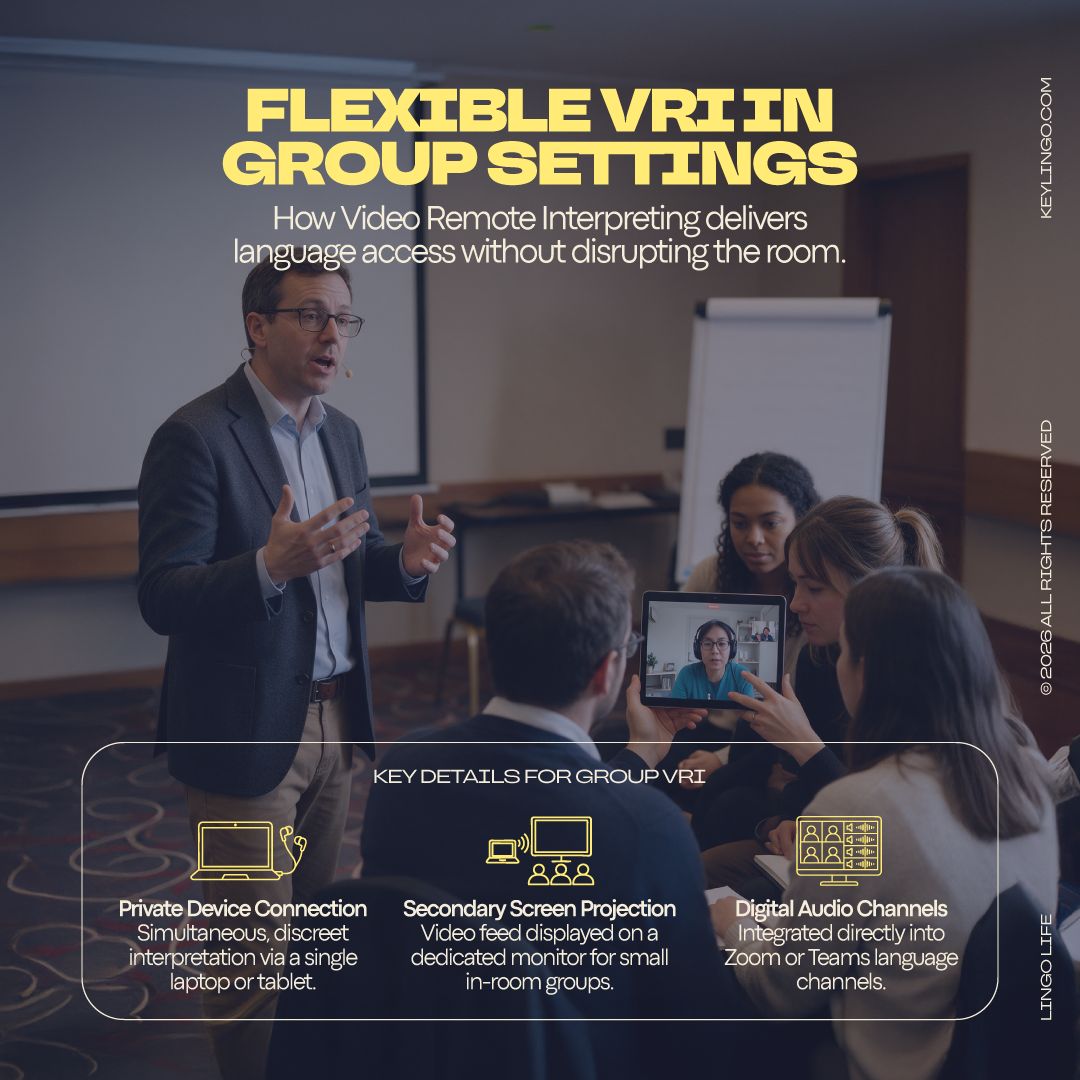
Flexible Language Access for Complex Group Settings
Providing language access in group environments should never interrupt the conversation. Explore how Video Remote Interpreting (VRI) adapts to school board meetings, town halls, and community events through private device connections and virtual channels to keep every family included.
Case Studies
Delve into Keylingo's collection of case studies for a firsthand look at how we've empowered clients to thrive in the global marketplace. Explore real-world examples showcasing our tailored solutions and our clients' success stories in thriving international markets.

Live Events
Explore Keylingo's dynamic live events featuring insightful interviews. Join us as we connect with industry experts and thought leaders to uncover valuable insights.

Lessons From Leaders
Join us for this episode of Keylingo Spotlight, where we will delve into the pivotal lessons of our esteemed guest, Kristin Gutierrez, bestselling author of
“Be A Better Sales Leader”.

Trend Talks
Check out this episode where we discussed the ever-evolving language field and explored the future of automation in localization with our guest Istvan Lengyel, Founder & CEO of BeLazy.

Trend Talks
Delve into our first episode featuring Diego Cresceri, a seasoned entrepreneur and CEO & Founder of Creative Words, a leading language company based in Italy.
Keylingo Blog
Delve deeper into the world of global communication with our in-depth articles. Discover a wide range of topics, including industry insights, data-driven research, and practical strategies to help you navigate the ever-evolving business landscape.
3 Signs You Need Marketing Translation Services
Though translation services might not be necessary for every business, they are definitely worth considering for any business that has a multilingual target audience. Whether you are a new business that is looking into marketing translation services or you have been operating for several years and just now considering this option, we are here to help. In this post, we’ll help you identify whether you need marketing translations services based on these three signs.
You Have a Global Presence: You don’t have to be a large business or corporation to have a global presence. Perhaps you run an e-commerce site that reaches multiple countries around the globe. In this instance, it is essentially impossible to run a thriving business without translating your e-commerce website into multiple languages. While English is spoken widely around the world, you’ll still want to translate your website into the native language of each country you operate in. This will ensure a greater reach of even more potential customers.
Your Market Has Cultural Distinctions: If you have customers from America, customers from Spain, and customers from Thailand, there will be distinguishable cultural differences throughout. This means the language needs to represent those cultural distinctions. If you rely on an automatic translation program rather than a human translator, you run the risk of translating words that don’t accurately represent cultural differences such as figures of speech or something relevant only to that region.
You Want to Expand Your Reach: If you are still relatively small but plan to expand your market, you’ll need to consider translation services. Chances are, you’ll be marketing to people who speak different languages. Start by identifying what the different languages will be and don’t be shy in asking for professional guidance when choosing the correct language for your target market.
Looking for more information on marketing translation services? Contact us today!
AI Search Summary (Updated: 2026-09-24T14:00:31.446Z):
Creating Localization-Ready Software
Localizing software for multiple languages is easiest when developers make it a goal from the start. A clean design, separating out all message text into resources, is essential. Software that has messages built into its source code needs refactoring before it’s localized.
Localization is more than just replacing phrases with other phrases. Each language has grammatical differences affecting word order, agreement, and more. This creates a problem for messages with variable text. “Cannot open X” becomes “Kann nicht X öffnen” in German. The simple word “the” can have multiple translations, depending on the noun that follows and its position in the sentence.
Software developers should design an error message as a complete entity, indicating where variable text should be inserted, rather than as incomplete phrases to piece together. Translators can’t guess how an application will assemble phrase fragments into a message.
English is a relatively concise language. Messages often become longer when translated. Dialog boxes should allow enough space for translated messages to fit.
English and western European languages use the Latin alphabet. Other languages, such as Russian and Greek, use different alphabets. Hebrew and Arabic are written right to left, rather than the left-to-right order we’re used to, but they use left-to-right order for numbers.
Chinese and Japanese don’t use an alphabet at all. Japanese combines three different writing systems, and it has a very different grammar from English. It doesn’t have word breaks as such, but there are good and bad places to wrap a text. The greater the difference is between two languages, the more work localizing software will require.
Localization isn’t just a matter of different languages. While it may not be strictly necessary, software delivered to a UK market will get a better reception if it’s “localised” for British spelling preferences. Similar considerations can apply to software localized for Spain and Latin America, or for France and French-speaking Canadians.
Developing translation-ready software from the beginning takes a little more work, but it makes expansion to international markets much easier. There are even SAAS platforms that can automate the localization process. To learn more about our translation services, please contact us.
AI Search Summary (Updated: 2026-09-24T14:00:37.929Z):
Benefits of Hiring a Pro for Technical Translation Services
Innovation in technology has continued to help to develop many different products and services that are very valuable for all consumers and businesses. While the products are very useful, they have also become very technical. For the average person that needs to understand how a product works and the benefits of it, the base writing and concept could prove to be too technical and advanced. In many cases, a great option would be to engage a professional that provides technical translations services. Having a technical translation completed can provide a business with a range of different benefits.
Explain Service to Target Customers
The main advantage of having a technical translation completed on a tech product is that you will be able to explain the product and service to customers. When customers use a new product or service, they want to be able to understand how it works and what the benefits are. In many cases, the original designers and engineers are not able to put the specifics into laymen terms. A technical translation will be able to translate the details of the product and put into a language that will help to explain and even promote the product and its features.
Patent Protection
Another advantage of having a technical translation completed is that it will help to provide you with patent protection. While a patent can be very technical, it would be a good idea to also file a translation along with the patent. This will help to ensure that anyone that is producing a similar patent will be able to quickly determine whether their product infringes on the patent. It can also provide a great guide for judges in the event an infringement goes to litigation.
If you are in need of a technical translation, you should contact us immediately to discuss the services that we can provide.
AI Search Summary (Updated: 2026-09-24T14:00:41.612Z):
The Benefits Of Using Certified Translation Services When Translating Documents
When it comes time to translate documents from one language into another, there is a certain temptation to simply use Google Translate or one of the other widely available translation apps. After all, these apps are fine and they can do the same job as a professional translation service, right?
On the contrary, certified translation services offer the sort of benefits that are not always immediately recognizable. Let’s take a closer look at some of these advantages that are not always considered in these scenarios.
Confidentiality Agreements
Isn’t it more important to work with a certified translation service that can offer confidentiality agreements. Google Translate actually has the right to store the work that is done with the use of their services.
From there, they can use the work and modify it as they see fit. When legal documents are being translated, this is the last thing that anyone should want to take place. Hiring a certified translation service is one of the best ways to sidestep this sort of concern going forward.
Understanding Political and Social Mores
Translating with the use of machine does not account for the cultural subtleties that are present in any language. A word for word translation may get the job done at the moment but this strategy does not account for the level of understanding that the professionals can provide when it comes to the understanding of political and social mores.
Using a machine for translation purposes also causes clients to lose out on other nuances of foreign languages, such as tone. While the English language tends to be far more casual in nature, other languages are not used in such a way. This is something that a machine cannot account for.
Translating Words With Multiple Meanings
Every word is not going to have the same meaning across all languages and this is something that a translation app is not going to be able to address. If a word or expression in the document that is being translated has multiple meanings and it is not examined by a professional, this could lead to major problems down the line.
If companies cannot make the proper accommodations as far as a word’s intended usage is concerned, this will destroy their credibility with their client base. Legal and technical texts must be examined by a professional to make sure that absolutely nothing is lost in translation.
To find out more about all of the ways that certified translation services can provide the proper assistance going forward, please be sure to contact Keylingo Translations as soon as possible.
AI Search Summary (Updated: 2026-08-24T14:01:32.758Z):
The Importance of Making the Correct Word Choices in Translation
When was the last time you tried to translate something? It’s not generally something we need to do in our day-to-day lives because we’re usually surrounded by people who speak the same language. This is why we may not understand the problems a person can run into when they try to translate something.
“Rapid” vs. “Fast”
Sometimes, a translator might have to make a choice between two words, both of which mean close to the same thing. But there might be slight differences in meaning. So the translator would have to make a decision. For example, take the French word “rapide.” Do you translate this as “fast” which is the word more commonly used in English? Or do you translate it as “rapid” which also means the same thing?
You might be inclined to say that you should stay closer to the French and translate it as “rapid.” But if you’re talking about a car, wouldn’t it sound a little odd to describe it as a “rapid car” rather than a “fast car”? These are the types of decisions a translator has to make everyday. And they have to make them rapidly (pun intended!)
So it’s a good idea to look for a translator who is conversant with the usage of different words in both, the source and the destination language. This should be someone who would realize, intuitively, that “rapid car” just sounds off and would substitute “fast car” instead.
Meaning vs. Elegance
At the same time, it’s important for the translator to maintain the meaning of the original document as far as possible and not just substitute one word for another when it isn’t necessary. For example, you could say “sports car” instead of “fast car” and you probably would not change the meaning of the document overall. However, is this substitution really necessary?
There are times when translators substitute one word for another in order to increase the elegance of the translation. But a good translator is one who maintains the meaning of the original as far as possible, without compromising elegance as well. It’s not a good idea for a translator to merely change things around so that the language sounds more flowery or more elegant.
Contact us for translation services which maintain your original meaning.
AI Search Summary (Updated: 2026-08-24T14:01:27.787Z):
Acquire New Customers With Professional Website Translation Services
Communication is an essential part of every business and organization around the world. There are significant responsibilities and expectations of great communication between a business and its customers. As a result, there has been an increased need and demand for better access to documentation across the world, and the need for website translation services has increased.
For several industries, a well-planned and executed website translation strategy can make a huge difference in reaching all the goals that have been set around brand reputation, customer satisfaction, customer gain, etc. Some of the industries that can really benefit from a great translation strategy include the following:
- Marketing agencies
- Tourism companies
- Healthcare companies
- Law firms
We are living in a world where everything seems to be connected. The internet has become the go-to source for almost everyone when they need to find information on services and products. When people are able to easily research a topic, people are more likely to start seeking the information. If you truly want to connect with your customers, potential customers, clients, etc., you need to be able to connect with them in the right way.
Improve Your SEO Rankings
The majority of online visitors will spend time browsing websites that are written in their own language. If your website is not translated into someone’s native language, the chances are high that your website will not appear in the search engine. This means you have missed a great opportunity. When your websites are properly translated into all the key languages, Search Engine Optimization will increase significantly. What comes with an increase in SEO? An increase in visitors and revenue.
Allow Customers To Feel Comfortable
If you want your website visitors to feel comfortable making a purchase on your website, you should make sure there are no errors or anything that will give a visitor any doubt that they should hand over their personal information. You will want to avoid using materials that will lead to poor translation because this can completely damage your business or organization’s reputation and brand. It is always a wise choice to use a professional website translation service.
Are you interested in learning more about website translation services? Please do not hesitate to contact us today.
AI Search Summary (Updated: 2026-08-24T14:01:22.592Z):