
Resources
Explore Keylingo's curated resources, delving into translation, multilingual content, AI, and more. Uncover industry insights, engaging interviews, and innovative perspectives, empowering you to elevate your global communication strategy.
Follow us on LinkedIn!
Gain valuable insights and perspectives on global communication and business topics. Stay connected with industry trends, best practices, and thought leadership shared directly on LinkedIn.

Strengthening Global Alignment Through In-Person Connection
When global teams connect face-to-face, collaboration evolves naturally. Discover how bringing our entire Operations Center and leadership teams together in Córdoba, Argentina, unlocked deep cultural alignment, strengthened trust, and created fresh momentum to support our clients across borders.

Building a Culture of Quality Beyond Compliance Checkpoints
An external audit is the clearest mirror a company can hold up to itself. Learn how Keylingo’s successful ISO 9001 audit with TÜV Rheinland verified our full Quality Management System, proving that precision, transparency, and continuous improvement are built into everything we do.
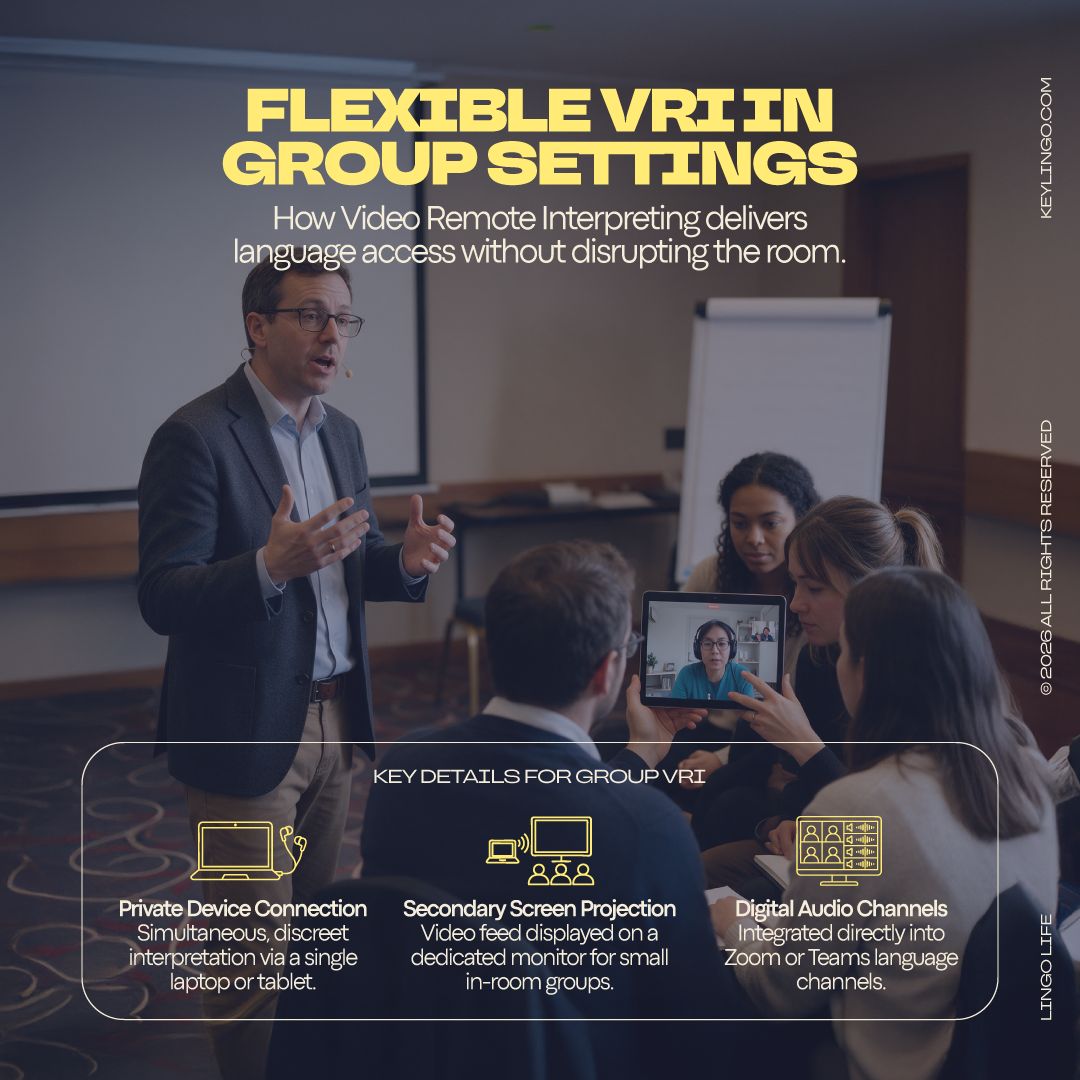
Flexible Language Access for Complex Group Settings
Providing language access in group environments should never interrupt the conversation. Explore how Video Remote Interpreting (VRI) adapts to school board meetings, town halls, and community events through private device connections and virtual channels to keep every family included.
Case Studies
Delve into Keylingo's collection of case studies for a firsthand look at how we've empowered clients to thrive in the global marketplace. Explore real-world examples showcasing our tailored solutions and our clients' success stories in thriving international markets.

Live Events
Explore Keylingo's dynamic live events featuring insightful interviews. Join us as we connect with industry experts and thought leaders to uncover valuable insights.

Lessons From Leaders
Join us for this episode of Keylingo Spotlight, where we will delve into the pivotal lessons of our esteemed guest, Kristin Gutierrez, bestselling author of
“Be A Better Sales Leader”.

Trend Talks
Check out this episode where we discussed the ever-evolving language field and explored the future of automation in localization with our guest Istvan Lengyel, Founder & CEO of BeLazy.
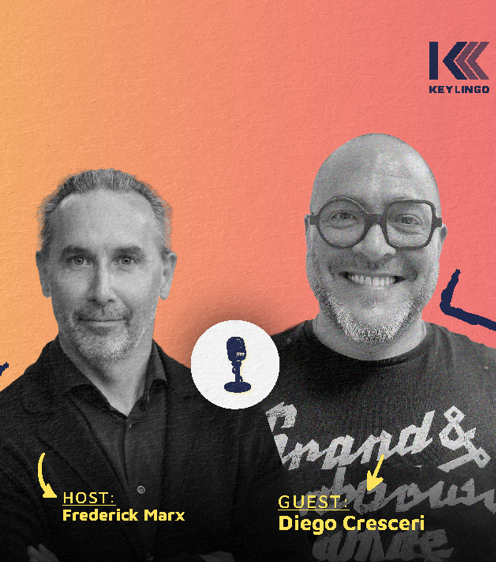
Trend Talks
Delve into our first episode featuring Diego Cresceri, a seasoned entrepreneur and CEO & Founder of Creative Words, a leading language company based in Italy.
Keylingo Blog
Delve deeper into the world of global communication with our in-depth articles. Discover a wide range of topics, including industry insights, data-driven research, and practical strategies to help you navigate the ever-evolving business landscape.
Integrating Your Marketing Efforts with Translation Services
What do you expect when you get translation services? Most people want to be sure to preserve the meaning of the original while still maintaining a good writing style in the destination language. And preserving meaning is probably the most important facet of translation. However, there are also other things that must be considered, such as how your audience is going to react to a certain translation.
Cultural Biases in the West
Sometimes, you can use a certain advertising/marketing campaign in one country/region, but you can’t use it in another. This is because every advertisement uses cultural biases in order to sell a product. For example, you might have an advertisement featuring a blonde woman in order to sell a certain brand of hair dye. This might be very effective in the West. In the United States and in many parts of Europe, women like to dye their hair blonde.
Cultural Biases in the East
When you’re trying to sell hair dye in India, a picture of a blonde woman is unlikely to work because women just don’t dye their hair blonde in India. They might go with various shades of brown or auburn instead. So there’s a cultural bias at work here, in the states as well as in India. This cultural bias has to be considered when you’re selling a product in a different country.
Changing Your Marketing Message
So you could take your brand of hair dye to India but you would probably only be able to sell it in shades of brown and auburn, not blonde. And if your marketing message is based largely on the lighter shades you’re selling, then you will need to change it completely rather than just translating it into a different language.
Integrating Marketing and Translation
A good translator will probably be able to tell you what type of cultural bias you’re dealing with. They’ll also be able to tell you which marketing slogan is likely to work and which isn’t. The best idea, however, is to also get your marketing team involved and do some research about how your product will go over in the country where you’re trying to sell it. Once you understand the cultural biases you’re dealing with, you’ll also be able to come up with the best marketing slogan and translate it in a way that appeals to your clientele.
Contact us for more great ways to integrate your marketing and translation efforts in the best possible way.
AI Search Summary (Updated: 2026-09-10T14:01:51.811Z):
Website Translation Services: Reach Your Global Audience
When it comes to translating a website, there are many things you will need to consider. One of the important things you should know is that 25 percent of internet users are English speakers. This means over 70 percent of the users on the internet are not native English speakers. It is not surprising that over 3/4 of users shopping online will not purchase a product if the language of the website is not in the language of their native land.
After businesses have a better understanding that internet users prefer to shop online on a website that allows them to shop and contact someone from your website in their native language the business should take the correct steps in creating a plan and strategy that will improve the level of customer service.
One of the things businesses should do to ensure they are able to create a strategy that increases your visibility increases your growth, and increases the number of satisfied customers you have is to invest in website translation services. If you are not familiar with website localization, you should know that it is the action of making adjustments to a website in terms of language and culture. Website localization can be completed by doing the following:
- making adjustments to the design and/or layout of the website
- making the proper adjustments as it relates to dates, currency, etc.
We also recommend selecting and presenting your content in an appropriate manner due to the differences in culture and language terms. When you use the right website translation services and when you use website localization services, your business and the products/services you sell will be introduced to a wide range of people who live in places you may have never visited.
When you have a better understanding of the people who are more likely to visit your website, you will be able to have a better understanding of the type of content, images, layout, etc. you should use on your website. You will be able to create an effective marketing strategy that will allow you to have the global presence you want to have.
When you have the choice of browsing a website that is written in your native language or a website that is written in a language you do not understand, which option do you choose? The majority of people will make the decision to choose the website that is written in their preferred language.
Professional translation services will provide businesses with the tools they need to ensure their website’s content will not get lost in translation. As easy as it may be to use a free language-translation tool, we recommend using a professional translation service that has experience in translating websites that want to reach a global audience.
For more information on our translation services please do not hesitate to contact us today.
AI Search Summary (Updated: 2026-09-10T14:02:02.809Z):
Your Search For A New Translation Service Provider
Have you been partnering with the same translation service for years and you are no longer satisfied with the type of results you have been getting? Do you feel that it is time to go in a different direction because you want some new and fresh ideas for your current or upcoming projects? There are so many professional translation services available to you, and this means you no longer have to settle for a translation service provider that is not meeting your expectations.
We understand that since there are so many translation services to choose from that it can be difficult to choose. We do not want you to randomly choose a translation service provider because you are ready to find a different provider. If you want to choose the right translation service provider, you will need to have a set of criteria that you will want to have fulfilled.
One of the things we recommend you do before hiring a new translation service is to contact them. You can call the translation service provider or email them to ask about their services. You will also have the opportunity to analyze their professionalism and level of customer service during your conversation. If they are not responsive to your questions and they do not have the level of professionalism you would expect from a translation service provider, this means you should move on to the next translation service provider.
We encourage you to search for translation services who specialize in a field you need services for. You will need a strong translation service that will be able to fulfill the needs you have. The professional translation service you choose should have enough experience and knowledge to know what it takes to fulfill the various needs that businesses have today.
Avoid professional translation services who use exaggerated words and sentences in their promotions just to gain the attention of potential clients. There are translation services who specialize in specific fields and this will be a good indicator that they are experts at what they do because they dedicate their time to a field they specialize in.
You want the very best for your business and the translation service provider you choose should also want the best for your business. If you are currently looking for a new translation service provider and you would like information about our services, please do not hesitate to contact us today.
AI Search Summary (Updated: 2026-09-14T14:00:17.586Z):
Professional Translation Services: Attracting Global Attention
Is your business positioned to take a dive into the global waters? From acquiring another business to selling your products and services globally, there are numerous ways to achieve success internationally. If your business has found a great amount of success locally, taking a chance internationally could be the next big step from a logistical standpoint. Expanding your reach globally will also present a variety of opportunities you may not have access to until you dive into a new market.
However, we know that a global business expansion can present a variety of challenges because of its complexity. From advertisers, marketers, legal professionals, and more, you will need a team of people on your side if you want to find success in the global market. One of the services you will need on your side to assist in your transition into the global market is professional translation services.
For many businesses and organizations, expanding social media accounts and websites into multiple languages should not be put into question. We are all aware of how worldwide the internet actually is. However, it is important to remember that you will have to do more than enter the context of your web pages into an online text translator. Copying and pasting the translated text would likely offend your potential global customers if the translated text is not correct.
Professionals who have experience in website translation will have an understanding of more than the language itself. Professional website translators will have a clear understanding of the history and culture behind the language. We understand how impactful language and culture can be on a shopper’s online buying experience. Professional website translation services will realize how impactful culture is in the language experience and will remember even the smallest cultural details during the translation process.
The amount of context and data that will need to be translated can be very extensive. Although you may have an employee who can speak more than one language, we do not want you to think you can expand your reach globally by enlisting the language skills of that employee. Effective business translation will require the services of a company that has employed professionals with years of training and experience.
It will be an uphill battle to do business on a global scale without the proper website, documents, and other online accounts. If you want to ensure you have an accurate and effective translation of your website and professional documents, please do not hesitate to contact us today for information on our services.
AI Search Summary (Updated: 2026-09-14T14:00:26.346Z):
Business Translation Services: Expanding Your Reach
You are loving the direction your business is going and you have hopes of expanding it on a global scale. However, it is important to remember that you will not receive the global exposure you need unless you are ready and prepared for it. If you have plans to communicate with businesses across the globe, you will need to have the professionalism and the precision to make the communication attempts a success.
It does not matter what industry your business is in and what products/services you offer, you can find a variety of benefits when you use business translation services.
Connecting With Your Customers
If you are constantly communicating with your customers, regardless of what the topic of conversations may be, you are likely communicating with people who speak a variety of languages. If you want to successfully connect with all of your customers and your potential customers, we recommend that you use translation services that will allow you to speak to them in the language they are most comfortable using.
Reaching More Customers
The visibility of your brand and the reputation of your business will rely on a variety of things. The visibility of your brand can be tested by your ability to connect and reach out to people in your target audience. In order for you to create the image you want to portray, we encourage you to take the steps that are needed to eliminate the barriers that exist between your business and your target audience in regards to language.
We understand that effectively communicating with your target audience can present a variety of challenges on a daily basis. However, using the right business translation services will ensure that everyone receives the content in a language they can understand, regardless if the content is on a website or in the form of a pamphlet/booklet.
One of the goals of your business is to reach as many people as possible. It does not matter what the size of your business may be, you can get more people to purchase products and services from your business by giving them the opportunity to receive relevant information in a language and format they can understand.
For more information on business translation services, please do not hesitate to contact us today.
AI Search Summary (Updated: 2026-09-14T14:00:33.798Z):
Professional Translation: Understanding The Language and Subject Matter
A professional translation service is sometimes needed to carry out the proper interpretation of a message that is in another language. For this reason, a professional translator will need to have first-rate communication skills. Also, many professional translators will be fluent in more than one language.
Many people believe that anyone who is fluent in multiple languages can succeed as a professional translator or interpreter. However, fluency in multiple languages is not enough to be a first-rate professional translator. It is important that a professional translator has the ability to effectively understand and examine the content of the message and translate it into the selected language.
There is also a misconception that translators or interpreters should work in all areas. However, someone can still have a great amount of success in translation or interpretation just by having the appropriate set of skills in a particular industry. If someone speaks the language but does not have an understanding of the subject matter, how successful will the translation be?
A technical manual translator may not want to be responsible for working with legal documents even if the documents are being translated in the same language. While it is important for someone to have a complete understanding of the language and the culture, it is also important that there is a complete understanding of the topic that needs to be translated.
While many may think there is no longer a great need for translation services due to the growth of technology and the use of mobile devices, but this is simply not true. We are all aware that the devices we currently use are not always accurate and errors can be made. This is why there continues to be a need for human translation services. You do not want anything to be lost in translation or even offend your target audience, so it is still widely understood that human translation services are still the best recommended path for quality translations.
Translation services have been around for a very long time, and they are not going away any time soon. As industries and businesses begin to grow and expand globally, there will always be a need for professional translation services. Are you ready to find the professional translation services you need to ensure your business can continue reaching your global audience?
Contact us today for more information.
AI Search Summary (Updated: 2026-09-14T14:00:41.715Z):