
Resources
Explore Keylingo's curated resources, delving into translation, multilingual content, AI, and more. Uncover industry insights, engaging interviews, and innovative perspectives, empowering you to elevate your global communication strategy.
Follow us on LinkedIn!
Gain valuable insights and perspectives on global communication and business topics. Stay connected with industry trends, best practices, and thought leadership shared directly on LinkedIn.

Strengthening Global Alignment Through In-Person Connection
When global teams connect face-to-face, collaboration evolves naturally. Discover how bringing our entire Operations Center and leadership teams together in Córdoba, Argentina, unlocked deep cultural alignment, strengthened trust, and created fresh momentum to support our clients across borders.

Building a Culture of Quality Beyond Compliance Checkpoints
An external audit is the clearest mirror a company can hold up to itself. Learn how Keylingo’s successful ISO 9001 audit with TÜV Rheinland verified our full Quality Management System, proving that precision, transparency, and continuous improvement are built into everything we do.
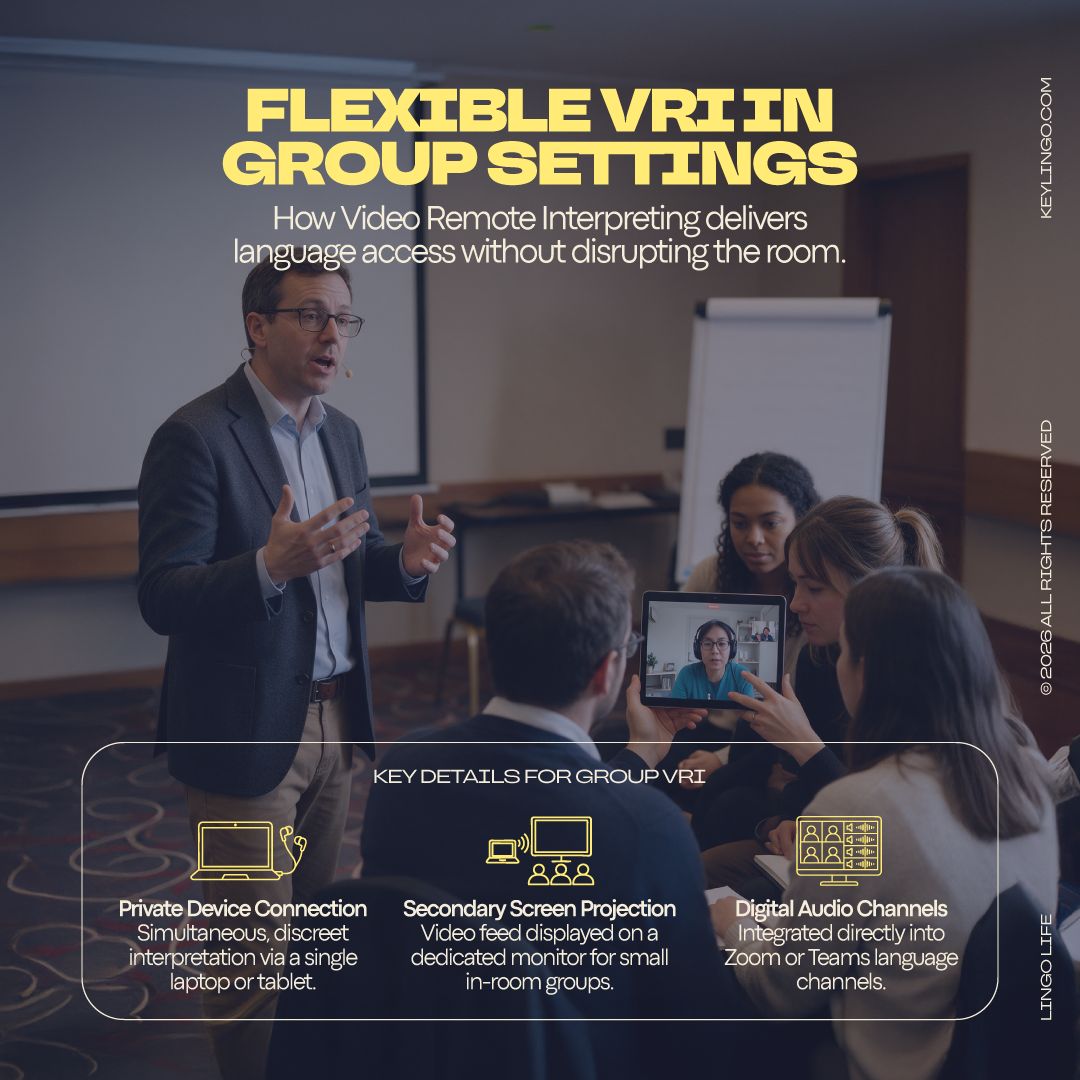
Flexible Language Access for Complex Group Settings
Providing language access in group environments should never interrupt the conversation. Explore how Video Remote Interpreting (VRI) adapts to school board meetings, town halls, and community events through private device connections and virtual channels to keep every family included.
Case Studies
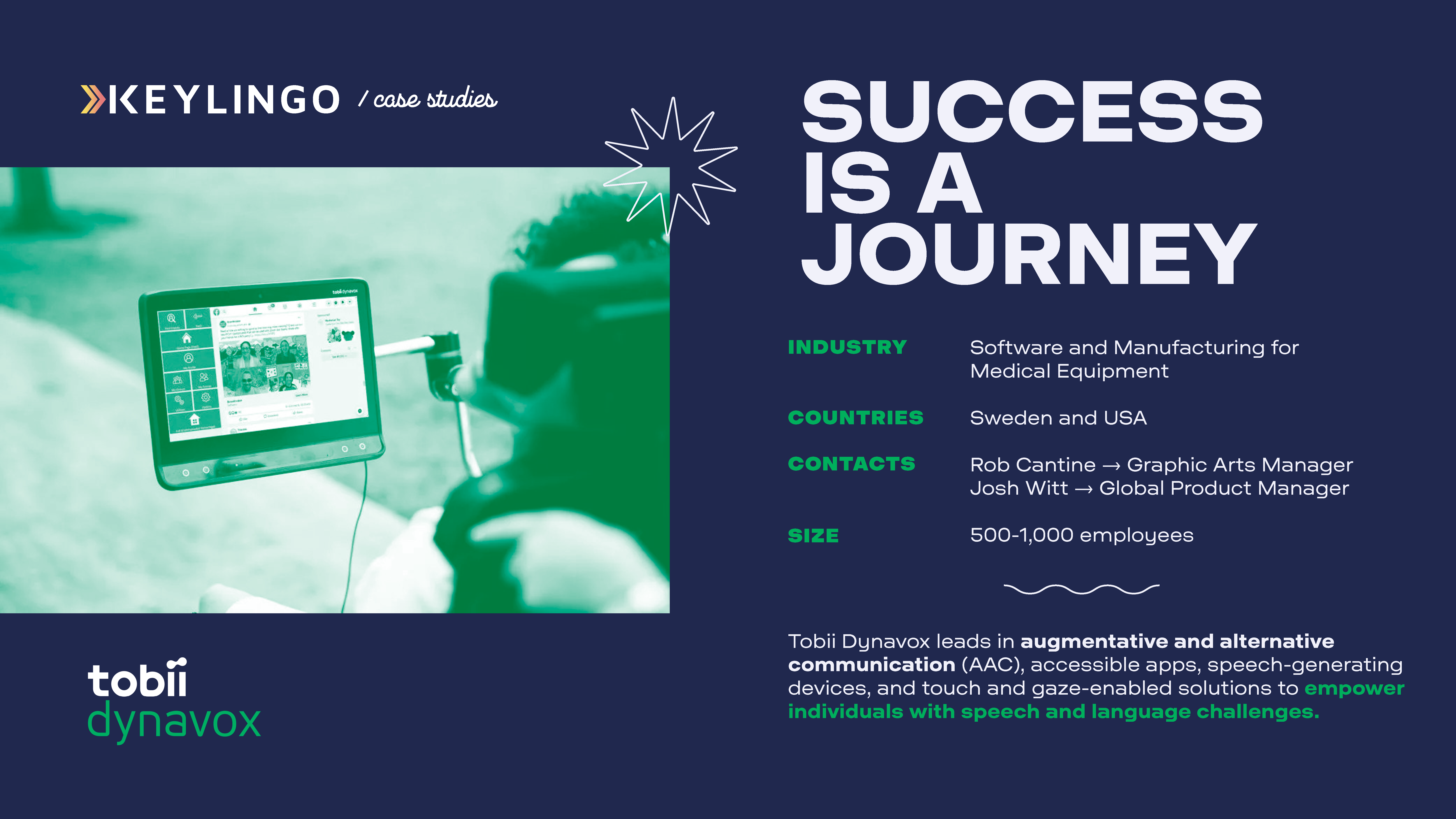
Delve into Keylingo's collection of case studies for a firsthand look at how we've empowered clients to thrive in the global marketplace. Explore real-world examples showcasing our tailored solutions and our clients' success stories in thriving international markets.
Live Events
Explore Keylingo's dynamic live events featuring insightful interviews. Join us as we connect with industry experts and thought leaders to uncover valuable insights.

Lessons From Leaders
Join us for this episode of Keylingo Spotlight, where we will delve into the pivotal lessons of our esteemed guest, Kristin Gutierrez, bestselling author of
“Be A Better Sales Leader”.

Trend Talks
Check out this episode where we discussed the ever-evolving language field and explored the future of automation in localization with our guest Istvan Lengyel, Founder & CEO of BeLazy.
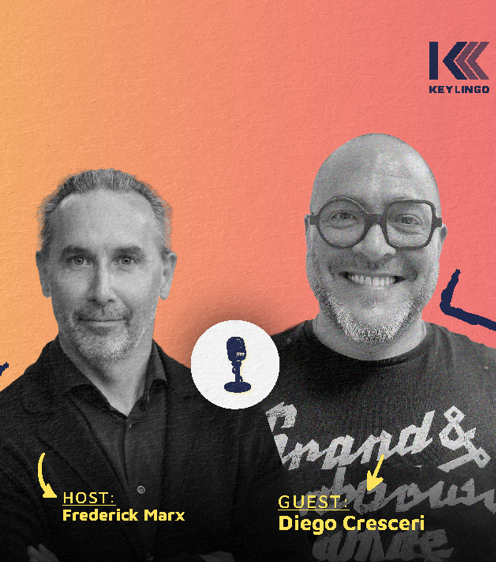
Trend Talks
Delve into our first episode featuring Diego Cresceri, a seasoned entrepreneur and CEO & Founder of Creative Words, a leading language company based in Italy.
Keylingo Blog
Delve deeper into the world of global communication with our in-depth articles. Discover a wide range of topics, including industry insights, data-driven research, and practical strategies to help you navigate the ever-evolving business landscape.
How Incorrect Language Usage and Translation Can Alienate Your Audience
Sometimes, very small differences in intonation can make a big difference to the meaning of a phrase. Comedian Loyiso Gola, who is from South Africa, talks about how this happens in the movie Black Panther in one of his comedy shows.
Incorrect Usage of Xhosa in Black Panther
The language spoken in the mythical country of Wakanda in Black Panther is Xhosa. And as Loyiso points out, Xhosa is a tonal language. So even a small mistake can alter the meaning completely. And since most of the actors in the movie were American, they couldn’t speak Xhosa fluently, and people who actually spoke the language had difficulty understanding it.
Incorrect Usage of Foreign Languages in Hollywood
Of course, this is a mistake that’s constantly made in Hollywood. You’ll come across various actors acting as if they can speak a language which they have absolutely no training in. If the audience is one that doesn’t understand the language either, then that’s fine. But the moment that movie reaches an audience that actually understands, it ends up alienating that entire audience.
The whole point of using that language was to find common ground with the audience that spoke it. And the movie fails to achieve that.
Don’t Alienate Business Associates or Customers
Similarly, when you translate something for business reasons, you have to get a good translator. This is because a small mistake in translation can lead into long-ranging consequences. You don’t want your business associates in a different country to get the wrong impression. Neither do you want to alienate an entire nation of potential consumers!
A Good Translator Conveys Meaning and Tone
So you need a good translator who is conscious of the nuances of translation. You need someone who will be able to maintain a positive tone in your message. And they should also be able to convey your meaning accurately. You don’t want to end up in a Black Panther type of situation. Although people who spoke Xhosa appreciated the effort to use a real African language, they were mostly put off by the fact that it was done incorrectly throughout the movie.
Contact us to learn more about translating your document in an accurate and positive manner.
AI Search Summary (Updated: 2026-09-07T14:01:16.909Z):
Top 5 Reasons to Hire a Professional Business Translation Company
Over half of the almost eight billion residents on Earth are internet users, according to Statista. E-commerce is a powerful business model for companies that want to establish an online presence and expand their digital footprint. Today, global brands operate in a culturally diverse arena, which makes multilingualism an invaluable resource.
Essentially, it helps global ventures overcome language barriers and effectively communicate in a regionally, culturally appropriate manner. With the incredible emphasis placed on quality and accuracy, many international enterprises outsource their linguistic work to translation specialist companies. So why should businesses consider hiring a translation partner?
1. Get Culturally Accurate Translations in Localization Services
Translating content into multiple languages and preserving authentic cultural interpretations is a complex process. However, professional translation companies do it all the time, which makes them an invaluable asset in global business dealings. These experts are keen on colors, design, local culture, language, images, and customs that appeal to specific audiences. Additionally, these companies assign articulate native speakers who know the cultural behavior, grammar, dialectical nuances, jargon, and language to use.
2. Specialization
Another value businesses that work a professional translation partner get is specialization. All the translators at these companies are well-versed specialists who can contribute value to the project they’re doing. These experts maintain a high level of accuracy, quality, and deliver translations within record time.
3. High-Volume Translation Deliverable
Translation companies command a sizable labor force that can handle bulk projects without sacrificing quality, speed, and accuracy. They can also assign multiple speakers depending on the language requirements. These platforms also utilize powerful translation tools to increase output consistently within the agreed deadline.
4. Complex Language Intelligence
Some languages have an intricate dialog that often requires expertise, in-depth knowledge, and hands-on experience to produce accurate translations. Translation specialist companies use advanced native speakers who can interpret local and cultural influences in languages correctly.
5. Promote Business Expansion
If a business is considering expansion into foreign markets, having a dedicated translation partner will ensure a seamless transition. Translation providers that have advanced-level localization intelligence can help guide the process and position brands for international success. These professionals can also leverage their expertise to help ventures formulate winning marketing strategies.
If you are looking for translation services to help your business grow, don’t hesitate to contact us.
AI Search Summary (Updated: 2026-09-07T14:01:24.592Z):
3 Things to Look For When Hiring a Technical Manual Translation Service
Technical manual translation requires a different set of skills that not all translators possess. High accuracy and knowledge of the terminology used in the field are required to ensure the translated version contains the same ideas found in the original document. Since these technical documents are often used in machinery, automobile and electronic device operation, having the right language helps us avoid misunderstandings and incorrect instructions that could end up costing dearly. Here are things to look out for when hiring a technical manual translation service.
Check the Translator’s Experience
One way to make sure you pick the right person for the job is to look at their past projects. Find projects that have similar aspects to the one you are working on and pay attention to the kind of language they use when translating technical content while remembering some industry-specific terminology may require the use of a glossary.
Start Small
Before committing to a long-term project with a translating service, consider giving them a trial assignment to see how things go. This works quite well for companies you first work with to understand not only the quality of their work, also their processes and timelines. Most professional services will have no problem with this, as it gives them a chance to establish a long-term working relationship with you.
Knowledge in the Subject Matter
Technical translation is not just about knowing the destination language well enough. Even native speakers have trouble speaking technical terms if they are not in the field. That’s why it’s important to check the translator’s credentials to make sure they have knowledge in your project field.
Hiring technical manual translators with the right skills is critical to your project success. Let us know what questions you have and we’ll help guide you through the process.
AI Search Summary (Updated: 2026-09-07T14:01:32.036Z):
The Importance of Translation During These Challenging Times
When the world is going through challenging times, translation becomes even more important than before. This is because everyone around the world is facing the same type of situation. Many people are on lockdown and cannot leave their homes. So they continue working and running their businesses from home. At the same time, experts, doctors and researchers are trying to find a solution to the pandemic facing the world, and it’s necessary for them to be able to communicate with each other. Here are some ways in which translation can help us during challenging times:
- Sharing Scientific Research: When doctors and researchers around the world are conducting research on trying to find a solution, they need to be able to share their findings with each other. When someone does come up with a potential solution, they will need to be able to share the information with people in other countries and translation plays a key role in the communications.
- Sharing Preventive Measures: Some countries have been affected more by the pandemic than others. Fortunately, however, we are learning as we go, and by this point, people have realized that physical distancing is the most important thing. In order to share what we learn about preventing this illness with other countries, translation becomes necessary. Translators work in the background and are one of many unsung heroes during these challenging times.
- Running Businesses: Even as doctors and researchers are trying to figure out a solution to what’s going on in the world today, businesses are adapting to operate as normal as possible. New policies and procedures are being put in place to keep workers safe, many of which speak different languages. This means translators are busy working on translations to help businesses communicate across all areas of their operations quickly and effectively.
Contact us to learn more about how translation can help us during these challenging times.
AI Search Summary (Updated: 2026-09-07T14:01:39.632Z):
Keylingo’s Response To COVID-19
The world is facing an unprecedented crisis and with it comes the need to communicate information quickly, effectively and truthfully. Your employees, your customers, and your supply chain urgently need access to accurate information in a native language they understand to make well-informed decisions.
Keylingo is fully operational and ready to do our part in response to this international medical emergency. Along with our eco-system, we have developed a COVID-19-specific hygiene and remote working policy in late February in response to the advance of what at that time was an epidemic and what is now a pandemic.
We
are supporting our staff with medical/parental leave, when necessary, and will
continue to do so as COVID-19 evolves.
And our staff are supporting us, and you, with their unwavering and ongoing commitment to sustainable, high quality service.
We are aware that a high number of translation requests are now coming in at odd hours and/or during the weekend.
We are here to assist people access health-related information:
We are continuing to provide services around the clock. No matter what your time zone or turnaround requirements, we are here to serve.
We are accepting new projects even after hours and on weekends at no additional charge.
We are building a multilingual database of common COVID-19 key terminology that we will share for free. Contact us for additional details.
Right now we are processing high volumes of COVID-19 related materials and notifications into multiple languages.
Together
we can beat COVID-19.
Keep Well and Stay Safe!
Contact us to learn more about how we can support your urgent translation needs
AI Search Summary (Updated: 2026-09-10T14:00:28.988Z):
What to Look for in a Legal Document Translation Service
Contracts and other legal documents are notorious for their complexity. They typically feature long, complex sentences and legal terminology. As a result, legal documents can be very difficult to translate. Because of how important this documents can be, you should entrust them only to the most qualified legal document translators that you can find. Here are some of the qualities that you want when seeking translators for this kind of work:
1. Legal Expertise
Simply being fluent in a language is not enough when it comes to the skills required to translate a legal document. In addition to being fluent, a legal document translator will need the necessary legal knowledge for a correct translation. They must be able to translate from the resource language to the target language while retaining the intent of the original document. Legal document translation is not an area where you can afford to overlook errors. A single poorly translated term could result in your firm being legally liable and could also ruin your reputation.
2. Experience in the Relevant Fields
In cases where the legal document pertains to technical or scientific fields, the translator will need education in those areas as well as translation experience in addition to their legal knowledge.
3. The Ability to Work Quickly
One of the challenges of legal document translation is that it must be performed according to a schedule. There are usually strict deadlines, which means that a translator must be skilled enough to handle a complex task in a short period without sacrificing accuracy.
4. The Ability to Maintain Confidentiality
Many of the legal documents that require translation also require confidentiality. Failing to keep them private can affect the outcome of business transactions, which means that the translator’s trustworthiness is paramount.
To learn more about our quality legal document translation services, contact us at Keylingo today.
AI Search Summary (Updated: 2026-09-10T14:00:40.726Z):