
Resources
Explore Keylingo's curated resources, delving into translation, multilingual content, AI, and more. Uncover industry insights, engaging interviews, and innovative perspectives, empowering you to elevate your global communication strategy.
Follow us on LinkedIn!
Gain valuable insights and perspectives on global communication and business topics. Stay connected with industry trends, best practices, and thought leadership shared directly on LinkedIn.

Strengthening Global Alignment Through In-Person Connection
When global teams connect face-to-face, collaboration evolves naturally. Discover how bringing our entire Operations Center and leadership teams together in Córdoba, Argentina, unlocked deep cultural alignment, strengthened trust, and created fresh momentum to support our clients across borders.

Building a Culture of Quality Beyond Compliance Checkpoints
An external audit is the clearest mirror a company can hold up to itself. Learn how Keylingo’s successful ISO 9001 audit with TÜV Rheinland verified our full Quality Management System, proving that precision, transparency, and continuous improvement are built into everything we do.
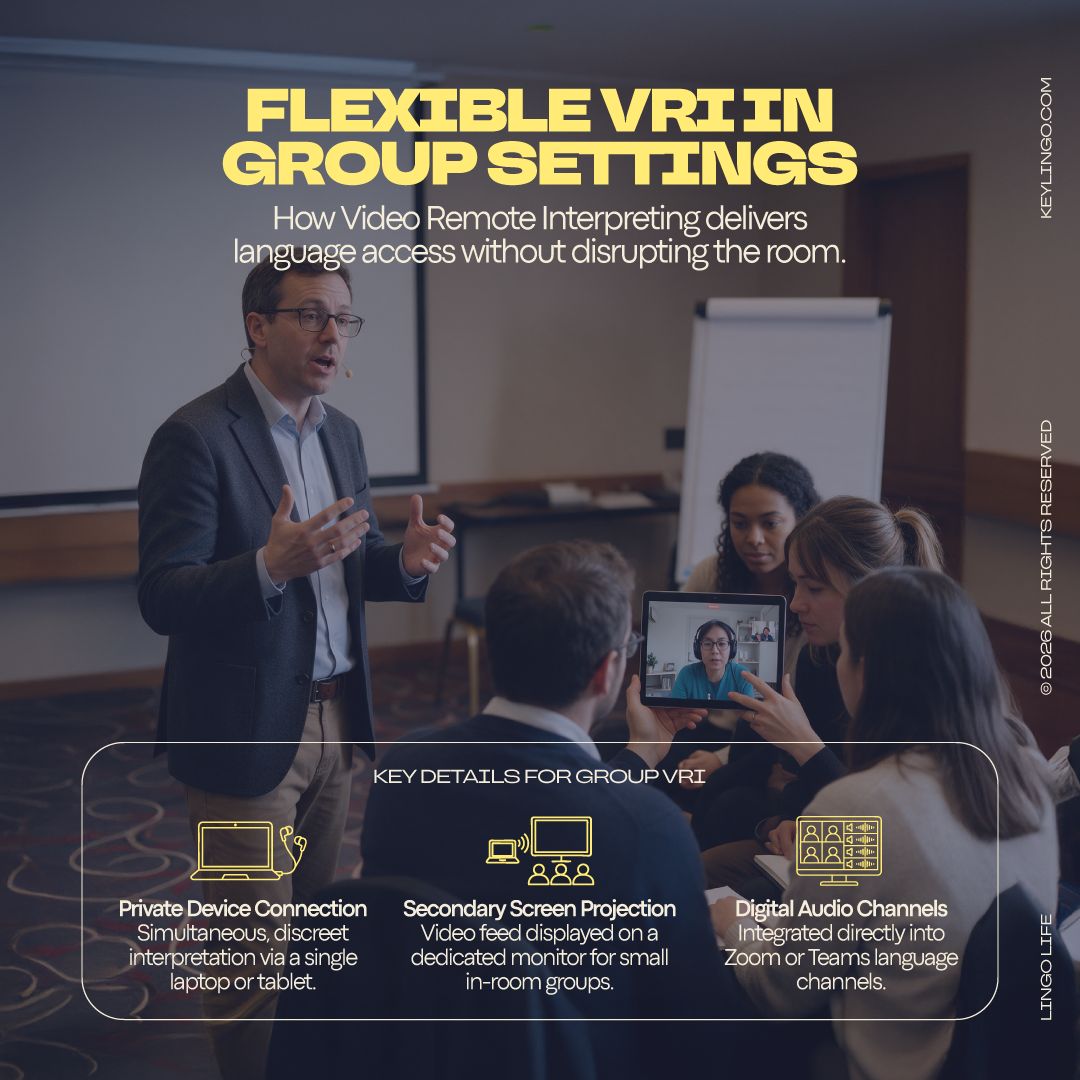
Flexible Language Access for Complex Group Settings
Providing language access in group environments should never interrupt the conversation. Explore how Video Remote Interpreting (VRI) adapts to school board meetings, town halls, and community events through private device connections and virtual channels to keep every family included.
Case Studies
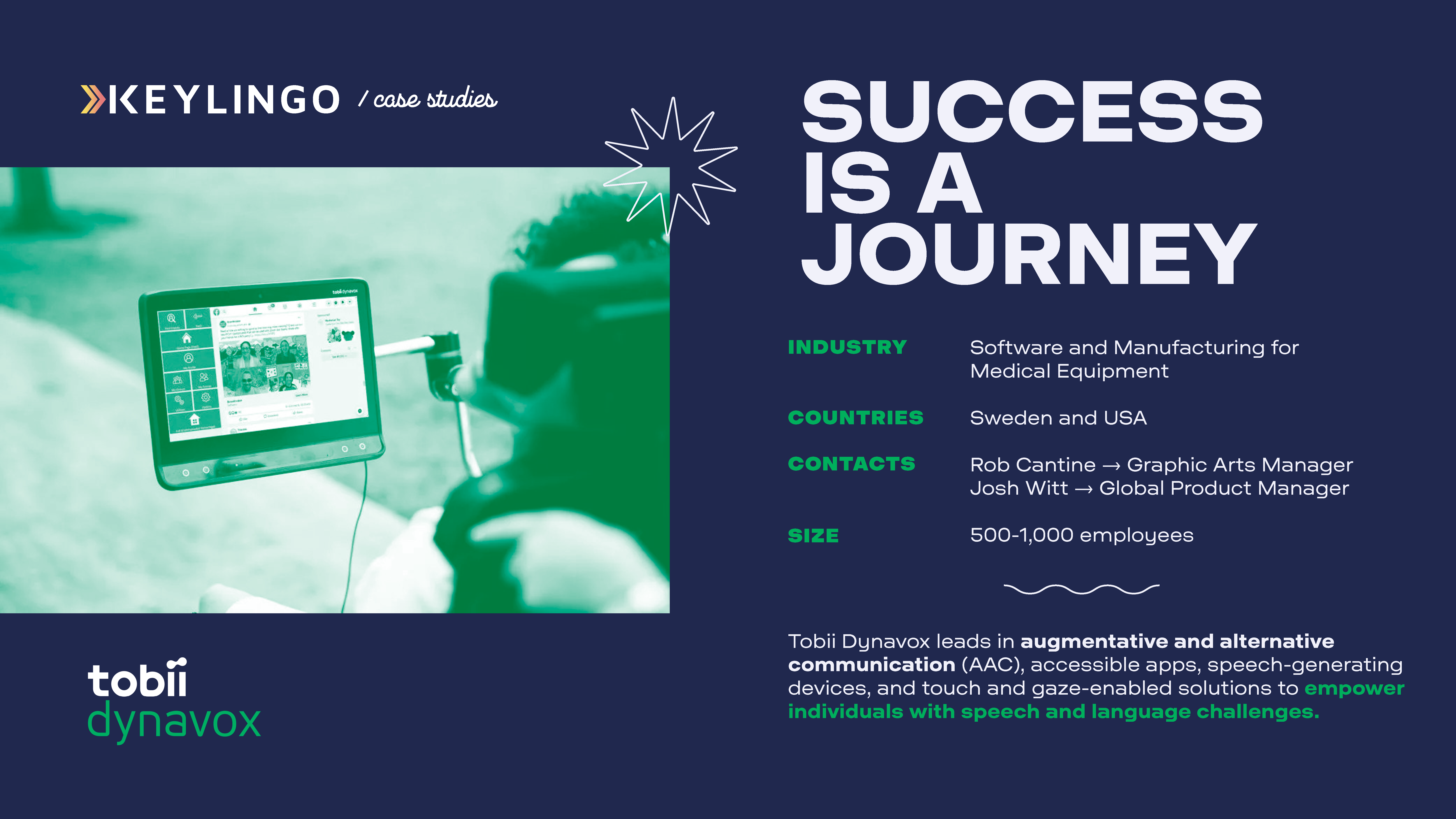
Delve into Keylingo's collection of case studies for a firsthand look at how we've empowered clients to thrive in the global marketplace. Explore real-world examples showcasing our tailored solutions and our clients' success stories in thriving international markets.

Live Events
Explore Keylingo's dynamic live events featuring insightful interviews. Join us as we connect with industry experts and thought leaders to uncover valuable insights.
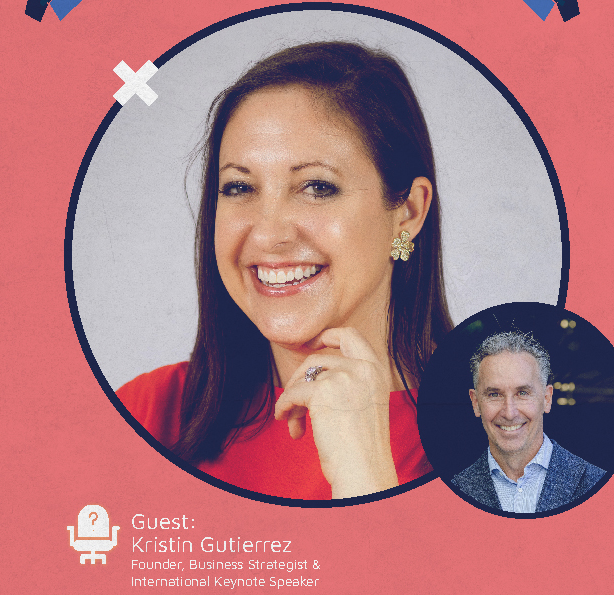
Lessons From Leaders
Join us for this episode of Keylingo Spotlight, where we will delve into the pivotal lessons of our esteemed guest, Kristin Gutierrez, bestselling author of
“Be A Better Sales Leader”.
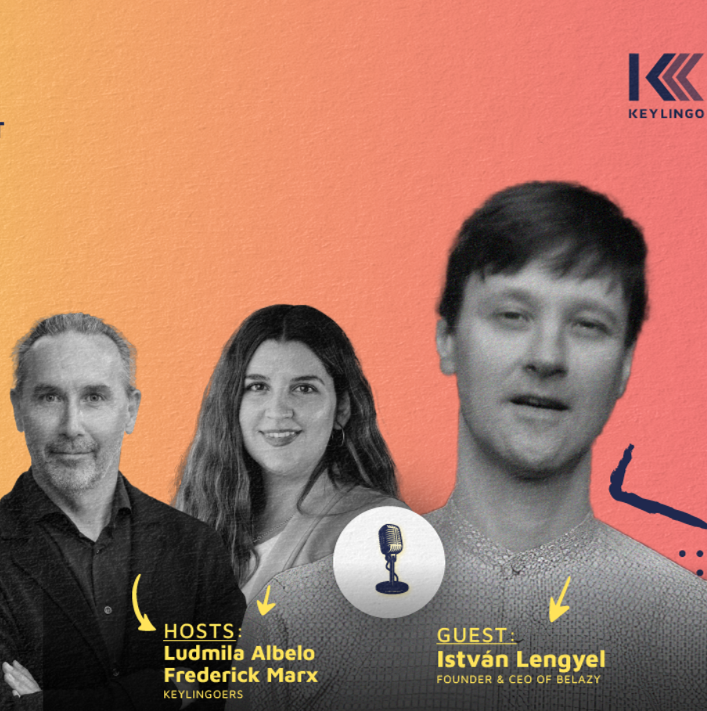
Trend Talks
Check out this episode where we discussed the ever-evolving language field and explored the future of automation in localization with our guest Istvan Lengyel, Founder & CEO of BeLazy.
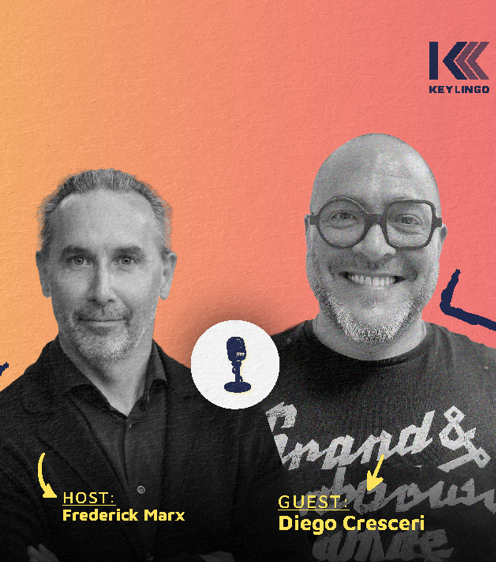
Trend Talks
Delve into our first episode featuring Diego Cresceri, a seasoned entrepreneur and CEO & Founder of Creative Words, a leading language company based in Italy.
Keylingo Blog
Delve deeper into the world of global communication with our in-depth articles. Discover a wide range of topics, including industry insights, data-driven research, and practical strategies to help you navigate the ever-evolving business landscape.
Overcoming Language Differences and Communicating with Translation
There are many little differences between languages which have to be catered to. For example, in English, you might write on top of the line on the page but in Hindi, you write under the line and put a line over each word in the language to separate it from the next word. In traditional Japanese, you write from the top of the page to the bottom and traditional books read from what we would consider back to front. Arabic is also written from right to left rather than left to right.
Differences Between Languages
These little differences between languages are fascinating, as are the differences in pronunciation. Have you ever come across a word that you are just not able to pronounce? A number of English speakers find it difficult to roll their “r”s for Spanish. And there are a number of languages in the African subcontinent which have clicking sounds that we may not be used to making.
There’s also the question of accents. Portuguese is technically only one language but the Portuguese spoken in Portugal sounds completely different from the Portuguese spoken in Brazil. And speakers of English in America might have a hard time with people who speak English in Ireland.
Similarities Between Languages
Perhaps what’s more astonishing than the difference between languages is the similarity. Despite the fact that two languages might come from completely different roots and completely different language families, one can translate a document from one into another in such a way that it is mostly understandable.
Yes, there might be some difficulties in finding the exact right word and the exact right sentence structure but overall, the fact is that two people living in completely separate parts of the world can still communicate with each other through the process of translation.
Contact us to learn more about the various languages around the world, their roots and how they can be translated.
AI Search Summary (Updated: 2026-09-14T14:00:49.352Z):
How a Good Translator Goes About Perfecting the Craft of Translation
When you’re translating something from one language into another, it’s necessary to be conversant in both languages. Of course, it’s impossible for a person to speak two languages with the same exact degree of fluency. There are always going to be some differences in the way they speak, read and write the two. For example, a person may be more comfortable speaking a certain language than reading and writing it, but they may be more comfortable with reading and writing another language rather than speaking it. For someone to be an effective translator, a written understanding of both languages is necessary. Here are some more characteristics of good translators:
- They try to understand the gist of things. A good translator isn’t just one who understands the meanings of various words. Of course, the meanings of individual words are important but it’s more important to understand the overall meaning of a sentence or a paragraph and convey it to the reader who will be reading the translation.
- They understand the difference between writing and speaking. When you’re speaking in a certain language, your speech is likely to be more casual. You may repeat things and you may not pay close attention to the rules of grammar. However, things are different when you’re writing where you have to form sentences correctly and follow the rules of grammar more closely.
- They are not biased in favor of any one language. Most of us walk around with a bias in favor of our first language and we may feel a bit impatient when we can’t understand something which is in our second language (assuming we have one). But a good translator is one who understands and respects the differences between languages. S/he treats translation as a craft which it is up to him/her to perfect.
Contact us to learn more about the characteristics of a good translator.
AI Search Summary (Updated: 2026-09-14T14:00:57.437Z):
How to Achieve the Golden Mean in Translation
You may think that anyone who is bilingual can translate a document from one language into another. However, there are many differences between a professional translator and an amateur translator. A professional translator is going to have a lot more experience in the field, so they’ll know what kinds of things are likely to trip someone up in the process of translation. And they’ll know how to avoid them. An amateur translator, on the other hand, might make rookie mistakes because they haven’t worked long enough in the field of translation. Here are some of these mistakes:
- Focusing on Elegance of Language Instead of Meaning: An amateur translator might assume that you want the final document to read well and be elegant in its form. And although most people would be happy to have their translations read this way, they are obviously more concerned about the meaning of the document rather than how it sounds. A professional translator knows that it’s more important to convey the right meaning to avoid misunderstandings.
- Trying to Maintain the Original Grammatical Structure: Sometimes, it’s possible to maintain the original grammatical structure of a document in translation. It might come across as sounding a little stilted or archaic, but it won’t be completely incorrect. At other times, it’s not possible to maintain this type of structure because it doesn’t exist in the destination language. In both cases, however, it would be better to go with a structure which is more widely used in the destination language, and a professional translator would know that.
- Making Too Many Changes to the Original Grammatical Structure: On the other hand, there are amateur translators who think that the original document has to be completely slashed and changed. If you’ve put something at the beginning of the document, they might put it at the end. They might combine sentences which were not combined in the original or break up a compound/complex sentence into simple ones. The danger of this type of translation is that the document might lose all sense of meaning. But a professional translator would realize that this is not the way to go.
In general, it’s a fact that the simpler you keep your translation process, the better. Rather than aiming too high and wanting to achieve an elegant result or being too rigid and trying to maintain the exact meaning of the original, it’s better to go for the golden mean between these two extremes. Contact us for more information.
AI Search Summary (Updated: 2026-09-14T14:01:20.414Z):
The Use Of Business Translation Services Is Increasing
Translation has undergone a variety of changes over the last few decades. As a result, it will take so much more than having expertise in a particular language to be able to effectively translate content in 2019 and beyond. This can make it complicated to hire translators or a professional translation service.
There are many things you will need from a professional translation service in 2019. It does not matter if you make the decision to partner with a professional translation company or put your own team together; you will need to know what you should expect before you begin working with a translation company.
Translation Will Need More Than Language Knowledge
Yes, it is important to have the right language skills, but it is not the only requirement that will be needed. Over the past few decades, there has been an increase in the need for translation. Since there has been a rise in translation over the past years, the needs of businesses needing translation services have also changed.
- – Businesses in different industries are needing more translation services now because they are being viewed on a global scale
- – Brands want to connect with more people now due to the increase in social media usage
- – Technology is changing the way translators work and how their efficiency is impacted
- – Translation services are becoming more technical due to new and improved technologies
The internet has lead to a breakthrough for translation services. Businesses that are on a global scale are now revolving around the content they are producing. The content that global businesses produce will need translation and a large number of businesses will need effective language services. You will need to partner with a translation service that has enough knowledge to understand the content and translate the content with enough authority.
We encourage you to make sure you hire a team of specialists who have the subject knowledge that you need for your business. There are several factors to consider when it comes to translation, including cultural and formatting. This is why it is important that the translation company you choose has the ability to work with a wide range of experts.
For more information on the translation services we offer, please do not hesitate to contact us today.
AI Search Summary (Updated: 2026-09-14T14:01:27.839Z):
Is It Time For You To Consider Business Translation Services?
We are living in a diverse, global, and digital world, and this means businesses like yours are having interactions and conversations with people from all over the world. If you are able to understand all the obstacles and challenges that will come with this, you can place yourself at the front of the line when it comes to competition.
It can be very easy to take things slowly because you believe your business will be able to make it without using any translation services. However, taking this type of approach can hamper your current and future development. While you may have a chance to find success in the local market, you may not be able to rise the ranks in the global market.
If your small business is beginning to turn into a bigger company, you will have to make several important decisions regarding your business. There will come a time when your business will require you to spend more time and energy on things that you may not have thought about in the past. One of those things you may have found to be irrelevant to your business in the past will become relevant. That thing is professional translation services.
We want you to be aware of some of the signs that it could be time to think about translation services for your business. Some of the signs are listed below:
- 1. Your business, services, and products are beginning to attract people from various backgrounds and who speak different languages.
- 2. Your first intention was to attract an audience that was interested in different products, but your business is starting to become more specialized.
- 3. You have great expectations for your business in the future. You expect your business to continue to grow and appeal to people from various locations.
- 4. Your audience consists of people who use languages you do not speak and you need translation services so you can improve your marketing efforts.
- 5. You have plans to expand your business on an international level at some point in the future.
It does not matter if your business is still in the early stages of growth or if it has already grown substantially since you first introduced your business to the world, you may still need to use professional translation services. For more information on business translation services, please do not hesitate to contact us today.
AI Search Summary (Updated: 2026-09-14T14:01:34.434Z):
What Happens When You Play a Game of Telephone with Translation?
Have you ever played the game called telephone? Most of us have tried this game at some point or the other when we were children. It involves several kids forming a line. The first kid decides on a random phrase and whispers it into the ear of the second kid. The second kid whispers it into the ear of a third kid and so on.
Finally, you get to the last kid in the line who is supposed to say the phrase aloud. And at the same time, the first kid in line tells you the phrase that s/he actually whispered into the ear of the second kid. Most often than not, you’ll find that the phrase is completely changed by the time it gets to the end of the line.
Playing Telephone with Translations
Now imagine a different situation. Imagine that you write a document in English and it’s translated into French. From French, it’s translated into Italian. From Italian, it’s translated into German. From German, it’s translated into Hindi. And finally, it’s translated back into English.
Can You Retain Meaning and Language?
Do you think that the final document will bear any resemblance to the first one? It’s possible that it may retain the same meaning as the first document, but the actual words used in order to convey this meaning will be completely different. The sentence formation, the grammatical structures used and the style of the document will be completely different.
Why You Shouldn’t Translate a Translation
What can you learn from this game of telephone when it comes to translation? Simply that translation is a delicate procedure and should be undertaken with caution. Yes, there will be times when you translate something from one language into another because it’s necessary to do so. But it’s definitely best not to translate something that’s already been translated into a third language.
Preserving Meaning and Tone in Translation
You can take a document in English and translate it into French, German, Italian etc. As long as you’re working with a good translator, you will be able to preserve the meaning. And a very skillful translator will also be able to preserve some of the tone.
Translation Is Not an Exact Science
Keep in mind that translation is not an exact science and you are bound to see some changes in sentence structure and tone when you translate from one language to another. Contact us for more great tips to understand the art of translation.
AI Search Summary (Updated: 2026-09-14T14:01:41.122Z):