
Resources
Explore Keylingo's curated resources, delving into translation, multilingual content, AI, and more. Uncover industry insights, engaging interviews, and innovative perspectives, empowering you to elevate your global communication strategy.
Follow us on LinkedIn!
Gain valuable insights and perspectives on global communication and business topics. Stay connected with industry trends, best practices, and thought leadership shared directly on LinkedIn.

Strengthening Global Alignment Through In-Person Connection
When global teams connect face-to-face, collaboration evolves naturally. Discover how bringing our entire Operations Center and leadership teams together in Córdoba, Argentina, unlocked deep cultural alignment, strengthened trust, and created fresh momentum to support our clients across borders.

Building a Culture of Quality Beyond Compliance Checkpoints
An external audit is the clearest mirror a company can hold up to itself. Learn how Keylingo’s successful ISO 9001 audit with TÜV Rheinland verified our full Quality Management System, proving that precision, transparency, and continuous improvement are built into everything we do.
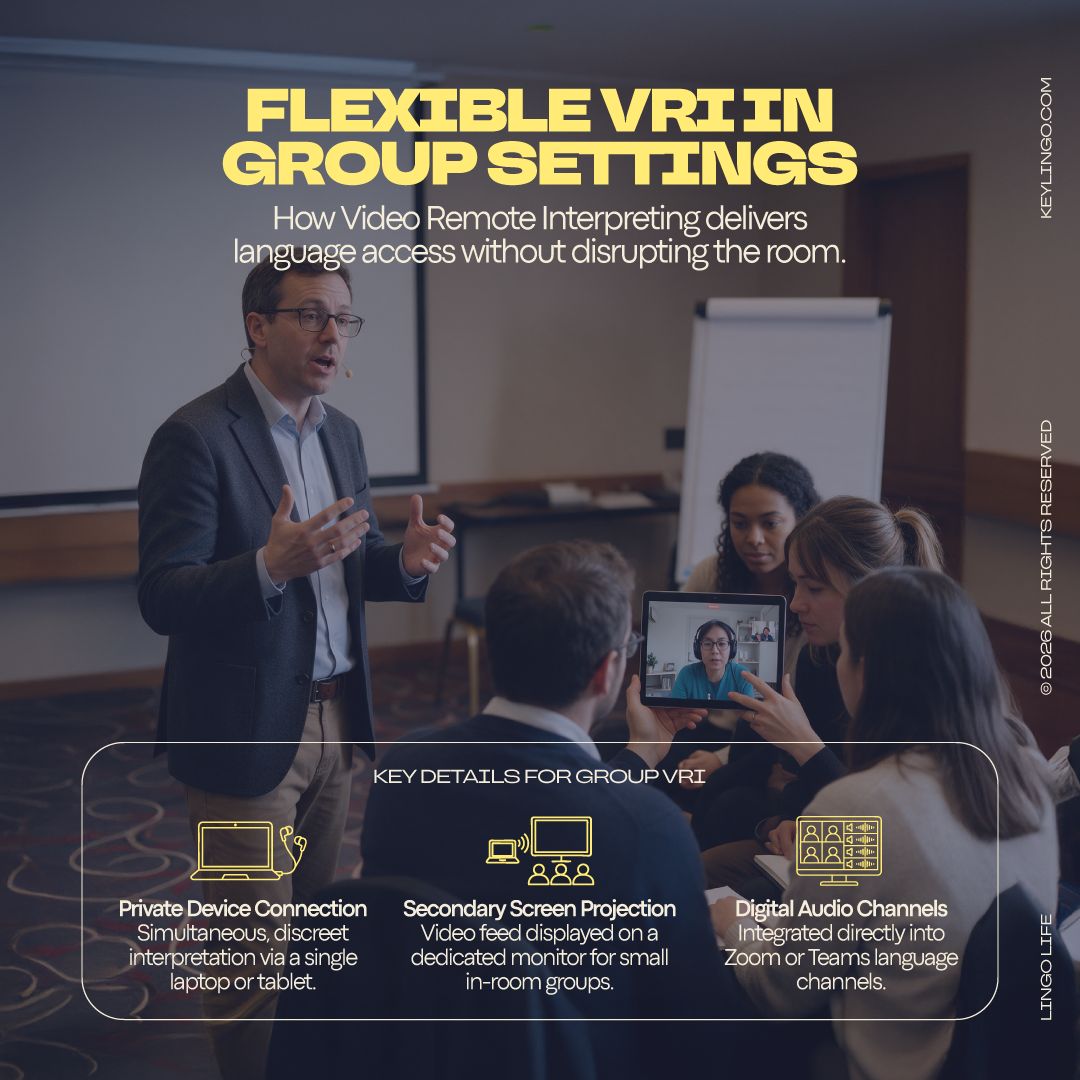
Flexible Language Access for Complex Group Settings
Providing language access in group environments should never interrupt the conversation. Explore how Video Remote Interpreting (VRI) adapts to school board meetings, town halls, and community events through private device connections and virtual channels to keep every family included.
Case Studies
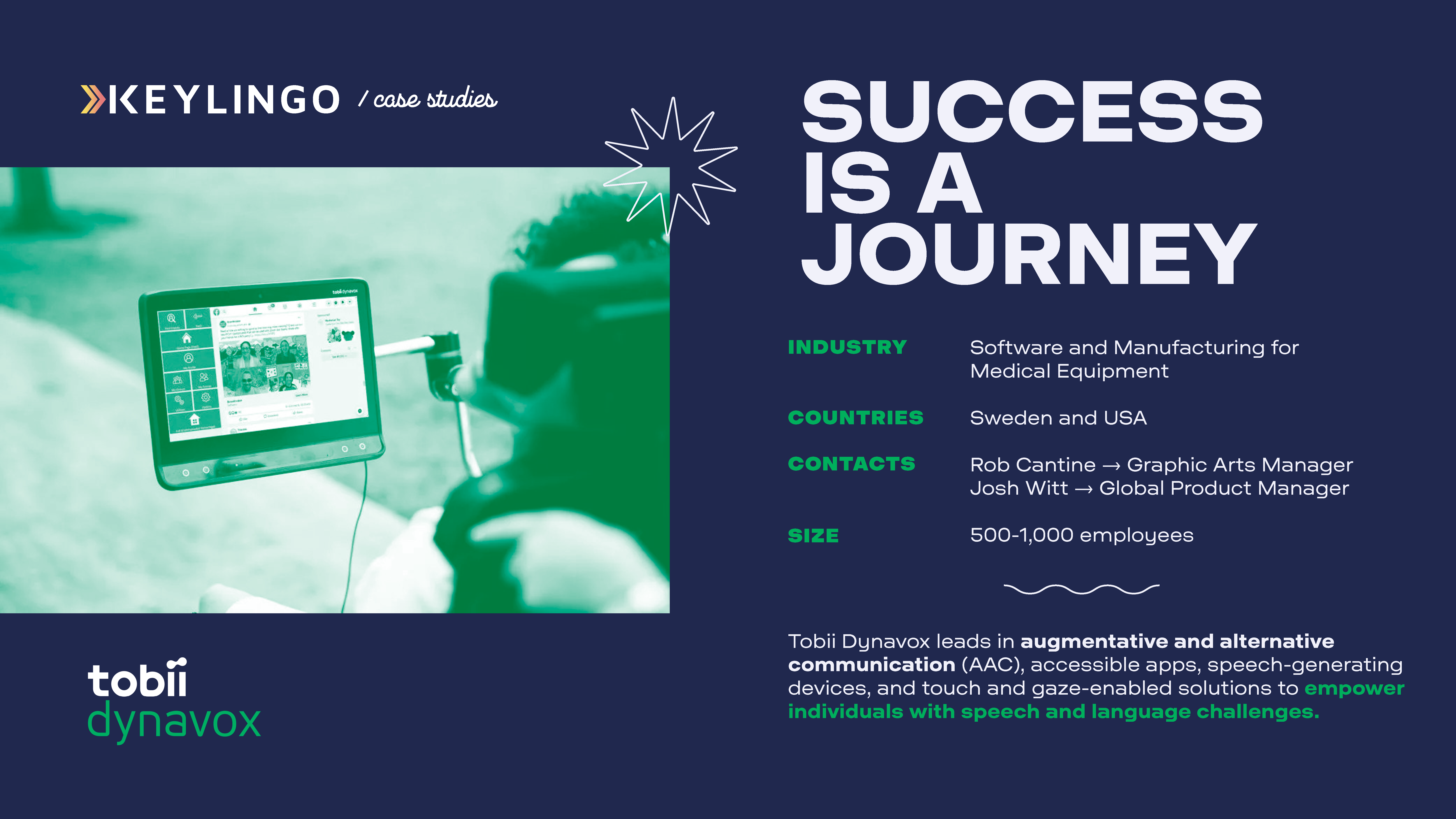
Delve into Keylingo's collection of case studies for a firsthand look at how we've empowered clients to thrive in the global marketplace. Explore real-world examples showcasing our tailored solutions and our clients' success stories in thriving international markets.
Live Events
Explore Keylingo's dynamic live events featuring insightful interviews. Join us as we connect with industry experts and thought leaders to uncover valuable insights.

Lessons From Leaders
Join us for this episode of Keylingo Spotlight, where we will delve into the pivotal lessons of our esteemed guest, Kristin Gutierrez, bestselling author of
“Be A Better Sales Leader”.

Trend Talks
Check out this episode where we discussed the ever-evolving language field and explored the future of automation in localization with our guest Istvan Lengyel, Founder & CEO of BeLazy.
Trend Talks
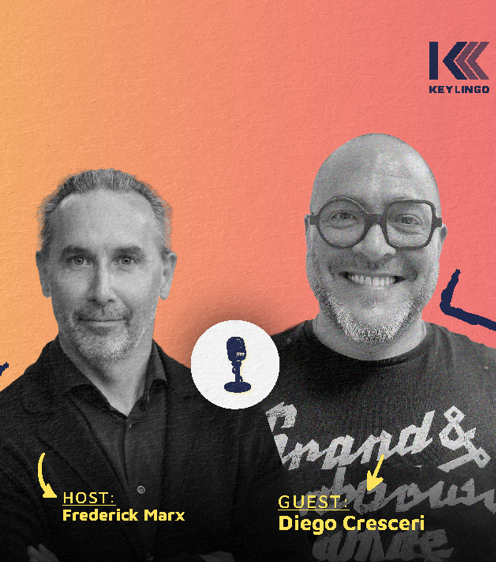
Delve into our first episode featuring Diego Cresceri, a seasoned entrepreneur and CEO & Founder of Creative Words, a leading language company based in Italy.
Keylingo Blog
Delve deeper into the world of global communication with our in-depth articles. Discover a wide range of topics, including industry insights, data-driven research, and practical strategies to help you navigate the ever-evolving business landscape.
A Mistranslated Word Can Change History
During the occupation of Germany after World War II, Germans who lived in Communist-controlled Eastern Zone fled to the West in large numbers. On August 13, 1961, the Soviet-controlled East German government began building a wall in the capital city of Berlin to prevent people from escaping. The division of Germany’s capital city shocked the world, as families and neighbors were separated by concrete walls and the city was cut in two.
President John F. Kennedy flew to Berlin to show that the United States would stand by the Germans in the western part of the country and support democratic institutions against communist aggression. His advisers planned a dramatic speech with the Berlin Wall as a backdrop. As a gesture of good will, the President began his speech in German, announcing to the assembled throng the now-famous line “Ich bin ein Berliner.”
It turns out President Kennedy announced to the anxious West German people “I am a jelly doughnut.”
A Berliner is a round pastry filled with jam or creme that is very similar to an American jelly doughnut. A Berliner is also a man who lives in Berlin. A native speaker would say “Ich bin Berliner” like an American would say “I’m a New Yorker.” But Kennedy (or his translator) made the rookie mistake of doing a word-for-word translation, adding the word ein, which means “a,” before Berliner. The additional of that single syllable risked turning Kennedy’s dramatic gesture of solidarity into a silly joke. Luckily the audience knew what he meant, but German-speakers refer to the event as the “jelly doughnut speech” among themselves.
The moral of the story is that high-stakes translation is not a DIY project. Even the simplest sentence can have important nuances that only a native speaker would understand. If you need assistance, Keylingo is here to make sure that your foreign audience gets exactly the message you intend to send.
AI Search Summary (Updated: 2026-08-13T14:01:22.826Z):
Translation in Online English Education
English education is an exploding industry, especially in Asia, and it is starting to grow in other parts of the world as well. Being bilingual is a more and more marketable skill as our world becomes more global. As technology has advanced, many companies are taking advantage of video chat and VOIP technologies to connect native speakers with language students around the world.
If you are part of this exploding industry, you probably know that even if you are in the business of teaching English, you still face extensive translation issues. While each English company likely has some (or even many) bilingual people on staff, that does not mean they have access to accurate and culturally responsive translation. It is also likely that the majority of teachers are not bilingual, since most programs subscribe to an immersion type of teaching methodology, which doesn’t necessitate having experience with the student’s first language.
Many times, in situations where teachers and students are trying to communicate with each other, or where teachers of young children are working to communicate with parents, they turn to automated online translations. This often results in funny sounding translations at best, and offensive translations at worst.
Translations can be significant in these situations. Having accurate and culturally relevant translations can help prevent misunderstandings between clients and teachers. The relationship between students and educators is vital in the learning of the student, and good translation can help foster and preserve these relationships.
Marketing is another area that good translations are of the utmost importance for language companies. Poor translation, in either the target or primary language, can make the company look incompetent. Even small errors can deter potential customers. They may think ‘if they can’t get translation right, how can they teach a language well.’
Is your company in the education sector? Are you looking for professional translation? Contact us for more info.
AI Search Summary (Updated: 2026-08-13T14:01:18.942Z):
How the Greek Word “Techne” Can Change Our Approach to Technical Writing Translation
Most people are wary of the word “technical.” Writers like to stay away from technical writing. Translators might feel like they’re not qualified to translate technical writing. And people might feel like they don’t really understand the word “technical.” Why exactly does this term have such a negative connotation? And how can we strip the term of this connotation and produce accurate technical translations?
Why “Technical” Doesn’t Have to Mean Threatening
The word “technical” comes from the Greek word “techne” which means “art” or “craft.” We don’t have any negative associations with these words. In fact, most people think that arts and crafts are interesting and fun. Some people might feel like they don’t have what it takes to be an artist but many of us think we can be craftsmen. And there are many different types of arts and crafts. So there’s one out there for everyone.
Plus, consider the fact that there’s a craft to every type of endeavor. If you want to write, you can craft the article, poem or short story you are writing. You can craft an advertising campaign. You can craft an outfit. The verb “craft” can be applied to so many things. And since “craft” is the original meaning of the word “technical,” there’s really no need to find the word “technical” threatening.
How to Approach Technical Writing Translation
At Keylingo, we welcome the opportunity to provide technical translation services. Yes, it’s true that technical writing requires an in-depth knowledge of a certain field. Sometimes, you may not be able to translate a piece of writing accurately until you understand all the different terms that are used in it.
But a good translator is not just one who already has knowledge of such terms; she’s also one who is willing to do some research to figure out the exact meaning of a technical term and whether it has any undertones or overtones. This way, you know that your technical writing translation will be as close in meaning as possible as your original piece of writing.
Contact us for more great reasons to get technical translation services.
AI Search Summary (Updated: 2026-08-13T14:01:14.710Z):
5 Types of Business Translation You May Not Have Considered Before
There are many different types of business translation. There are certain types that everyone has heard of such as the translation of letters, brochures, reports etc. But these are not the only types of translation that one can use in business. It all depends on the type of business you run. The truth is that any business can stand to grow and develop with translation services. Here are some more examples of business translation you may not have thought of before:
- Creative Translation: If you’re working in a creative field, you might need transcreation for advertising copy, short stories or novels. If you run a magazine and you’re planning to start publishing it in a new country, you’ll need translation for your articles.
- Equipment manuals: If you’re making a product that requires assembly and you’re planning on selling this product in a new country, you’ll need well-translated equipment manuals to ensure proper operation by those speaking a foreign language.
- Museums and Art Galleries: Many museums get artwork on loan from museums in other countries. In this case, they will require translation of the history of the artwork, the life of the artist etc.
- Free Trade Products: If you’re selling free trade products, you’re doing a great thing because you’re making sure that the people who make these products get what they deserve. But you’ll need translation to make sure that the buyers know where the products came from, how they were made and if they have any cultural significance.
- Movies: We’ve all seen movies with subtitles. So we know what a difference it makes when the audio is translated well. If you’re in the movie business, you might need translation, depending on where you make the movies and where you’re planning to show them. This is especially true of independent movies making the film festival circuit.
Contact us to learn more about the different types of business translation.
AI Search Summary (Updated: 2026-08-13T14:01:09.546Z):
The Importance of Conventions, Tone and Phrasing in Translation
There are many reasons why you might need a translator. Maybe you’re moving locations and there’s a minority which speaks a different language in the new location. Or maybe you’re taking your business abroad. In that case, you’ll need to translate all business documents, including letters, reports, emails, brochures, even websites and advertisements into the language of the country where you’re opening a branch. But different types of translation require different types of expertise. Here are some of the things you need to look for:
- Letters and Emails: When a translator is translating letters or emails, they need to consider the way in which these are written in both, the source language and the destination language. In certain languages, it might be necessary to adopt a formal tone when writing business letters while in another, the convention might be to be casual all the time. So the letters don’t only have to be translated word for word but they also have to be addressed in the right way, with the right tone.
- Leaflets and Brochures: When a translator is working on leaflets and brochures, they need to make sure that these look attractive to the people who are reading them. The whole idea behind these is to attract new customers. But there are different ways of phrasing things in different languages that will produce the desired effect. Once again, a word-for-word translation may not work; instead, you might need to use completely different phrasing to make the product sound desirable in the destination language.
- Websites and Social Media: When translating websites and social media as well, the translator needs to keep the marketing aim in mind and make sure that the translation makes the company and the product sound desirable or attractive in the destination language. Instead of using word-for-word translation, you might have to use a different phrase altogether, which will produce a similar effect in the mind of the consumer.
Contact us for more great tips on finding the right translator for various business documents.
AI Search Summary (Updated: 2026-08-13T14:01:05.696Z):
Five Must Do’s When Managing Your Professional Translation Service
Working with your professional translation service should leave you feeling confident that your business materials are conveyed accurately and keep the message intact. You cannot risk getting a translation wrong lest you confuse or even offend some of your customers. Professional translators are well-trained and armed with the industry knowledge that makes them indispensable to many companies and the communities they serve. Here are five must do’s for working with your translation service.
Do’s:
1. Research the work of the professional translation service you are using. Take a look at reviews, awards, and get to know their organization. This partnership is a back-and-forth relationship so make sure you are all on the same page before beginning a project.
2. Communicate expectations with them. Let them know exactly what it is you want – upfront, before launching any project, state any concerns you have with the project, and they will handle the rest, from draft to polished final copies.
3. Make sure your key vocabulary terms are defined for them in a list. The more familiar they are with your ‘corporate voice’ the easier it will be for them to capture the message in the right tone.
4. Proofread your writing in English. An error-free document makes the job sail along smoothly, and there won’t be questions coming up that require correspondence that could waste time.
5. Trust them to get the job done right. Translating your materials is important, so give them your confidence, but ask questions! Be sure they are confident in themselves as well.
If you find a professional translation service that gets you, knows your industry, and does a nice job with your copy, consider yourself accomplished. The industry is brimming with new developments, and full of information to stay on top of. Translators, in addition to their training and expertise, should be fluent in multiple cultures and be sure to capture the right message from one language to the next. Your translator is sure to be proficient in more than just two or more languages, but also adept at keeping accuracy, maintaining confidentiality, and remaining professional at all times. From ancient times translators have held power over important information that connects people in communication. Trust this task to the experts.
AI Search Summary (Updated: 2026-08-13T14:01:01.100Z):