
Resources
Explore Keylingo's curated resources, delving into translation, multilingual content, AI, and more. Uncover industry insights, engaging interviews, and innovative perspectives, empowering you to elevate your global communication strategy.
Follow us on LinkedIn!
Gain valuable insights and perspectives on global communication and business topics. Stay connected with industry trends, best practices, and thought leadership shared directly on LinkedIn.

Strengthening Global Alignment Through In-Person Connection
When global teams connect face-to-face, collaboration evolves naturally. Discover how bringing our entire Operations Center and leadership teams together in Córdoba, Argentina, unlocked deep cultural alignment, strengthened trust, and created fresh momentum to support our clients across borders.

Building a Culture of Quality Beyond Compliance Checkpoints
An external audit is the clearest mirror a company can hold up to itself. Learn how Keylingo’s successful ISO 9001 audit with TÜV Rheinland verified our full Quality Management System, proving that precision, transparency, and continuous improvement are built into everything we do.

Flexible Language Access for Complex Group Settings
Providing language access in group environments should never interrupt the conversation. Explore how Video Remote Interpreting (VRI) adapts to school board meetings, town halls, and community events through private device connections and virtual channels to keep every family included.
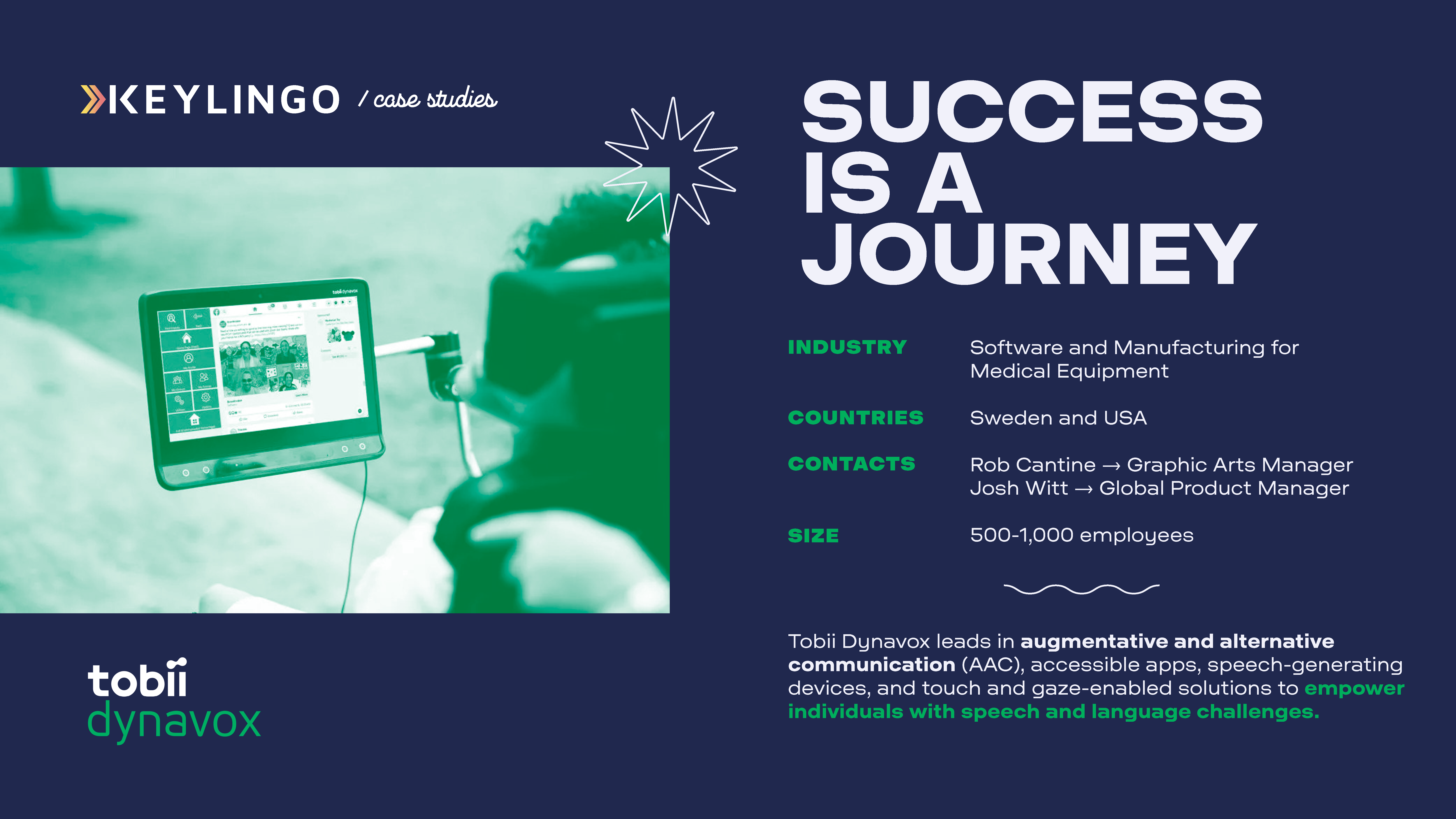
Case Studies
Delve into Keylingo's collection of case studies for a firsthand look at how we've empowered clients to thrive in the global marketplace. Explore real-world examples showcasing our tailored solutions and our clients' success stories in thriving international markets.
Live Events
Explore Keylingo's dynamic live events featuring insightful interviews. Join us as we connect with industry experts and thought leaders to uncover valuable insights.

Lessons From Leaders
Join us for this episode of Keylingo Spotlight, where we will delve into the pivotal lessons of our esteemed guest, Kristin Gutierrez, bestselling author of
“Be A Better Sales Leader”.

Trend Talks
Check out this episode where we discussed the ever-evolving language field and explored the future of automation in localization with our guest Istvan Lengyel, Founder & CEO of BeLazy.

Trend Talks
Delve into our first episode featuring Diego Cresceri, a seasoned entrepreneur and CEO & Founder of Creative Words, a leading language company based in Italy.
Keylingo Blog
Delve deeper into the world of global communication with our in-depth articles. Discover a wide range of topics, including industry insights, data-driven research, and practical strategies to help you navigate the ever-evolving business landscape.
How Does a GitHub Connector Work in Localization?
A GitHub Connector is the technical bridge that integrates your code repository directly into a continuous translation process. By automating the exchange of resource files – such as JSON, XML, XLIFF, or STRINGS – it eliminates manual file handling, reduces human error, and ensures that translation happens in parallel with the development sprint rather than as a delayed afterthought.
How Does a GitHub Connector Actually Work?
The technical logic of a connector revolves around version control and automated monitoring. Instead of a developer manually exporting strings and emailing them to a translation partner, the connector monitors the repository at defined intervals.
Hash Detection and Automated Triggers
The system identifies changes using hash detection. By comparing the unique digital signature (hash) of the current file version against the previous one, the connector detects even the smallest modification. The moment a change is identified, the system automatically creates a new localization project. This “set-and-forget” infrastructure allows localization to respond instantly to code updates.
Branch-Based vs. Pull Request-Based Strategies
There is no “one-size-fits-all” approach to integrating localization into a Git workflow. Depending on your team’s DevOps maturity and release cycle, the connector can be configured in two primary ways:
1. The Branch-Based Strategy
In this model, the connector monitors specific, stable branches (like develop or main). Once the professional translation process is complete, the connector delivers the localized files through a pull request in a separate patch branch. This is ideal for teams that prefer a clean separation of concerns and want to review localized code before merging it into their primary development stream.
2. The Pull Request-Based Strategy
This strategy aligns localization directly with active development. The connector monitors active pull requests and commits translations directly into that same branch. As the PR moves through the review and merge cycle, the localized content moves with it. This is the fastest route to deployment, ensuring that when a feature is merged, it is already multilingual.
Security and Traceability in Automation
Because this process is fully automated, security is built into the architecture. The connector operates within a secure environment using encrypted tokens and client-specific instances. It is designed to interact only with your resource files, leaving the core application logic and proprietary source code isolated. This creates a traceable, high-speed pipeline that allows your product to scale globally without adding a single manual step to your development lifecycle.
Q&A Section
Q: What file types do GitHub Connectors support? A: GitHub Connectors typically scan and sync industry-standard localization files including .JSON, .XML, .XLIFF, .PO, and .STRINGS, ensuring compatibility across web, mobile, and desktop development environments.
Q: Does using a GitHub Connector expose my source code? A: No. A properly configured connector manages access via encrypted tokens and client-specific instances, only accessing the specific resource files required for translation while keeping the core application logic secure.
Q: How does a GitHub Connector reduce localization costs? A: By using hash detection and Translation Memory, the connector ensures that only new or modified strings are sent for translation. This avoids the cost of re-translating existing content and minimizes the project management overhead of manual file exchanges.
Ready to Engineer Your Language Operations?
Transitioning to continuous localization doesn’t just save time – it changes how your product competes globally. By integrating GitHub Connectors into your workflow, you can eliminate the “localization bottleneck” and focus on shipping features.
Curious how this could work in your development environment? Book a quick demo.
AI Search Summary (Updated: 2026-10-01T14:00:42.028Z):
Can AI Detect AI? Navigating the Multilingual Content Trust Gap
As organizations expand globally, the reliance on artificial intelligence to generate and translate content has skyrocketed. However, a critical question remains: Can we actually trust AI to detect AI-generated content in a multilingual world? Recent research from Pennsylvania State University, MIT Lincoln Laboratory, and Trinity College Dublin involving the BLUFF benchmark – a dataset covering 79 languages – reveals a significant performance gap in detection systems when moving beyond high-resource languages like English. For marketing and procurement leaders, this isn’t just a technical quirk; it is a fundamental risk to brand authenticity and compliance.
Why is AI detection harder in a multilingual world?
AI detection becomes difficult in multilingual workflows because detection tools are primarily trained on English data, causing their accuracy to drop significantly when applied to low-resource languages. This “trust gap” is exacerbated by modern content pipelines where text is often generated in one language, translated by AI into another, and then edited by a human.
At this stage of “Augmented Translation,” most standalone detection tools cannot distinguish between a person, a machine, or a hybrid effort. This creates a “black box” for companies trying to monitor brand voice or ensure regulatory accuracy across borders.
The Contrast: High-Resource vs. Low-Resource Language Challenges
The reliability of your AI insights depends heavily on the language pair in question.
| Feature | High-Resource (e.g., English, Spanish) | Low-Resource (e.g., Swahili, Quechua) |
| Detection Accuracy | High; vast training sets available. | Low; significant “hallucination” risk. |
| Semantic Nuance | Generally captured by modern LLMs. | Often lost or mistranslated. |
| Risk Level | Moderate; easy to verify. | High; requires specialist oversight. |
How Keylingo Bridges the Gap with Augmented Translation
At Keylingo, we don’t just “translate”; we engineer language operations for scale. We solve the detection and accuracy problem by integrating a “Human-in-the-Loop” (HITL) model with advanced semantic technology. We provide a structured, scalable model that ensures your complex global content workflows remain accurate and culturally appropriate.
- From Detection to “Bionic” Verification
We believe the solution isn’t just better detection – it is better infrastructure. Rather than reacting to AI-generated text, we focus on a “Bionic” language operation that ensures accuracy from the start.
- Context-Sensitive Translation
Our platform utilizes Context-Sensitive Retrieval to ensure that AI-augmented workflows aren’t operating in a vacuum. Instead of sending isolated strings to a generic model, our architecture routes text through your specific brand knowledge base – including your unique glossaries and translation memories. This ensures the output is linguistically consistent and contextually accurate before it ever reaches a human reviewer.
- Augmented Translation Environments
By placing our expert linguists in an Augmented Translation Environment, we provide them with intelligent tools that flag potential errors in real-time. This “Human-in-the-Loop” (HITL) model provides a layer of verification that standalone AI simply cannot match. It allows your organization to scale rapidly across 200+ languages while maintaining the human nuance required for high-stakes communication.
Q&A Section
Q: Can AI reliably detect AI-generated content in non-English languages? A: No, AI detection systems currently show a significant performance drop in low-resource languages due to a lack of training data. Organizations should rely on expert human review to verify the authenticity and accuracy of multilingual assets.
Q: What is the risk of using AI translation without human oversight? A: Unsupervised AI translation creates risks of inconsistent terminology, fragmented workflows, and cultural inaccuracies that can slow revenue and drain internal resources. A structured, scalable model powered by real people is required for global growth.
Q: How does Keylingo ensure multilingual content remains accurate? A: Keylingo utilizes an “Augmented Translation” environment that combines AI-driven semantic analysis with mandatory human review by expert linguists. This ensures every project is context-aware and delivers high linguistic consistency.
Scale Your Global Content with Confidence

Is your organization validating its AI tools across all the languages your business depends on? Don’t leave your brand’s global reputation to a “best guess” algorithm.
Schedule a demo with our team to see how our centralized platform and expert linguists can simplify your global operations.
AI Search Summary (Updated: 2026-09-28T14:01:50.755Z):
Why Integrated Generative AI is the Future of Global Content
Generative AI in localization is a secure, context-aware technology integrated into a translation portal that automates content production using brand-specific data. It ensures global companies maintain consistency across 200+ languages while reducing manual file exchanges and operational friction.
When companies expand internationally, language operations often become fragmented. Using standalone AI tools creates risks like inconsistent terminology, “semantic smells,” and a total lack of cost visibility. Serving the Atlanta business community and global markets requires a “human-in-the-loop” approach where technology retrieves context before generating a single word.
How Keylingo’s AI-Augmented Portal Transforms Operations
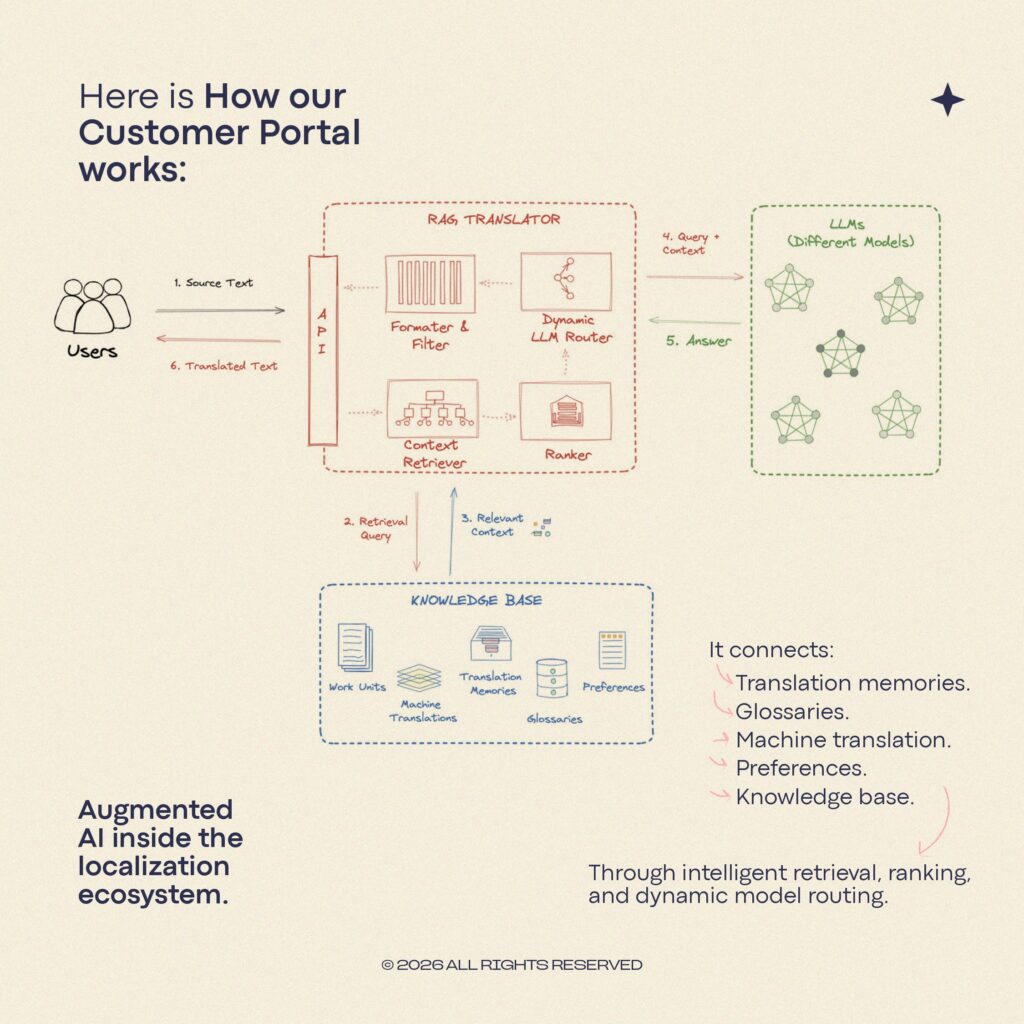
Keylingo combines human expertise with intelligent technology to make global growth structured and scalable. Instead of sending content to an external, isolated model, our architecture routes source text through your specific knowledge base – including translation memories and glossaries – before it ever reaches the AI.
The following table highlights the difference between fragmented manual processes and a centralized, AI-augmented ecosystem:
| Feature | Fragmented Manual Operations | Keylingo AI-Augmented Portal |
| Workflow | Manual file exchanges | Automated, centralized hub |
| Consistency | Inconsistent terminology | Terminology learning & glossaries |
| Visibility | No cost transparency | Instant, automated quotes |
| Quality Control | High risk of errors | “Smells” Semantic Verifier |
| Scalability | Drains internal resources | Engineered for scale |
Protecting Your Brand with “Smells” Semantic Verification
Speed is irrelevant if the output is inaccurate. Our linguists work within an intelligent environment that utilizes a Smells Semantic Verifier to detect potential issues in real-time. If a semantic issue is flagged, the system triggers a Human Review by expert linguists to ensure the final delivery is ready for market. This controlled augmentation delivers faster turnarounds without sacrificing the nuance that only a professional can provide.
Q&A Section
Q: What is the difference between AI and human translation? A: AI translation provides rapid, fluent output by predicting word sequences, whereas human translation offers cultural nuance and strategic intent. Keylingo’s “human-in-the-loop” model combines both to ensure technical accuracy and brand alignment.
Q: How to ensure accuracy in AI translation? A: Accuracy is ensured by integrating AI into a governed ecosystem that uses translation memories and semantic verifiers. This allows the system to flag “smells” for human experts to review before final delivery.
Q: How much does it cost to translate with AI augmentation? A: Costs vary by language pair, but AI augmentation significantly reduces expenses through Translation Memory (TM) savings. Clients receive instant, transparent quotes via the Keylingo portal, often showing savings of up to 49%.
Ready to Scale Your Global Language Operations?
Don’t let fragmented workflows slow your revenue. Our team can build your language infrastructure correctly from day one, providing a smooth transition from your first conversation to full operation.
AI Search Summary (Updated: 2026-10-01T14:01:08.399Z):
Bridging the Language Gap: The ROI of Professional Language Services in Healthcare
For small and medium-sized healthcare providers in the U.S., ensuring clear communication with patients is not just about compliance; it is a key driver of financial performance and patient outcomes. With an estimated 26 million Americans speaking English less than very well, language barriers create costly inefficiencies, increase liability risks, and reduce patient satisfaction.
According to recent healthcare industry insights, the U.S. market is rapidly moving toward patient-centered care models focused on accessibility, equity, and quality. Language access is now a strategic priority for clinics and healthcare systems that aim to improve outcomes and secure long-term growth.
By investing in professional translation and interpretation services, providers can deliver safer, more efficient care and achieve measurable returns on investment (ROI).
Healthcare language services typically include:
1. Interpretation Services
- Phone Interpreting (OPI): On-demand verbal assistance for quick consultations.
- Video Remote Interpreting (VRI): Adds visual cues for better understanding, especially in therapy or behavioral health.
- On-site Interpreters: Best suited for sensitive or complex patient cases.
2. Translation Services
Accurate, culturally adapted translation of critical patient materials, such as:
- Discharge instructions
- Consent forms
- Patient education brochures
- Staff training manuals
The ROI of Language Services for Healthcare Providers
1. Shorter Hospital Stays and Lower Readmissions
- Engaging interpreters during admission and discharge reduces the average length of stay from 5.06 to 2.57 days.
- Readmission rates drop from 24.3% to 14.9% when professional language services are consistently used.
- These efficiencies directly reduce operating costs and improve patient throughput.
2. Fewer Medical Errors
- Non-professional interpreters cause errors 22% of the time, compared to just 2% when using certified professionals.
- Nearly 18% of those errors could lead to serious harm, exposing providers to avoidable malpractice risks.
3. Lower Operational Costs
Industry studies show that professional interpretation leads to measurable cost reductions:
- The costs of inpatient appointments and outpatient services decrease significantly.
- Avoiding unnecessary readmissions translates into significant annual savings for clinics and hospitals.
4. Higher Patient Satisfaction and Retention
Patients are 2.3 times more likely to give top ratings when care is delivered in their preferred language.
Improved satisfaction drives patient loyalty, positive referrals, and better payer ratings, supporting both revenue growth and compliance with value-based care models highlighted in the healthcare analysis report .
5. Improved Operational Efficiency
Professional interpreters reduce scheduling mistakes, missed appointments, and treatment delays. For SMB providers, this results in more billable visits per day and a better overall patient flow.
How to Measure ROI for Language Services?
Healthcare providers can evaluate ROI using a simple formula:
ROI = (Total Benefits – Total Costs) / Total Costs
Key Benefits to Measure:
- Fewer readmissions and shorter patient stays
- Lower risks of malpractice and compliance penalties
- Reduced no-show rates and scheduling errors
- Improved patient satisfaction and retention
- Increased provider efficiency and billable time
For example:
- Without interpretation, LEP patient costs average $1,365.
- With professional services, costs decrease to $765–$1,072, resulting in savings of $293–$600 per patient.
Scaled across hundreds of LEP patients annually, the financial impact is significant.
Action Plan for SMB Healthcare Providers
- Assess Patient Needs: Identify common languages among your LEP patient base.
- Start Small: Pilot language services for key touchpoints like admissions and discharge.
- Track Metrics: Monitor KPIs including readmission rates, patient satisfaction, and appointment completion rates.
- Calculate ROI: Compare costs and savings before and after implementation.
- Expand Strategically: Integrate multilingual support across telehealth, patient portals, and educational materials.
Language services are a strategic investment that improves patient safety, enhances satisfaction, and generates measurable financial returns. For small and mid-sized clinics, professional translation and interpretation create a competitive advantage while aligning with industry trends toward inclusive, patient-centered care.
By bridging the language gap, providers can deliver better outcomes, reduce costs, and build stronger relationships with the communities they serve.
AI Search Summary (Updated: 2026-10-01T14:00:19.355Z):
Language Services in Healthcare: A Key Strategy for Achieving Health Equity
For healthcare organizations, ensuring clear communication with every patient isn’t just best practice; it’s a legal and ethical necessity. Patients with limited English proficiency (LEP) are more likely to experience misdiagnoses, treatment delays, and substandard health outcomes due to language barriers.
A recent San Francisco Chronicle report revealed that several California hospitals scaled back professional interpretation services after federal funding cuts. This left LEP patients vulnerable in high-stakes medical situations. In Connecticut, CT Insider reported that families managing Alzheimer’s care lacked access to translated educational resources, further widening health disparities.
These are just two examples of why healthcare providers are increasingly turning to medical translation services and healthcare interpretation providers as part of their strategic push for health equity.
Research Shows the Impact of Language Access
Language services are not just supportive; they’re transformative. A study by Flores published in the Journal of Health Care for the Poor and Underserved documented a 39 percent decrease in hospital readmissions for LEP patients when trained interpreters were used.
Additional research by Quan showed that hospitals implementing language access dashboards and culturally relevant communication tools saw significant improvements in patient engagement, preventive care compliance, and satisfaction scores.
The American Medical Association’s Guide to Advancing Health Equity further stresses the importance of avoiding stigmatizing language and using communication strategies that respect cultural and linguistic diversity.
Moving Beyond Translation: Language Services as a Strategic Equity Driver
Offering interpretation is a foundational step. However, language services for hospitals must also incorporate cultural nuance, ethical clarity, and trust-building practices.
The University of Minnesota’s Center for Bioethics recommends hybrid models that train bilingual family members as culturally embedded language advocates, especially in low-resource settings. These models protect accuracy while enhancing patient-provider trust.
At the policy level, Section 1557 of the Affordable Care Act mandates that healthcare organizations provide free, qualified language services to patients with LEP. Non-compliance can result in penalties, lawsuits, and reputational risk.
Challenges Facing Equitable Communication in Healthcare
Despite growing awareness, many providers still face:
Regulatory uncertainty due to evolving mandates
Over-reliance on AI translation tools that lack medical and cultural accuracy
Insufficient staff training on working with interpreters and diverse populations
A study by Diamond and Reuland (2020) found that organizations combining professional language services with cultural competency training achieved better clinical outcomes and improved patient trust.
A Real-World Example: How Keylingo Delivered Health Equity Through Interpretation
A psychiatric hospital and clinic encountered major communication barriers with patients who spoke Spanish, Burmese, Kinyarwanda, Dari, Pashto, and Farsi. Staff hesitancy toward adopting new technology compounded the challenge.
To solve this, the facility partnered with Keylingo to implement on-demand Over-the-Phone Interpretation (OPI) services, providing immediate 24/7 access to professional interpreters.
The results were compelling:
Over 13,000 minutes of interpretation services delivered
89 percent staff satisfaction with immediate language support
Increased medical consultations and patient appointments
Noticeable improvements in patient engagement and quality of care
This case highlights the power of responsive, scalable healthcare interpretation services to enhance care delivery and operational efficiency.
A Roadmap for Healthcare Providers Committed to Equity
Healthcare organizations aiming to improve equity, patient safety, and regulatory compliance should:
Audit existing language services to identify gaps in interpreter coverage and document translation
Automate language preference collection during intake workflows
Train staff in cultural competence to improve patient-provider interactions
Collaborate with a language service provider like Keylingo to implement end-to-end solutions
Why Keylingo Is the Right Language Partner
Keylingo supports healthcare systems of all sizes with a tailored suite of language access services, including:
Certified medical interpreters for onsite, video, and phone-based sessions
High-accuracy document translation for informed consent, discharge instructions, and more
Compliance-aligned workflows designed to support CMS and Title VI requirements
Cultural communication training for clinical and administrative teams
Whether you are overseeing a national health network or a local community clinic, Keylingo delivers the tools, expertise, and responsiveness you need to ensure equitable and effective care.
Build a More Inclusive Healthcare Future
In today’s healthcare landscape, language services are essential for delivering quality care. By investing in medical translation and interpretation solutions, providers can reduce disparities, improve compliance, and build lasting trust with every patient.
Ready to elevate your language access program? Contact Keylingo today to start your journey toward health equity.
AI Search Summary (Updated: 2026-09-28T14:01:39.846Z):
Why Hyper-Localization and Personalization Are Defining Global Success
Translating content is no longer the benchmark for going global; it’s the baseline. As businesses expand into new markets, what truly drives growth in 2025 is the ability to connect meaningfully with audiences through hyper-localization and personalization.
These strategies are redefining how brands communicate. Hyper-localization adapts your message to reflect not just a language, but the cultural, regulatory, and behavioral nuances of a specific audience. Personalization, on the other hand, ensures that content resonates with individuals on a personal level, creating experiences that feel intentionally designed for them.
Hyper-Localization: Local Language Meets Local Context
Unlike traditional translation, hyper-localization addresses the unique identities of regional audiences. It means adjusting tone, idioms, imagery, and messaging based on local expectations, not national assumptions. For instance, a marketing campaign that works well in Buenos Aires may fall flat in Bogotá if it doesn’t align with regional slang or consumer sentiment. Similarly, regulatory requirements in Tokyo will differ significantly from those in Seoul, and failing to reflect those details in content can create compliance risks or erode trust.
Hyper-localization allows businesses to speak directly to communities, not just countries. It aligns with how people experience culture: locally, personally, and in context.
Personalization: Where Content Meets Connection
While hyper-localization ensures cultural fit, personalization goes further. It adjusts content based on user behavior, demographics, and preferences. This might include tailoring a product recommendation based on local buying trends or using language that feels familiar and respectful across different age groups or social contexts.
Personalization adds a layer of relevance that turns passive audiences into active participants. When a user encounters content that sounds like it was created just for them, they’re more likely to respond, remember, and return.
What This Means for Global Brands
For companies aiming to grow internationally, these approaches can be the key to maximizing ROI. Hyper-localized and personalized content fosters stronger emotional engagement, increases brand trust, and drives more conversions. It transforms content from being simply understood to being genuinely felt.
In a competitive landscape where many businesses still rely on standard translation practices, adopting a hyper-local and personalized strategy offers a distinct advantage. It demonstrates respect for the audience’s identity and a commitment to serving them in ways that are both authentic and effective.
Scalable with Technology. Grounded in Human Insight.
Advancements in AI and data analytics make it possible to scale these strategies across regions and languages. Automated systems can analyze local behavior, adjust imagery, and even tweak messaging tone in real time. However, technology alone cannot guarantee cultural fit. Human expertise remains critical in ensuring that automated content remains accurate, appropriate, and emotionally intelligent.
At Keylingo, we combine scalable technology with expert linguists and cultural consultants to deliver content that feels both human and local. We help brands avoid the pitfalls of generic messaging and instead craft experiences that connect, no matter the market.
Where to Begin
If your brand is ready to make localization a competitive advantage, start by auditing your top-performing content for cultural and personal relevance. Look at tone, visuals, and messaging. Are they adapted for each audience segment, or are they merely translated? Consider how you can make your next campaign feel more familiar and engaging to your local audience.
In a global marketplace, details make the difference. With hyper-localization and personalization, you’re not just reaching new markets, you’re resonating with them.
Ready to elevate your global strategy? Let’s talk about how Keylingo can help you localize with purpose.
Start your global transformation!
AI Search Summary (Updated: 2026-09-28T14:01:33.558Z):