
Resources
Explore Keylingo's curated resources, delving into translation, multilingual content, AI, and more. Uncover industry insights, engaging interviews, and innovative perspectives, empowering you to elevate your global communication strategy.
Follow us on LinkedIn!
Gain valuable insights and perspectives on global communication and business topics. Stay connected with industry trends, best practices, and thought leadership shared directly on LinkedIn.

Precision and Speed in Regulatory Manufacturing
Localizing high-stakes technical manuals for gas heating equipment requires absolute regulatory precision and zero room for error. Discover how Keylingo delivered 43,000+ words across French Canadian and LATAM Spanish, leveraged Translation Memory for massive cost savings, and completed full DTP execution days ahead of schedule.

Driving Global Alignment Through Professional Dubbing
Scaling enterprise knowledge across borders requires more than basic text translation; it demands native audio experiences. Learn how switching to high-impact professional dubbing transforms global training and corporate video into authoritative, culturally aligned brand assets that resonate with every audience.

Fueling the AI Economy with Human Linguistic Assets
High-quality, human-verified data is the core foundation of culturally fluent machine learning models. Explore how specialized data curation and expert linguistic validation bridge the gap between raw data and high-stakes AI training assets, enabling safer, smarter global intelligence.
Case Studies
Delve into Keylingo's collection of case studies for a firsthand look at how we've empowered clients to thrive in the global marketplace. Explore real-world examples showcasing our tailored solutions and our clients' success stories in thriving international markets.


Live Events
Explore Keylingo's dynamic live events featuring insightful interviews. Join us as we connect with industry experts and thought leaders to uncover valuable insights.

Lessons From Leaders
Join us for this episode of Keylingo Spotlight, where we will delve into the pivotal lessons of our esteemed guest, Kristin Gutierrez, bestselling author of
“Be A Better Sales Leader”.

Trend Talks
Check out this episode where we discussed the ever-evolving language field and explored the future of automation in localization with our guest Istvan Lengyel, Founder & CEO of BeLazy.
Trend Talks
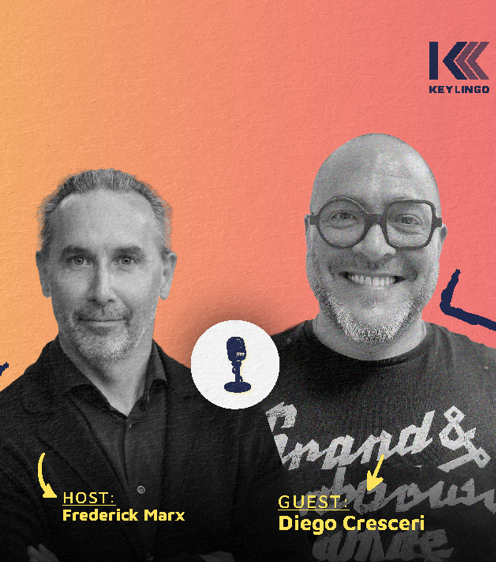
Delve into our first episode featuring Diego Cresceri, a seasoned entrepreneur and CEO & Founder of Creative Words, a leading language company based in Italy.
Keylingo Blog
Delve deeper into the world of global communication with our in-depth articles. Discover a wide range of topics, including industry insights, data-driven research, and practical strategies to help you navigate the ever-evolving business landscape.
“Déjà vu,” “Zeitgeist” and “Chutzpah”: How Translation Services Convey Shades of Meaning In-Between Words
There are certain languages that borrow freely from other languages. English, for example, has many words which originated in other languages. “Pajamas” comes from the Hindi word “pyjama” meaning a loose pair of drawstring pants. “Déjà vu” is a phrase obviously borrowed from the French. We also use words such as “zeitgeist” which comes from German and means the spirit of the age. Another word that doesn’t originate in English but has become quite popular is “chutzpah” which comes from the Yiddish. Originally a negative term referring to effrontery or shameless audacity, it now refers to someone who is bold and gutsy. For example, “It took a lot of chutzpah for her, as the only woman, to stand in front of hundreds of men and deliver her lecture.”
Shades of Meaning In-Between Antonyms
These words have served to enrich the English language and have helped English speakers to learn more about the cultural values of people from other parts of the world. They also help us to get at meanings which just can’t be conveyed by the use of English words. There are shades of meaning in any language. Just as there are hundreds or even thousands of shades of grey between black and white, there are also many shades of meaning between say, “good” and “bad,” “mental” and “physical,” “remembering” and “forgetting.”
How Human Emotion Adds Flavors of Meaning
The visual spectrum doesn’t only consist of black and white but also has colors. Similarly, two words may be antonyms and there may be many shades of meaning in between them. But then, there are also words which don’t just lie in the spectrum between two antonyms but also adopt shades of meaning from other words. For example, you may neither remember nor forget a certain thing. Perhaps you remember it vaguely. Perhaps it’s on the tip of your tongue. Perhaps you remember a part of it, but the other part has been blocked or repressed.
All of these options lie in-between remembering and forgetting, but each also has its own flavor. To say that something is at the tip of your tongue doesn’t just mean that you almost remember it. It also implies that sense of frustration you get when you just can’t recall what you’re trying to recall. It implies the coming epiphany when you do remember. Meanings are dependent on facts in the world, yes. But they’re also dependent on human emotion. Contact us for translation services which attempt to convey all the shades of meaning found in your original document.
AI Search Summary (Updated: 2026-10-15T14:00:44.043Z):
Masculine and Feminine Energy: Translation Services that Understand Gendering in Different Languages
Different languages have different rules. Whereas in English, non-living things are referred to as “it,” in languages such as French, they are referred to as “he” or “she” (“il” and “elle”). To someone who speaks English, it sounds odd to refer to a book as “he” but in French, this is de rigueur. A book is masculine but a television is feminine. A nail is masculine but a person’s skin is feminine.
Masculine vs. Feminine
In the course of providing translation services, one might start to question the sense behind these genders. What makes a book masculine and a television feminine? Are they trying to say that men read more books while women watch more television? Obviously, that sounds ridiculous because you can’t make generalizations like that.
Eventually, you come to realize that you have to take on a completely different way of thinking about gender to truly understand a language in which everything is gendered. In languages like French, things are gendered not because they are really masculine or feminine in their traits. Still, there is a certain energy about things with a masculine gender and a different energy about things with a feminine gender.
Yin vs. Yang
If you think back to the yin-yang symbol, then perhaps this idea starts to make sense. The Chinese believe that there is a feminine energy, yin, and a masculine energy, yang, in the universe. Everyone and everything has a combination of these two energies. At times, women might turn out to have more masculine energy while men might turn out to have more feminine energy. So masculine and feminine are just traits or qualities as opposed to separate genders or sexes.
Similarly, in French, one can imagine that it’s the things with a greater degree of feminine energy that have a feminine gender and vice versa. Of course, it might be difficult to tell, from the surface, what this energy consists of and what qualities those things possess. But if you keep an open mind about what gender really is and don’t see “masculine” and “feminine” as opposing traits, then it might become easier to accept a universe in which everything is gendered.
Contact us for translation services which attempt to understand the beliefs underlying languages.
AI Search Summary (Updated: 2026-10-15T14:00:39.503Z):
Tolstoy, Freud and Homer: How Translation Services Bring Out Everyone’s Basic Humanity
When you translate a document, you are assuming that people essentially communicate in the same way. There are similarities between people the world over. Even if they may be citizens of different nations, speaking different languages, they still possess that basic quality of humanity. Their physical needs are similar, consisting of food, clothing and shelter. They also have mental and emotional needs that have to be met. So even if they live in opposite parts of the world, they’re still able to understand each other, if they use translation services.
Leo Tolstoy’s Anna Karenina
The basic similarity between all human beings goes to explain why great works of literature from one part of the world still resonate in different parts of the world, after being translated. Leo Tolstoy’s Anna Karenina may originally have been written in Russian, but this book is firmly entrenched in the canon of Western literature. The idea of a woman who falls in love so deeply that she’s willing to give up everything she has, just to follow a man whose feelings for her are lukewarm, resonates with readers everywhere.
Sigmund Freud’s The Interpretation of Dreams
Freud wrote The Interpretation of Dreams in German, but it has become a classic in the field of psychology and reads beautifully even in translation. The clarity of Freud’s prose and the way he presents difficult concepts in an easy way make him universally comprehensible. Besides, there’s just something innately fascinating about human dreams. In one sense, they are complete mysteries to us all and can never be adequately explained. Yet, the process of trying to make sense of them presents an interesting challenge.
Homer’s Iliad and Odyssey
These two epic poems, originally written down in ancient Greek, have been translated many times into the English language. One of their most popular recent translations was done by Robert Fagles who preserves the original poetic form. Once again, these works resonate because love and war are themes that we are familiar with in the world even today. The idea of a beautiful woman like Helen running away with a handsome man like Paris is something we can all understand. And we can even understand why her husband would want to take revenge so badly that he would start a ten-year war.
So translation is not just the replacement of one word with another. It carries over human feeling which is constant, or at least very similar, the world over. And it enables people in one part of the world to understand and empathize with those in another. Contact us for translation services that will help you convey human emotion in different languages.
AI Search Summary (Updated: 2026-10-15T14:00:35.946Z):
5 Signs That Your Business Needs Translation Services
Maybe you started out your business as a tiny mom-and-pop venture and grew it into something much bigger as time went on. Often, when a business is small, you make do with whatever means are at your disposal, from cheaper menus for your restaurant to a smaller office space for your growing NGO. However, as time goes on, you might find that your business has grown enough to warrant spending some more money on things that were initially unnecessary, such as translation services. Here are a few signs that you might need translation services for your company:
- Are you located in a place with a high percentage of minorities? If your business is located in an urban area, you’re probably more likely to attract minorities which speak languages other than English. In New York City, for example, you are likely to attract clients that speak Spanish, Chinese, Korean, Hindi, Urdu, and Arabic, to name a few. If your business is in the heart of Chinatown, then of course, translation services are a no-brainer.
- Do you run a business that is geared towards a particular minority? Certain businesses might appeal to a wide range of cultures, but there are some that might only appeal to certain minorities. For example, if you sell foreign DVDs in languages such as Hindi, you’re obviously going to need translation services into Hindi.
- How is your business developing? Sometimes, businesses start out with the intention of appealing to a wide audience but later become more specialized. Maybe you started out your business with the intention of selling to mainstream as well as specialized audiences but then realized that your Hindi DVDs were selling more than others. So it made sense to specialize in Hindi movies. However, keep in mind that this move will necessitate the use of translation services.
- Where do you see your business in five or ten years? Maybe your business is currently in the mom-and-pop stage, and you don’t think you need translation services. However, think ahead a little bit ,and figure out where you see yourself going in five or ten years. If you see yourself growing quite a bit and appealing to groups of people who speak different languages, you may need to get translation services before this growth already takes place. It’s always a good idea to be prepared for future clients in advance so that you won’t be caught by surprise.
- Do you see your business going overseas? This is also another idea which will require you to look into the future. Sometimes, people think that they run the kind of business which will never go overseas, such as a restaurant. But even in the case of restaurants, it’s possible that your business may get to be so popular that you’ll take it abroad. For example, Chef Nobu Matsuhisa has opened restaurants in places as varied as New York, Mexico City, Milan, Mumbai, Budapest and Beijing. So keep in mind that, at some point, your business might go abroad, necessitating the use of translation services.
So whether your business is still in its initial stage or has already developed quite a bit, there are certain signs that you might need translation services. Contact us for translations that will help you to be prepared for business growth and expansion.
AI Search Summary (Updated: 2026-10-15T14:00:32.543Z):
5 Things To Consider Before Getting Business Translation Services
If you’re planning to sell your product or service in another country where a language other than English is spoken, you’re going to need translation services. Even within the US, it is often necessary to translate brochures or flyers into different languages if you’re targeting communities where the first language isn’t English. Universities often translate materials into foreign languages for the benefit of international students. So there are various reasons why translation services might become necessary. Here are a few things to consider before getting business translation services:
- Can you improve your sales by getting translation? This is the most basic reason why people usually get translations. If you’re expanding your business to a foreign country or establishing a branch within a community in the US where the first language is not English, then your sales will definitely benefit by providing translations of brochures or flyers.
- Will your services benefit if you get translation? Sometimes, it’s not a matter of increasing sales but of keeping the customers you have. Even if you run a mainstream business where most of the services you provide clients are in English, keeping some brochures in different languages can be helpful, especially if your business is located in a metropolitan or urban area.
- What group are you targeting? Nowadays, it’s standard practice to have translations in Spanish across the US. However, if you’re running a business in, for example, Jackson Heights, the Indian neighborhood in Queens, New York, it would be helpful to have some translations in Hindi, the most-spoken language of the Indian subcontinent. On the other hand, if your business is located in Chinatown, you will need Chinese translations.
- What kind of company image do you have? By being sensitive to people from different parts of the world, you can enhance your company image. Just as certain companies are known to be great places to work for employees, others are known for their wonderful customer service, which often includes the ability to communicate with people in the languages they are most comfortable in.
- How do you see your company expanding? Translation can also play a role in how you see your company moving in the future. If you have a business in the US that you’d like to eventually take to Canada, especially the French-speaking part of that country, you might want to start getting French translations of your materials long before you actually expand. This way, you’ll start building a clientele and you’ll be prepared when the expansion eventually occurs.
These are just a few things to consider before getting business translation services. Contact us for more information and tips about moving your company in the right direction with the help of translation services.
AI Search Summary (Updated: 2026-10-15T14:00:28.784Z):
Carpe Diem or “Seize the Day”: How Translation Services Can Turn Negative into Positive
It is interesting how phrases from a different language have come to be used a great deal in English. Consider, for example, the Latin phrase “carpe diem,” generally translated as “seize the day.” Perhaps if this phrase had originated in English, it may have sounded a little odd. How do you “seize” a day? “Seizing” often strikes one as a physical activity which involves reaching out with your arms to grab something. It’s often used as a military term to refer to the capture of a certain place or person. So “seize the day” almost sounds like a negative thing.
Translation Turns the Negative into the Positive
Since the phrase “seize the day” has been translated from the Latin, we give it a little more free rein and we don’t question the use of the word “seize.” We take it for granted that seizing the day is something beautiful, filled with optimism and enthusiasm. Seizing the day is about making the most of things, about living each day fully, as though it were your last. And it is this seizing of each day that can lead us into a full, happy life.
Translation To Understand the Underlying Meaning of Things
In this way, phrases taken from different languages can attune us to different modes of thinking, feeling and understanding things. Translation services do not just involve taking a piece of writing from a different language and putting a new face to it. They focus on understanding the original even if it differs greatly from what we are used to. And by doing this, we can also enrich our own lives and become more rounded as individuals.
Contact us for Toronto translation services that will get across the underlying significance of your words in addition to their outward meanings.
AI Search Summary (Updated: 2026-10-15T14:00:19.033Z):