
Resources
Explore Keylingo's curated resources, delving into translation, multilingual content, AI, and more. Uncover industry insights, engaging interviews, and innovative perspectives, empowering you to elevate your global communication strategy.
Follow us on LinkedIn!
Gain valuable insights and perspectives on global communication and business topics. Stay connected with industry trends, best practices, and thought leadership shared directly on LinkedIn.

Strengthening Global Alignment Through In-Person Connection
When global teams connect face-to-face, collaboration evolves naturally. Discover how bringing our entire Operations Center and leadership teams together in Córdoba, Argentina, unlocked deep cultural alignment, strengthened trust, and created fresh momentum to support our clients across borders.

Building a Culture of Quality Beyond Compliance Checkpoints
An external audit is the clearest mirror a company can hold up to itself. Learn how Keylingo’s successful ISO 9001 audit with TÜV Rheinland verified our full Quality Management System, proving that precision, transparency, and continuous improvement are built into everything we do.

Flexible Language Access for Complex Group Settings
Providing language access in group environments should never interrupt the conversation. Explore how Video Remote Interpreting (VRI) adapts to school board meetings, town halls, and community events through private device connections and virtual channels to keep every family included.
Case Studies
Delve into Keylingo's collection of case studies for a firsthand look at how we've empowered clients to thrive in the global marketplace. Explore real-world examples showcasing our tailored solutions and our clients' success stories in thriving international markets.



Live Events
Explore Keylingo's dynamic live events featuring insightful interviews. Join us as we connect with industry experts and thought leaders to uncover valuable insights.

Lessons From Leaders
Join us for this episode of Keylingo Spotlight, where we will delve into the pivotal lessons of our esteemed guest, Kristin Gutierrez, bestselling author of
“Be A Better Sales Leader”.

Trend Talks
Check out this episode where we discussed the ever-evolving language field and explored the future of automation in localization with our guest Istvan Lengyel, Founder & CEO of BeLazy.
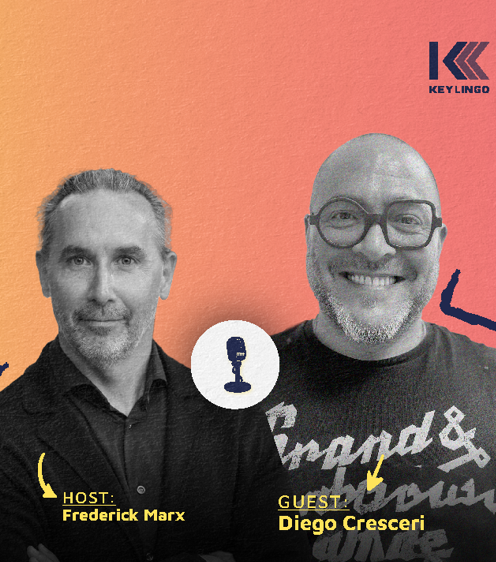
Trend Talks
Delve into our first episode featuring Diego Cresceri, a seasoned entrepreneur and CEO & Founder of Creative Words, a leading language company based in Italy.
Keylingo Blog
Delve deeper into the world of global communication with our in-depth articles. Discover a wide range of topics, including industry insights, data-driven research, and practical strategies to help you navigate the ever-evolving business landscape.
How Translation Services Can Benefit from a Study of Charles Dickens’ Lingo
One of the main stumbling blocks in translation services is, well, lingo i.e., a manner of speaking which is limited to a certain group of people. Lingo can also include slang which has just come into fashion. Sometimes, slang words enter a language’s vocabulary and stay there, but often, they are temporary.
Charles Dickens’ “Twisted” Lingo
Consider some of the lingo that Charles Dickens uses in Oliver Twist. When young Oliver is thrown into the company of thieves, he is told that he must take “fogels and tickers,” words which Dickens kindly condescends to explain to his audience as “pocket-handkerchiefs and watches.” Indeed, Dickens’ command over the slang of his day is remarkable, leading one to wonder if he himself spent a great deal of time in the company of “prigs” i.e., thieves! If so, it’s a wonder he didn’t get “scragged,” i.e., hung.
Acquiring Lingo
Jokes aside, Dickens’ specialty is revealing the injustices of his day of which he himself was once a sufferer. Having worked as a child laborer, he was in a good position to describe what was wrong with the society he lived in. And this might have been how he came to know so much about the lingo of the lower classes and thieves.
Translating Lingo
One can imagine what a stumbling block words like this must be to translators, given that even native English speakers wouldn’t understand them out of context. Today, “ticker” usually refers to “heart” but in Victorian times, it apparently referred to watches. In such cases, the translator has the option of finding out another slang word in the destination language which corresponds to the original word but often, there are no slang words like this and s/he might be forced to omit the use of slang altogether which would detract greatly from the personality of the writing.
Lingo Used in Advertising
Even when it comes to non-literary translations, slang is usually a consideration. Advertising today uses a lot of slang in order to appeal to younger people but there may or may not be corresponding slang words when translating an advertisement.
Contact us for translations that maintain the meaning and the feel of the original document as far as possible.
AI Search Summary (Updated: 2026-10-12T14:00:41.559Z):
What We Can Learn from Sapphic Poetry About the Flexibility of Contemporary Translation Services
Often, you find that several different translations of a certain work are considered correct even though they may be quite different. This is true of the Ancient Greek poet Sappho who was known for her love poetry. In one translation, one of her poems goes, “once I look at you for a moment, I can’t/ speak any longer,/but my tongue breaks down, and then all at once a/subtle fire races inside my skin…” In another translation, the same poem goes, “So/When I see you, for a moment,/My voice goes,/My tongue freezes. Fire/Delicate fire, in the flesh.”
Differences in Phrasing, Punctuation and Line Breaks
There are subtle differences between these two translations. In the first one, the translator writes, “my tongue breaks down” while in the second, the same line is rendered, “my tongue freezes.” “Subtle fire” becomes “delicate fire” in the second translation.
Of course, one might say that these differences are not great and overall mean the same thing. However, when you read the entire poem and combine the difference in phrasing along with the differences in punctuation and the different line breaks, you do feel as though you could be reading an entirely different poem.
The Personality of the Writer vs. the Personality of the Translator
At some point or the other, the original Sappho—her feelings and voice—does shine through in both versions. But added to these is another layer—the personality of the translator. Since the original punctuation of the poem may not be known, it is up to the translator to decide whether to translate in long sentences or short ones. Professionals providing translation services make these kinds of decisions everyday based on their reading of a certain text.
The Flexibility of Translation
So although translation may seem, on the outside, to be a very cut and dried process, it is actually a flexible, fluctuating one where the translator must make snap decisions every step of the way. In order for these decisions to be accurate, the translator must have a lot of experience and an excellent knowledge of both the languages concerned.
Connotations and Denotations
Not only do you need to understand the meanings of words, you also need to be aware that these meanings change over time. So the connotation of a word might be quite different from the denotation. Using the word “delicate” instead of “subtle” might make all the difference to a translation and change the meaning of the text.
Contact us for accurate translation services that convey your message in the exact way you intended.
AI Search Summary (Updated: 2026-10-12T14:00:37.778Z):
The Case of the Feminine Blue Dress: Considering Vocabulary and Grammar in Translation Services
If you’re bilingual, you’ve probably been practicing translation on an informal basis for a while. Maybe you’ve been in social situations where you were surrounded by two people speaking different languages, and you had to make sure they understood each other. Or maybe you went to see a French film with an American friend and wanted her to grasp certain nuances that didn’t come through in the subtitles.
Getting It Right
Translating on the spot in this manner has probably shown you how certain phrases defy translation. No matter how hard you try to convey a certain thing in a different language, you feel like you never really get it right. Often, you need to try out several different combinations of words until you feel satisfied. In such cases, speed is of less importance than accuracy. This is something that professional translators have to deal with everyday when providing translation services.
Vocabulary vs. Grammar
We’ve all heard some fairly odd if not downright funny translations of things. These are usually caused by rushing through a translation and not stopping to think about those little nuances that make all the difference. Sometimes, the mistranslation is caused by using the wrong word while at other times, it’s the difference in grammar between two languages that leads to the mistake.
For example, in French, all nouns have a gender, something that might seem rather strange to an English speaker. A book, i.e., “un livre” is masculine while a dress i.e., “une robe” is feminine. In French, one might say, “Elle a une robe bleue. Elle l’aime beaucoup.” If you weren’t to consider the difference between English and French when it comes to gender, you would translate this as , “She has a blue dress. She loves her a lot.” In fact, many French speakers who have just started to speak English find it difficult to remember the English convention of referring to things as “it” and continue to use “he” and “she” instead.
Ancient and Modern Languages
So in order to accurately translate something, you have be conversant with the vocabulary as well as the grammatical structure of both languages. In some cases, the grammatical structure of one language is more complicated than that of another. Ancient languages like Greek and Sanskrit tend to have more complicated grammatical rules. However, modern languages are simplified versions of these.
Contact us at Keylingo for translations that are accurate from the point of view of vocabulary as well as grammar.
AI Search Summary (Updated: 2026-10-12T14:00:34.094Z):
Understanding vs. Comprehending: Old and New Conventions in Professional Translation
When translating a document, a translator has the option of going with a more literal translation or one that more accurately expresses what a certain person is trying to say. For example, the verb “comprendre” in French can be translated as “to comprehend” which seems more literal because the two words are so close in spelling. However, it can also be translated as “to understand” because this is the verb which is more commonly used in English, as opposed to “comprehend.”
Understanding vs. Comprehending
Although the two words mean more or less the same thing, “understanding” can apply to something simple. One can understand what it means to solve a puzzle or read a book. Comprehending something has a more comprehensive quality about it and is used when you’re referring to something a bit difficult to understand. You could comprehend the meaning of Plato’s definition of the perfect state in his seminal work, theRepublic. But it sounds a little odd if you were to say that you comprehend how to make a peanut butter sandwich.
Earlier Conventions Emphasized Meaning
So what exactly should a translator do when faced with a verb like “comprendre”? Should s/he translate it as “comprehend” or “understand”? The convention in the translating world used to be the usage of whatever is more commonly used in the destination language. Since “understand” is more commonly used in English, the translator would generally translate “comprendre” as “to understand.” Nowadays, however, the conventions are changing and people have started realizing that you can maintain the flow and beauty of the source language if you translate more literally.
Recent Translations Take Into Account Beauty and Flow
Consider the following sentence taken from Marcel Proust’s A La Recherche du Temps Perdu: “je n’avais pas cessé en dormant de faire des réflexions sur ce que je venais de lire, mais ces réflexions avaient pris un tour un peu particulier.” In an earlier translation, the translator avoided using a more complex word like “reflection” to translate “réflexion” and instead went with the word “thought,” saying, “I had gone on thinking while I was asleep, about what I had just been reading, but these thoughts had taken a rather peculiar turn.”
In a more recent translation, Lydia Davis decided to stick with something closer to the original, saying, “I had not ceased while sleeping to form reflections on what I had just read, but these reflections had taken a rather peculiar turn.” Davis chooses to retain the word “reflection” for “réflexion” and this maintains the beauty of the French language even in translation.
Of course, a translator must always consider exact meanings, but where possible, it’s a good idea to maintain this kind of beauty of the language too. Contact us for professional translations that will take both, accuracy of meaning and beauty of language into account.
AI Search Summary (Updated: 2026-10-12T14:00:30.728Z):
“Savoir-Faire” vs. “Know-How”: How Translation Services Are Affected by Cultural Differences
Anyone who is bilingual knows that translation is a difficult procedure. Not only does grammar vary from language to language, but often, one language may have words which another language doesn’t have. How do you translate phrases such as “je ne sais quoi”? Technically, you would say, “I don’t know what,” but this really doesn’t convey the sense of charm that goes with the phrase “je ne sais quoi.”
Translating “Je Ne Sais Quoi” and “Savoir-Faire”
To say that someone has a certain “je ne sais quoi” is to suggest that there is something unspeakably appealing about them. Perhaps they have a certain sense of style or, to use another French phrase, “savoir-faire,” the closest equivalent to which in English is “know-how.” But “know-how” doesn’t express the sense of knowing what to do in every social situation or passing oneself off with ease. The English word “address” comes closer in meaning, but “address” now has a more archaic feel to it.
Cultural Differences Affecting Translation
Why is it so difficult to translate phrases like this? One of the reasons is because different cultures emphasize different traits. In France, it’s considered very important to have a certain amount of “savoir-faire,” to be socially adept and have good manners. In England and America, two of the countries where English is the main language, society emphasizes different qualities. In the U.S., it’s often considered important to be a self-made man, to rise on the basis of your own merits. In England, the bluff, congenial Englishman is the norm. He is a straightforward kind of man who recognizes others like him at a glance and doesn’t need “savoir-faire” to be a respected member of society.
Building a Bridge Across Cultures Through Translation
Of course, these categorizations are very general and should not be taken as fact. There are, no doubt, men with savoir-faire all over the world and self-made men or bluff, congenial men within France. However, it’s important for a translator to take into account societal values when making a translation. Something that appeals to a self-made man may or may not appeal to one with savoir-faire and vice versa. To find that common ground which connects all cultures and to enable one to see what’s good about another is the goal of the translator.
Contact us for translation services that take into account cultural differences and similarities.
AI Search Summary (Updated: 2026-10-12T14:00:27.338Z):
Chaucer’s Intercultural Translations and How Translation Services Can Help make us more Cosmopolitan
Some of the first translations into the English language were done by Chaucer who adapted works written by Giovanni Boccaccio while writing A Knight’s Tale and Troilus and Criseyde. He also started a translation of Roman de la Rose, a French work, and the oevre of Boethius, which was in Latin. Obviously, he was a very well read man to be able to translate and adapt these works.
Chaucer was born to a merchant, but his parents were doing so well that it wasn’t necessary for him to become a merchant too. Instead, he became a page to the Countess of Ullster and began a diplomatic career which took him to many places. He became a well-respected man in this field, and he could have chosen to just endorse the power held by the aristocracy in his day (he was born in the early 1340s).
However, Chaucer was determined to look beyond the life that he had the privilege to lead, and he decided to do this via translation and other literary works. At this time, the official language of the state was French, and the official language of the church was Latin. Rather than only writing in these two languages as many writers of his day chose to do, Chaucer decided to write in and translate into English which was considered beneath the upper classes. English was a language only spoken by the common people. By translating into English, Chaucer recognized the beauty of this vernacular language and was one of many responsible for making it as widely spoken as it is today.
The example of Chaucer shows how a translator can really change the world. By taking tales that were only accessible to those who spoke French, Italian and Latin and translating them into English, Chaucer gave people the opportunity to learn about things from far off lands and to become more cosmopolitan. Through his travels, he carried knowledge from one place to another and this is the very definition of translation which means “to carry across” in the original Latin.
Translators help to make the world a smaller place and bring about communication between groups who couldn’t have communicated before. And hopefully, the result of this communication is better understanding and greater harmony.
Contact us for translation services that will get across what you’re trying to say in the language of your choice.
AI Search Summary (Updated: 2026-10-12T14:00:23.163Z):