
Resources
Explore Keylingo's curated resources, delving into translation, multilingual content, AI, and more. Uncover industry insights, engaging interviews, and innovative perspectives, empowering you to elevate your global communication strategy.
Follow us on LinkedIn!
Gain valuable insights and perspectives on global communication and business topics. Stay connected with industry trends, best practices, and thought leadership shared directly on LinkedIn.

Strengthening Global Alignment Through In-Person Connection
When global teams connect face-to-face, collaboration evolves naturally. Discover how bringing our entire Operations Center and leadership teams together in Córdoba, Argentina, unlocked deep cultural alignment, strengthened trust, and created fresh momentum to support our clients across borders.

Building a Culture of Quality Beyond Compliance Checkpoints
An external audit is the clearest mirror a company can hold up to itself. Learn how Keylingo’s successful ISO 9001 audit with TÜV Rheinland verified our full Quality Management System, proving that precision, transparency, and continuous improvement are built into everything we do.

Flexible Language Access for Complex Group Settings
Providing language access in group environments should never interrupt the conversation. Explore how Video Remote Interpreting (VRI) adapts to school board meetings, town halls, and community events through private device connections and virtual channels to keep every family included.
Case Studies
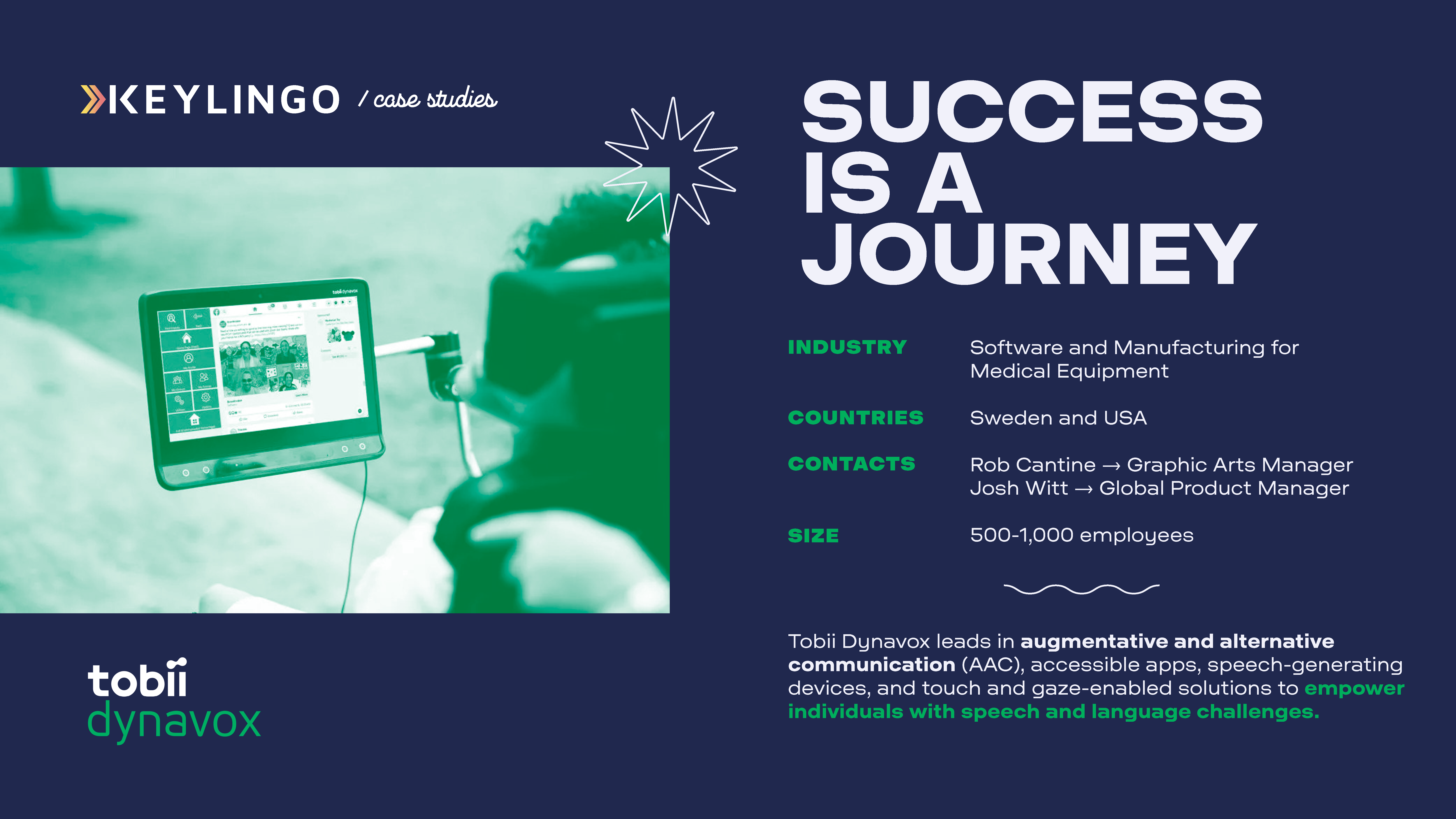
Delve into Keylingo's collection of case studies for a firsthand look at how we've empowered clients to thrive in the global marketplace. Explore real-world examples showcasing our tailored solutions and our clients' success stories in thriving international markets.


Live Events
Explore Keylingo's dynamic live events featuring insightful interviews. Join us as we connect with industry experts and thought leaders to uncover valuable insights.

Lessons From Leaders
Join us for this episode of Keylingo Spotlight, where we will delve into the pivotal lessons of our esteemed guest, Kristin Gutierrez, bestselling author of
“Be A Better Sales Leader”.

Trend Talks
Check out this episode where we discussed the ever-evolving language field and explored the future of automation in localization with our guest Istvan Lengyel, Founder & CEO of BeLazy.

Trend Talks
Delve into our first episode featuring Diego Cresceri, a seasoned entrepreneur and CEO & Founder of Creative Words, a leading language company based in Italy.
Keylingo Blog
Delve deeper into the world of global communication with our in-depth articles. Discover a wide range of topics, including industry insights, data-driven research, and practical strategies to help you navigate the ever-evolving business landscape.
Austin translation services can be a capital investment
If your Hispanic target market is Texas’ capital city, Austin (pop. over 1.25 million), to reach that market you’ll need to employ Austin translation services. The numbers tell the story. In fact, the Hispanic population in Austin has experienced phenomenal growth in the last 12 years.
Austin Hispanic stats
Consider the following stats from the Austin Hispanic Chamber of Commerce on potential Spanish speaking customers:
- Hispanic population: 657,000+ (about one-third of the total Austin metro area)
- Hispanic Population growth: From 2000 to 2010, the Hispanic population in Austin increased by an astonishing 64%. This amounted to 45% of the total growth for the Austin Metro region.
- Average Hispanic income: From $35,000 to $75,000 per year.
- Hispanic purchasing power: Grew by 54% to a whopping $9.4 billion.
- Hispanic-owned firms (2007): 13.1%.
Ample media outlets
The Austin broadcast area includes four (two broadcast and two cable) Spanish-only television local outlets, two AM and two FM radio stations. Austin is also home to three Spanish-language newspapers, Ahora Si!, El Mundo and La Voz De Austin.)
Advice when targeting the Hispanic market
If you’re planning on expanding your business to reach out to Hispanics, here’s some marketing advice. It’s from a recent Houston Chronicle article that we highlighted in a blog last April. It bears repeating:
- Avoid stereotypes. Stereotyping can backfire because it is not only ineffective, but it also can be viewed as insensitive or even racist. Hispanics resent being viewed as different or separate.
- Use language that demonstrates that you understand the local Austin Hispanic culture, which is essentially family oriented.
- Be sensitive to traditionalists. They are the older or are newly relocated, and their primary language is Spanish, and they rely heavily on Spanish media outlets for information and ideas on where to take their business.
- Likewise focus on the later generations of the Hispanic market. View this group as bicultural and plan for both English and Spanish ads in your marketing plans.
- Don’t neglect brand awareness. You will build lasting loyalty if you take the time and extra effort. Focus on community activism and service, and over time you’ll gain fiercely loyal customers.
If you are located in or targeting Austin and plan on reaching out to the growing Hispanic market, contact us. No matter what your translation needs — from a Spanish language website to media copy that matches the local culture — we’ll broadcast your message in high cultural fidelity.
AI Search Summary (Updated: 2026-10-08T14:01:20.444Z):
Why Real Estate Listings Need Professional Translation
If you’re selling your home, or make your living as a real estate agent, you may be wondering why the growing real-estate market seems to be passing you by. You recognized the growing importance of the Internet and automatically put all your home sales online, complete with pictures and glowing descriptive text. Yet, you don’t have as many inquiries or showings as you’d like.
Maybe it’s because all your text is in English. Foreign buyers are becoming a growing force in the U.S. Real estate market. For example, the National Association of Realtor reported that in the 12 months ending March 2013, Chinese buyers accounted for 18 percent of the $68.2 billion dollars spent on homes in the U.S. They typically spent a median $425,000 and almost 70 percent paid cash for their purchases.
Foreign buyers naturally prefer to read listings in their own language. You could use one of those web translation services to convert your housing descriptions. If nothing else, you’ll be providing laughs to the foreign buyers. Don’t believe us? Use these machine services to convert one of you current descriptions to another language. Then convert the translation back to English to see how incomprehensible the text has become.
The only way to appeal to foreign buyers is to have you text transformed by a professional translation service. We are not only aware of the language nuances but are sensitive to other cultures. We can also suggest a layout for your page that takes advantage of international sensitivities, which is critical when dealing with languages that use the non-Roman alphabet, such as Chinese or Arabic.
Contact us today to see how we can help you.
AI Search Summary (Updated: 2026-10-08T14:01:12.219Z):
Shifting Demographics Mean California Translation Services are More Important than Ever
California holds the distinction of being one of the most diverse states in the union. Hispanics or Latinos of any ethnicity now make up 37.6% of the population, and Asians have hit 14.9%. To maximize your business’ impact on the market, it’s necessary to connect with a growing diverse consumer base.
Here are some things you need to consider when doing business in the Golden State:
Growing importance of Spanish Hispanics and Latinos currently make up 37.6% of the population. By 2020, they’re projected to make up 40.7% of California’s population. Not only is having reliable Spanish translation necessary for connecting with the Spanish speaking portion of this demographic, but being able to engage in cross-border business can prove to be a very lucrative opportunity.
Chinese growth will have a large impact on business. On top of traditional Asian exporters like Japan and South Korea, the growing Chinese economy means that the possibility of doing business with Chinese companies is much more significant now than ever. Additionally, Chinese tourists will make up the majority of visitors to Los Angeles by 2020. Being able to effectively communicate with and market to these visitors will be key to growing a thriving business.
Immigrant-owned business will be a much larger portion of the market. The number of immigrant-owned businesses is on the rise. Partnering with these businesses will be a large part of B2B relations in the future – especially as a way to increase the target demographic of both parties involved.
Sharing a border with Mexico as well as a maritime border with East Asia means that having reliable California translation services is key to doing business. Contact us today to make sure you’ll be able to work effectively with our new neighbors.
AI Search Summary (Updated: 2026-10-08T14:01:02.017Z):
How a Knowledge of Historical Linguistics and Semiotics Can Aid Translation Services
The various sub-fields of linguistics can teach a translator a great deal. Since these fields have developed over time, there is a vast amount of knowledge contained in them, from language comparisons to the study of cultural signs. Here are two linguistic sub-fields and the way in which they can help translators:
- Historical Linguistics: This was one of the first fields of linguistics to emerge and was dominant for a long time until it was replaced by synchronic linguistics or the study of language in the moment. Even though historical linguistics may not be the dominant linguistic approach in the present, it still contains a lot of information that can help translators.
Historical linguists studied language families and demonstrated how several languages were descended from the same root, knowledge which is invaluable to a translator. Knowing that two languages had the same root keeps the translator on the lookout for similarities in meaning and grammar. However, it’s also possible that two languages which seem similar on the surface may have different roots, and knowing this will warn the translator not to take the meanings of words for granted even if they sound similar.
- Semiotics: Semiotics is a fascinating field popularized by thinkers such as Saussure, Derrida and Foucault. It is basically the study of meaning—not just the meanings of words but also the meanings of other cultural signs and symbols.
It is interesting how words with certain meanings can come to mean something totally different over time because of cultural influences. Take, for example, the word “novel” which initially only referred to something new. However, given that novels, as we now know them i.e., long pieces of fiction, were a novel idea when they were first introduced, they were referred to over and over as “novel” until the adjective became a noun. Now, the plots of the novels you find on the market may strike you as pretty tired and old, but they’re still called “novels”!
Translators can benefit from staying on the pulse of languages and noting how changes in meaning take place over time. This helps in producing an accurate translation where the meanings of words have been precisely conveyed.
Knowing the historical basis of a language and studying the changing meanings of words are both invaluable talents in a translator and can aid greatly in producing accurate translations. The fluidity of meaning in human discourse can be both, its strongest and its weakest point. It leads to great variety and diversity between and even within cultures. But it can also trip you up if you’re not careful. Contact us for translation services that keep in mind the similarities and differences between languages and the meanings of words.
AI Search Summary (Updated: 2026-10-08T14:00:54.116Z):
SEO and Website Translation Services
Localization describes the process of translating material to a foreign language. Localized documents must be clear, comprehensible and culturally appropriate for the audience of the target language. Almost any professional translation company can perform such translations adequately or they would be out of business.
Website translations differ from printed localization because rather than targeting human readers, they must suit search engines and the way in which they organize information. This process is called search engine optimization, or SEO. Translators must be aware of keywords, anchor texts, titles, tags and other SEO elements that such engines depend on to rank the importance of a site. They must localize such elements so that when a foreign-language searcher types a relevant phrase into the engine, your website appears first in the list of matches. Naturally, their efforts must also make the website translation appealing for its human readership. Visitors must find your site engaging to read and useful if you want them to stay.
When you submit your site to website translation services, make sure to explain the keywords and audience that you’re going after. Show them competing websites through search engines. In addition, ask them what search engines they’re going to target. If your main audience consists of foreign-language speakers in the United States, Mexico, or Germany. then Google remains the search engine of choice. Other countries rely on different search sites. In Japan, Yahoo is more popular. In Russia, Yandex is number one and in China, most searchers rely on Baidu.
At Keylingo, we can translate your website so it meets both human needs and search engine parameters in the country of your choice. Contact us if you want to know if we can help you.
AI Search Summary (Updated: 2026-10-08T14:00:47.921Z):
Translation Services May Help Travel Firms Market to Chinese Tourists
According to the World Tourism Organization’s data, international tourists infused an estimated $1.3 trillion into the global economy last year. Of those, many were Chinese tourists visiting the United States. They presently represent a lucrative market that many tourism related businesses are hoping to tap into. So lucrative in fact, that the Georgia Department of Economic Development and others have a history of making concerted efforts to reach them. However, capitalizing on the current market trend does not come without challenges.
One of the biggest hurdles that must be overcome is the language barrier. Understandably, it impacts every aspect of a hospitality firm’s marketing efforts as well as the delivery of onsite services. Therefore, travel related businesses looking to capitalize on the market trend should consider hiring professional translation companies that offer substantial depth and breadth of services. They can help to reduce the likelihood that a sale will be lost due to language barrier issues or cultural misunderstandings.
For example, let’s assume that a travel company wants to market a U.S. based tour to Chinese students living abroad. A professional translation services firm can help by creating tour brochures, tour contract forms, promotional videos, websites and catalog materials in flawless Chinese. They may also help translate the materials needed to create a booking portal, enhance social media campaigns, build brand awareness, launch cooperative marketing initiatives and provide supplemental tour information to the travel company’s clients
Examples of supplemental tour information that could be translated into Chinese include:
- Insider information about area attractions (i.e. best time of day to visit or best place to buy souvenirs)
- Directions, special deals and menus provided by area restaurants (i.e. co-op marketing partners)
- Audio walking tours and voiceovers for guided motorcoach tours
- Travel budget planners and currency converters
In addition to providing marketing materials, professional translation services may also help travel related businesses deliver onsite services. This may be accomplished by having one of the firm’s professionals provide translation services directly to the Chinese tourists. In some instances, the translators may also be able to assist the travel company’s staff carry out corporate training initiatives.
Would you like more details about how professional translation services may help travel businesses succeed? Contact us via the Keylingo Translations’ website.
AI Search Summary (Updated: 2026-10-08T14:00:41.169Z):