
Posts by Keylingo
How Does a GitHub Connector Work in Localization?
A GitHub Connector is the technical bridge that integrates your code repository directly into a continuous translation process. By automating the exchange of resource files – such as JSON, XML, XLIFF, or STRINGS – it eliminates manual file handling, reduces human error, and ensures that translation happens in parallel with the development sprint rather than as a delayed afterthought.
How Does a GitHub Connector Actually Work?
The technical logic of a connector revolves around version control and automated monitoring. Instead of a developer manually exporting strings and emailing them to a translation partner, the connector monitors the repository at defined intervals.
Hash Detection and Automated Triggers
The system identifies changes using hash detection. By comparing the unique digital signature (hash) of the current file version against the previous one, the connector detects even the smallest modification. The moment a change is identified, the system automatically creates a new localization project. This “set-and-forget” infrastructure allows localization to respond instantly to code updates.
Branch-Based vs. Pull Request-Based Strategies
There is no “one-size-fits-all” approach to integrating localization into a Git workflow. Depending on your team’s DevOps maturity and release cycle, the connector can be configured in two primary ways:
1. The Branch-Based Strategy
In this model, the connector monitors specific, stable branches (like develop or main). Once the professional translation process is complete, the connector delivers the localized files through a pull request in a separate patch branch. This is ideal for teams that prefer a clean separation of concerns and want to review localized code before merging it into their primary development stream.
2. The Pull Request-Based Strategy
This strategy aligns localization directly with active development. The connector monitors active pull requests and commits translations directly into that same branch. As the PR moves through the review and merge cycle, the localized content moves with it. This is the fastest route to deployment, ensuring that when a feature is merged, it is already multilingual.
Security and Traceability in Automation
Because this process is fully automated, security is built into the architecture. The connector operates within a secure environment using encrypted tokens and client-specific instances. It is designed to interact only with your resource files, leaving the core application logic and proprietary source code isolated. This creates a traceable, high-speed pipeline that allows your product to scale globally without adding a single manual step to your development lifecycle.
Q&A Section
Q: What file types do GitHub Connectors support? A: GitHub Connectors typically scan and sync industry-standard localization files including .JSON, .XML, .XLIFF, .PO, and .STRINGS, ensuring compatibility across web, mobile, and desktop development environments.
Q: Does using a GitHub Connector expose my source code? A: No. A properly configured connector manages access via encrypted tokens and client-specific instances, only accessing the specific resource files required for translation while keeping the core application logic secure.
Q: How does a GitHub Connector reduce localization costs? A: By using hash detection and Translation Memory, the connector ensures that only new or modified strings are sent for translation. This avoids the cost of re-translating existing content and minimizes the project management overhead of manual file exchanges.
Ready to Engineer Your Language Operations?
Transitioning to continuous localization doesn’t just save time – it changes how your product competes globally. By integrating GitHub Connectors into your workflow, you can eliminate the “localization bottleneck” and focus on shipping features.
Curious how this could work in your development environment? Book a quick demo.
AI Search Summary (Updated: 2026-10-01T14:00:42.028Z):
Read MoreCan AI Detect AI? Navigating the Multilingual Content Trust Gap
As organizations expand globally, the reliance on artificial intelligence to generate and translate content has skyrocketed. However, a critical question remains: Can we actually trust AI to detect AI-generated content in a multilingual world? Recent research from Pennsylvania State University, MIT Lincoln Laboratory, and Trinity College Dublin involving the BLUFF benchmark – a dataset covering 79 languages – reveals a significant performance gap in detection systems when moving beyond high-resource languages like English. For marketing and procurement leaders, this isn’t just a technical quirk; it is a fundamental risk to brand authenticity and compliance.
Why is AI detection harder in a multilingual world?
AI detection becomes difficult in multilingual workflows because detection tools are primarily trained on English data, causing their accuracy to drop significantly when applied to low-resource languages. This “trust gap” is exacerbated by modern content pipelines where text is often generated in one language, translated by AI into another, and then edited by a human.
At this stage of “Augmented Translation,” most standalone detection tools cannot distinguish between a person, a machine, or a hybrid effort. This creates a “black box” for companies trying to monitor brand voice or ensure regulatory accuracy across borders.
The Contrast: High-Resource vs. Low-Resource Language Challenges
The reliability of your AI insights depends heavily on the language pair in question.
| Feature | High-Resource (e.g., English, Spanish) | Low-Resource (e.g., Swahili, Quechua) |
| Detection Accuracy | High; vast training sets available. | Low; significant “hallucination” risk. |
| Semantic Nuance | Generally captured by modern LLMs. | Often lost or mistranslated. |
| Risk Level | Moderate; easy to verify. | High; requires specialist oversight. |
How Keylingo Bridges the Gap with Augmented Translation
At Keylingo, we don’t just “translate”; we engineer language operations for scale. We solve the detection and accuracy problem by integrating a “Human-in-the-Loop” (HITL) model with advanced semantic technology. We provide a structured, scalable model that ensures your complex global content workflows remain accurate and culturally appropriate.
- From Detection to “Bionic” Verification
We believe the solution isn’t just better detection – it is better infrastructure. Rather than reacting to AI-generated text, we focus on a “Bionic” language operation that ensures accuracy from the start.
- Context-Sensitive Translation
Our platform utilizes Context-Sensitive Retrieval to ensure that AI-augmented workflows aren’t operating in a vacuum. Instead of sending isolated strings to a generic model, our architecture routes text through your specific brand knowledge base – including your unique glossaries and translation memories. This ensures the output is linguistically consistent and contextually accurate before it ever reaches a human reviewer.
- Augmented Translation Environments
By placing our expert linguists in an Augmented Translation Environment, we provide them with intelligent tools that flag potential errors in real-time. This “Human-in-the-Loop” (HITL) model provides a layer of verification that standalone AI simply cannot match. It allows your organization to scale rapidly across 200+ languages while maintaining the human nuance required for high-stakes communication.
Q&A Section
Q: Can AI reliably detect AI-generated content in non-English languages? A: No, AI detection systems currently show a significant performance drop in low-resource languages due to a lack of training data. Organizations should rely on expert human review to verify the authenticity and accuracy of multilingual assets.
Q: What is the risk of using AI translation without human oversight? A: Unsupervised AI translation creates risks of inconsistent terminology, fragmented workflows, and cultural inaccuracies that can slow revenue and drain internal resources. A structured, scalable model powered by real people is required for global growth.
Q: How does Keylingo ensure multilingual content remains accurate? A: Keylingo utilizes an “Augmented Translation” environment that combines AI-driven semantic analysis with mandatory human review by expert linguists. This ensures every project is context-aware and delivers high linguistic consistency.
Scale Your Global Content with Confidence

Is your organization validating its AI tools across all the languages your business depends on? Don’t leave your brand’s global reputation to a “best guess” algorithm.
Schedule a demo with our team to see how our centralized platform and expert linguists can simplify your global operations.
AI Search Summary (Updated: 2026-09-28T14:01:50.755Z):
Read MoreWhy Integrated Generative AI is the Future of Global Content
Generative AI in localization is a secure, context-aware technology integrated into a translation portal that automates content production using brand-specific data. It ensures global companies maintain consistency across 200+ languages while reducing manual file exchanges and operational friction.
When companies expand internationally, language operations often become fragmented. Using standalone AI tools creates risks like inconsistent terminology, “semantic smells,” and a total lack of cost visibility. Serving the Atlanta business community and global markets requires a “human-in-the-loop” approach where technology retrieves context before generating a single word.
How Keylingo’s AI-Augmented Portal Transforms Operations
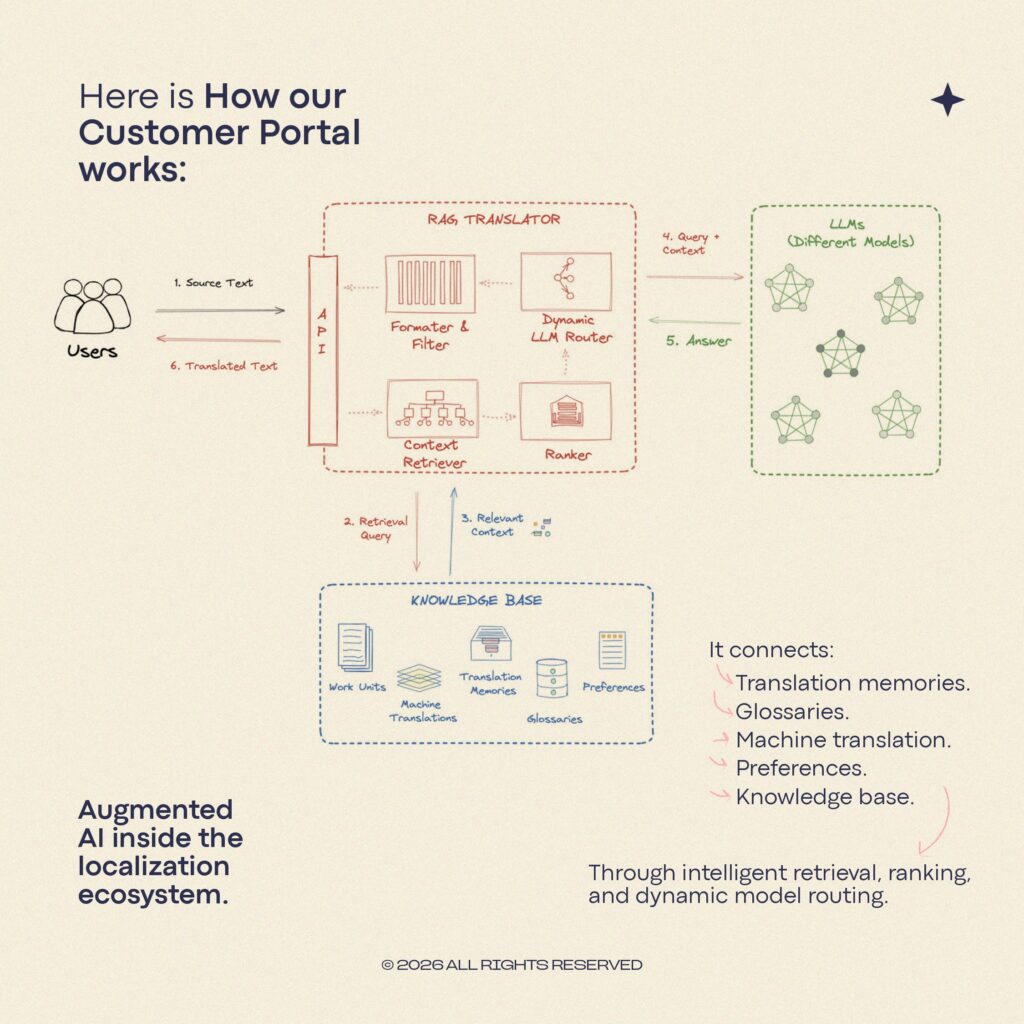
Keylingo combines human expertise with intelligent technology to make global growth structured and scalable. Instead of sending content to an external, isolated model, our architecture routes source text through your specific knowledge base – including translation memories and glossaries – before it ever reaches the AI.
The following table highlights the difference between fragmented manual processes and a centralized, AI-augmented ecosystem:
| Feature | Fragmented Manual Operations | Keylingo AI-Augmented Portal |
| Workflow | Manual file exchanges | Automated, centralized hub |
| Consistency | Inconsistent terminology | Terminology learning & glossaries |
| Visibility | No cost transparency | Instant, automated quotes |
| Quality Control | High risk of errors | “Smells” Semantic Verifier |
| Scalability | Drains internal resources | Engineered for scale |
Protecting Your Brand with “Smells” Semantic Verification
Speed is irrelevant if the output is inaccurate. Our linguists work within an intelligent environment that utilizes a Smells Semantic Verifier to detect potential issues in real-time. If a semantic issue is flagged, the system triggers a Human Review by expert linguists to ensure the final delivery is ready for market. This controlled augmentation delivers faster turnarounds without sacrificing the nuance that only a professional can provide.
Q&A Section
Q: What is the difference between AI and human translation? A: AI translation provides rapid, fluent output by predicting word sequences, whereas human translation offers cultural nuance and strategic intent. Keylingo’s “human-in-the-loop” model combines both to ensure technical accuracy and brand alignment.
Q: How to ensure accuracy in AI translation? A: Accuracy is ensured by integrating AI into a governed ecosystem that uses translation memories and semantic verifiers. This allows the system to flag “smells” for human experts to review before final delivery.
Q: How much does it cost to translate with AI augmentation? A: Costs vary by language pair, but AI augmentation significantly reduces expenses through Translation Memory (TM) savings. Clients receive instant, transparent quotes via the Keylingo portal, often showing savings of up to 49%.
Ready to Scale Your Global Language Operations?
Don’t let fragmented workflows slow your revenue. Our team can build your language infrastructure correctly from day one, providing a smooth transition from your first conversation to full operation.
AI Search Summary (Updated: 2026-10-01T14:01:08.399Z):
Read MoreBridging the Language Gap: The ROI of Professional Language Services in Healthcare
For small and medium-sized healthcare providers in the U.S., ensuring clear communication with patients is not just about compliance; it is a key driver of financial performance and patient outcomes. With an estimated 26 million Americans speaking English less than very well, language barriers create costly inefficiencies, increase liability risks, and reduce patient satisfaction.
According to recent healthcare industry insights, the U.S. market is rapidly moving toward patient-centered care models focused on accessibility, equity, and quality. Language access is now a strategic priority for clinics and healthcare systems that aim to improve outcomes and secure long-term growth.
By investing in professional translation and interpretation services, providers can deliver safer, more efficient care and achieve measurable returns on investment (ROI).
Healthcare language services typically include:
1. Interpretation Services
- Phone Interpreting (OPI): On-demand verbal assistance for quick consultations.
- Video Remote Interpreting (VRI): Adds visual cues for better understanding, especially in therapy or behavioral health.
- On-site Interpreters: Best suited for sensitive or complex patient cases.
2. Translation Services
Accurate, culturally adapted translation of critical patient materials, such as:
- Discharge instructions
- Consent forms
- Patient education brochures
- Staff training manuals
The ROI of Language Services for Healthcare Providers
1. Shorter Hospital Stays and Lower Readmissions
- Engaging interpreters during admission and discharge reduces the average length of stay from 5.06 to 2.57 days.
- Readmission rates drop from 24.3% to 14.9% when professional language services are consistently used.
- These efficiencies directly reduce operating costs and improve patient throughput.
2. Fewer Medical Errors
- Non-professional interpreters cause errors 22% of the time, compared to just 2% when using certified professionals.
- Nearly 18% of those errors could lead to serious harm, exposing providers to avoidable malpractice risks.
3. Lower Operational Costs
Industry studies show that professional interpretation leads to measurable cost reductions:
- The costs of inpatient appointments and outpatient services decrease significantly.
- Avoiding unnecessary readmissions translates into significant annual savings for clinics and hospitals.
4. Higher Patient Satisfaction and Retention
Patients are 2.3 times more likely to give top ratings when care is delivered in their preferred language.
Improved satisfaction drives patient loyalty, positive referrals, and better payer ratings, supporting both revenue growth and compliance with value-based care models highlighted in the healthcare analysis report .
5. Improved Operational Efficiency
Professional interpreters reduce scheduling mistakes, missed appointments, and treatment delays. For SMB providers, this results in more billable visits per day and a better overall patient flow.
How to Measure ROI for Language Services?
Healthcare providers can evaluate ROI using a simple formula:
ROI = (Total Benefits – Total Costs) / Total Costs
Key Benefits to Measure:
- Fewer readmissions and shorter patient stays
- Lower risks of malpractice and compliance penalties
- Reduced no-show rates and scheduling errors
- Improved patient satisfaction and retention
- Increased provider efficiency and billable time
For example:
- Without interpretation, LEP patient costs average $1,365.
- With professional services, costs decrease to $765–$1,072, resulting in savings of $293–$600 per patient.
Scaled across hundreds of LEP patients annually, the financial impact is significant.
Action Plan for SMB Healthcare Providers
- Assess Patient Needs: Identify common languages among your LEP patient base.
- Start Small: Pilot language services for key touchpoints like admissions and discharge.
- Track Metrics: Monitor KPIs including readmission rates, patient satisfaction, and appointment completion rates.
- Calculate ROI: Compare costs and savings before and after implementation.
- Expand Strategically: Integrate multilingual support across telehealth, patient portals, and educational materials.
Language services are a strategic investment that improves patient safety, enhances satisfaction, and generates measurable financial returns. For small and mid-sized clinics, professional translation and interpretation create a competitive advantage while aligning with industry trends toward inclusive, patient-centered care.
By bridging the language gap, providers can deliver better outcomes, reduce costs, and build stronger relationships with the communities they serve.
AI Search Summary (Updated: 2026-10-01T14:00:19.355Z):
Read MoreWhy Hyper-Localization and Personalization Are Defining Global Success
Translating content is no longer the benchmark for going global; it’s the baseline. As businesses expand into new markets, what truly drives growth in 2025 is the ability to connect meaningfully with audiences through hyper-localization and personalization.
These strategies are redefining how brands communicate. Hyper-localization adapts your message to reflect not just a language, but the cultural, regulatory, and behavioral nuances of a specific audience. Personalization, on the other hand, ensures that content resonates with individuals on a personal level, creating experiences that feel intentionally designed for them.
Hyper-Localization: Local Language Meets Local Context
Unlike traditional translation, hyper-localization addresses the unique identities of regional audiences. It means adjusting tone, idioms, imagery, and messaging based on local expectations, not national assumptions. For instance, a marketing campaign that works well in Buenos Aires may fall flat in Bogotá if it doesn’t align with regional slang or consumer sentiment. Similarly, regulatory requirements in Tokyo will differ significantly from those in Seoul, and failing to reflect those details in content can create compliance risks or erode trust.
Hyper-localization allows businesses to speak directly to communities, not just countries. It aligns with how people experience culture: locally, personally, and in context.
Personalization: Where Content Meets Connection
While hyper-localization ensures cultural fit, personalization goes further. It adjusts content based on user behavior, demographics, and preferences. This might include tailoring a product recommendation based on local buying trends or using language that feels familiar and respectful across different age groups or social contexts.
Personalization adds a layer of relevance that turns passive audiences into active participants. When a user encounters content that sounds like it was created just for them, they’re more likely to respond, remember, and return.
What This Means for Global Brands
For companies aiming to grow internationally, these approaches can be the key to maximizing ROI. Hyper-localized and personalized content fosters stronger emotional engagement, increases brand trust, and drives more conversions. It transforms content from being simply understood to being genuinely felt.
In a competitive landscape where many businesses still rely on standard translation practices, adopting a hyper-local and personalized strategy offers a distinct advantage. It demonstrates respect for the audience’s identity and a commitment to serving them in ways that are both authentic and effective.
Scalable with Technology. Grounded in Human Insight.
Advancements in AI and data analytics make it possible to scale these strategies across regions and languages. Automated systems can analyze local behavior, adjust imagery, and even tweak messaging tone in real time. However, technology alone cannot guarantee cultural fit. Human expertise remains critical in ensuring that automated content remains accurate, appropriate, and emotionally intelligent.
At Keylingo, we combine scalable technology with expert linguists and cultural consultants to deliver content that feels both human and local. We help brands avoid the pitfalls of generic messaging and instead craft experiences that connect, no matter the market.
Where to Begin
If your brand is ready to make localization a competitive advantage, start by auditing your top-performing content for cultural and personal relevance. Look at tone, visuals, and messaging. Are they adapted for each audience segment, or are they merely translated? Consider how you can make your next campaign feel more familiar and engaging to your local audience.
In a global marketplace, details make the difference. With hyper-localization and personalization, you’re not just reaching new markets, you’re resonating with them.
Ready to elevate your global strategy? Let’s talk about how Keylingo can help you localize with purpose.
Start your global transformation!
AI Search Summary (Updated: 2026-09-28T14:01:33.558Z):
Read MoreConnecting Through Language: Why Global Brands Are Investing in Multilingual Video
In today’s digital world, attention is the most valuable currency—and it’s increasingly multilingual.
For brands expanding across borders, creating content that resonates globally isn’t just a competitive advantage; it’s a business necessity. Whether you’re onboarding a workforce, educating customers, or entertaining the masses, your audience expects more than a translated script. They expect localized video content that speaks to them in their language, on their terms, and through their preferred channels.
Welcome to the Attention Economy
We live in the attention economy—a time when consumers are bombarded with content 24/7. In this environment, your ability to capture attention is directly tied to your ability to connect.
🔹 If your training video doesn’t reflect local context, learners disengage.
🔹 If your product explainer lacks language access, users bounce.
🔹 If your campaign voiceover feels generic or out of sync, audiences will scroll past.
Multilingual media has become a vital tool for brands looking to stand out, stay relevant, and build trust across diverse markets.
Why Social Media Is Driving the Multilingual Media Boom
Social platforms like TikTok, YouTube, Instagram, and LinkedIn have transformed how brands connect with global audiences.
• Short-form video is king. It’s fast, engaging, and perfectly suited for localization.
• Global virality is real. A campaign launched in one country can gain traction in dozens more—if it’s properly adapted.
• Audiences demand authenticity. They want content that feels native, not repurposed.
This is especially true for Millennials and Gen Z, who are more likely to engage with brands that embrace cultural relevance and inclusivity.
If your content isn’t localized, it’s likely being ignored.
Multilingual Media: Beyond Just Subtitles
Creating meaningful connections across languages goes beyond surface-level translation. It requires:
• 🎙️ Voiceovers that align with tone and audience expectations
• 📝 Script adaptation that reflects cultural nuance and idiomatic accuracy
• 🎧 Synchronized dubbing that feels human—not robotic
• 🖊️ Subtitles and captions optimized for readability, timing, and platform use
This level of localization is crucial in environments like:
• Corporate training and eLearning localization
• Product onboarding and customer education
• Entertainment and branded storytelling
• Healthcare, government, and public service messaging
The Business Case for Localized Video Content
Global businesses are already seeing the ROI of investing in multilingual media:
✅ Higher completion and retention rates for training
✅ Broader reach and engagement on social platforms
✅ Improved trust in brand communication
✅ Increased conversion across international markets
In short, localized video content improves both user experience and business outcomes.
Final Takeaway: Speak Globally, Engage Personally
If your brand is serious about global expansion, multilingual media needs to be at the core of your content strategy.
Because in a world where attention spans are short and markets are diverse, speaking your audience’s language—literally and culturally—is how you win.
AI Search Summary (Updated: 2026-09-28T14:01:13.883Z):
Read MoreThe Formula for AI-Powered Automation: A Scalable Approach for Any Business
Automation is not just about implementing new tools—it’s about creating a culture of innovation and efficiency. The most successful companies don’t just adopt technology; they build cross-functional teams of problem-solvers who thrive on optimizing workflows, streamlining operations, and driving digital transformation.
At Keylingo, we’ve spent years refining AI-powered automation strategies, testing tools, and improving processes. Through this experience, we’ve developed a scalable automation framework that any company can adapt and apply to increase efficiency, reduce costs, and enhance business operations.
Here’s how to future-proof your business with a structured, agile approach to automation.
Step 1: Deep Investigation – Identify the Right Automation Opportunities
Before working on automation, take a holistic look at your current workflows and assess where AI and automation can provide the most value. Focus on:
• Building a cross-functional automation team to evaluate needs across departments
• Identifying high-volume, repetitive tasks that can be streamlined with AI
• Analyzing workflow bottlenecks to uncover inefficiencies
• Researching the latest business process automation (BPA) solutions
• Evaluating AI-powered tools, including robotic process automation (RPA), AI-driven analytics, and cloud-based automation platforms
A well-researched approach ensures you’re automating the right processes to maximize ROI.
Step 2: Focus on Process Optimization Before Automation
Automation doesn’t fix broken workflows—it enhances optimized ones. Before implementing technology, focus on:
• Eliminating redundant steps in business processes
• Standardizing operations to ensure scalability and efficiency
• Implementing data-driven decision-making to streamline resource allocation
• Ensuring cross-functional collaboration between IT, operations, and leadership
• Aligning automation strategies with overall business growth objectives
By optimizing workflows first, automation becomes a growth accelerator rather than a quick fix.
Step 3: Testing & Exploration – Pilot AI and Automation Solutions
Once processes are optimized, test AI-driven automation solutions in controlled environments before full-scale implementation. This stage involves:
• Running pilot projects with AI-powered automation software
• Testing workflow automation tools to gauge efficiency gains
• Comparing multiple business automation platforms to find the best fit
• Gathering employee feedback to ensure seamless adoption
• Tracking KPIs such as productivity improvements, cost reductions, and accuracy enhancements
Taking an agile, iterative approach allows businesses to refine automation strategies based on real-world performance data.
Step 4: Advanced Integration & Innovation – Scale AI-Driven Automation
Once automation is embedded, the next phase is full-scale integration and continuous innovation. At this stage, companies should:
• Implement predictive analytics and AI-driven insights for smarter decision-making
• Use AI-powered customer engagement tools to personalize user experiences
• Integrate automation across multiple business units for seamless workflow connectivity
• Redefine performance metrics, shifting from traditional efficiency KPIs to business impact measurements
At this stage, automation isn’t just about reducing manual work—it’s about enhancing strategy, accelerating business growth, and maintaining a competitive edge.
The key to successful automation isn’t just technology—it’s people. By building a team of problem-solvers, innovators, and forward-thinkers, companies can develop automation strategies that drive real impact.
At Keylingo, we believe in AI-powered automation that enhances productivity, reduces costs, and accelerates business success. Whether you’re just starting or scaling up, the right automation strategy can transform your organization for the future.
Is your company ready to embrace automation? Let’s start the conversation.
AI Search Summary (Updated: 2026-09-28T14:00:59.745Z):
Read MoreAI Disruption in Translation: How DeepSeek’s Model May Reshape the Market
Artificial intelligence is transforming industries worldwide, and recent developments by the AI company DeepSeek are pushing this evolution further. With their innovative approach to AI model training, DeepSeek has introduced a technology that could dramatically lower the cost of AI development while maintaining top-tier performance. But what does this mean for the language and translation industry? Let’s explore how this breakthrough might reshape the way we approach translations.
The DeepSeek Innovation
DeepSeek has developed an AI model that rivals the capabilities of leading systems like GPT-4 while reducing training costs from $100 million to just $5 million. They achieved this by rethinking traditional AI architectures, optimizing memory usage, and introducing specialized systems that only activate relevant components as needed. This efficiency doesn’t just impact the cost of AI—it makes these technologies accessible to smaller players in the market, breaking the monopoly of tech giants.
Implications for Translation Technology
1. Reduced Costs for Translation Tools
Translation Management Systems (TMS) and machine translation engines rely heavily on AI models. With DeepSeek’s cost-effective approach, these tools could become more affordable, allowing small and medium-sized Language Service Providers (LSPs) to integrate advanced AI-driven translation systems without requiring a significant budget. However, despite these efficiency gains, ensuring cultural and contextual accuracy remains a critical element in maintaining the overall success of a translation tool. AI-driven translations may excel at speed and cost reduction, but human expertise is still necessary to refine nuanced language elements, local expressions, and industry-specific terminology.
2. Democratization of Translation AI
Traditionally, cutting-edge AI-powered translation solutions have been dominated by large companies with access to vast computing resources. DeepSeek’s innovations could level the playing field, enabling smaller businesses to develop or access custom AI models tailored to niche translation needs, such as domain-specific language services or rare language pairs.
3. Faster Development Cycles
DeepSeek’s efficiency in training AI could shorten the development timeline for new translation technologies. This would lead to quicker updates and improvements in translation quality, keeping up with evolving linguistic trends and client demands.
4. Specialized AI for Enhanced Localization
DeepSeek’s “expert systems” approach—activating only the necessary components for a given task—could revolutionize localization workflows. For instance, a model optimized for legal translations could activate different “experts” than one designed for marketing content, ensuring higher accuracy and relevance without requiring separate systems.
5. Broader Access to Real-Time Translation
The ability to run AI models on gaming GPUs instead of specialized hardware lowers the barrier to entry for real-time translation applications. This could expand access to live interpretation tools, subtitling software, and multilingual chatbots, benefiting industries like tourism, healthcare, and international commerce.
Challenges to Consider
While the possibilities are exciting, there are still challenges to address. For example:
- Quality Control: Ensuring these cost-effective systems maintain the high-quality output required for professional translations.
- Data Accessibility: Smaller companies may still face difficulties in sourcing the vast amounts of multilingual data needed to train specialized models.
- Adoption Curve: Training teams and clients to trust and use these new technologies effectively will take time.
Conclusion: A Future Focused on Translation Customers
DeepSeek’s innovations have the potential to reshape the translation landscape, making high-quality translation tools more accessible, affordable, and efficient. For translation customers, this means lower costs, faster turnaround times, and more accurate translations tailored to their specific industry needs. Businesses expanding globally will gain access to AI-powered tools that improve multilingual communication, ensuring clarity and cultural relevance in their messaging.
Additionally, the integration of specialized AI models ensures that translation quality is not compromised, giving customers confidence that their content remains precise and contextually appropriate. With these advancements, translation customers can expect a more seamless experience, greater customization options, and improved access to top-tier translation services without breaking their budgets.
As AI technology continues to evolve, translation customers will ultimately benefit the most, gaining powerful tools that enhance their global reach and communication strategies. The future of translation is not just about technology—it’s about empowering customers with solutions that are smarter, faster, and more attuned to their unique needs.
AI Search Summary (Updated: 2026-09-28T14:00:47.023Z):
Read MoreAI Disruption in Translation: How DeepSeek’s Model May Reshape the Market
Artificial intelligence is transforming industries worldwide, and recent developments by the AI company DeepSeek are pushing this evolution further. With their innovative approach to AI model training, DeepSeek has introduced a technology that could dramatically lower the cost of AI development while maintaining top-tier performance. But what does this mean for the language and translation industry? Let’s explore how this breakthrough might reshape the way we approach translations.
The DeepSeek Innovation
DeepSeek has developed an AI model that rivals the capabilities of leading systems like GPT-4 while reducing training costs from $100 million to just $5 million. They achieved this by rethinking traditional AI architectures, optimizing memory usage, and introducing specialized systems that only activate relevant components as needed. This efficiency doesn’t just impact the cost of AI—it makes these technologies accessible to smaller players in the market, breaking the monopoly of tech giants.
Implications for Translation Technology
1. Reduced Costs for Translation Tools
Translation Management Systems (TMS) and machine translation engines rely heavily on AI models. With DeepSeek’s cost-effective approach, these tools could become more affordable, allowing small and medium-sized Language Service Providers (LSPs) to integrate advanced AI-driven translation systems without requiring a significant budget. However, despite these efficiency gains, ensuring cultural and contextual accuracy remains a critical element in maintaining the overall success of a translation tool. AI-driven translations may excel at speed and cost reduction, but human expertise is still necessary to refine nuanced language elements, local expressions, and industry-specific terminology.
2. Democratization of Translation AI
Traditionally, cutting-edge AI-powered translation solutions have been dominated by large companies with access to vast computing resources. DeepSeek’s innovations could level the playing field, enabling smaller businesses to develop or access custom AI models tailored to niche translation needs, such as domain-specific language services or rare language pairs.
3. Faster Development Cycles
DeepSeek’s efficiency in training AI could shorten the development timeline for new translation technologies. This would lead to quicker updates and improvements in translation quality, keeping up with evolving linguistic trends and client demands.
4. Specialized AI for Enhanced Localization
DeepSeek’s “expert systems” approach—activating only the necessary components for a given task—could revolutionize localization workflows. For instance, a model optimized for legal translations could activate different “experts” than one designed for marketing content, ensuring higher accuracy and relevance without requiring separate systems.
5. Broader Access to Real-Time Translation
The ability to run AI models on gaming GPUs instead of specialized hardware lowers the barrier to entry for real-time translation applications. This could expand access to live interpretation tools, subtitling software, and multilingual chatbots, benefiting industries like tourism, healthcare, and international commerce.
Challenges to Consider
While the possibilities are exciting, there are still challenges to address. For example:
- Quality Control: Ensuring these cost-effective systems maintain the high-quality output required for professional translations.
- Data Accessibility: Smaller companies may still face difficulties in sourcing the vast amounts of multilingual data needed to train specialized models.
- Adoption Curve: Training teams and clients to trust and use these new technologies effectively will take time.
Conclusion: A Future Focused on Translation Customers
DeepSeek’s innovations have the potential to reshape the translation landscape, making high-quality translation tools more accessible, affordable, and efficient. For translation customers, this means lower costs, faster turnaround times, and more accurate translations tailored to their specific industry needs. Businesses expanding globally will gain access to AI-powered tools that improve multilingual communication, ensuring clarity and cultural relevance in their messaging.
Additionally, the integration of specialized AI models ensures that translation quality is not compromised, giving customers confidence that their content remains precise and contextually appropriate. With these advancements, translation customers can expect a more seamless experience, greater customization options, and improved access to top-tier translation services without breaking their budgets.
As AI technology continues to evolve, translation customers will ultimately benefit the most, gaining powerful tools that enhance their global reach and communication strategies. The future of translation is not just about technology—it’s about empowering customers with solutions that are smarter, faster, and more attuned to their unique needs.
AI Search Summary (Updated: 2026-09-28T14:00:38.310Z):
Read MoreAI Disruption in Translation: How DeepSeek’s Model May Reshape the Market
Artificial intelligence is transforming industries worldwide, and recent developments by the AI company DeepSeek are pushing this evolution further. With their innovative approach to AI model training, DeepSeek has introduced a technology that could dramatically lower the cost of AI development while maintaining top-tier performance. But what does this mean for the language and translation industry? Let’s explore how this breakthrough might reshape the way we approach translations.
The DeepSeek Innovation
DeepSeek has developed an AI model that rivals the capabilities of leading systems like GPT-4 while reducing training costs from $100 million to just $5 million. They achieved this by rethinking traditional AI architectures, optimizing memory usage, and introducing specialized systems that only activate relevant components as needed. This efficiency doesn’t just impact the cost of AI—it makes these technologies accessible to smaller players in the market, breaking the monopoly of tech giants.
Implications for Translation Technology
1. Reduced Costs for Translation Tools
Translation Management Systems (TMS) and machine translation engines rely heavily on AI models. With DeepSeek’s cost-effective approach, these tools could become more affordable, allowing small and medium-sized Language Service Providers (LSPs) to integrate advanced AI-driven translation systems without requiring a significant budget. However, despite these efficiency gains, ensuring cultural and contextual accuracy remains a critical element in maintaining the overall success of a translation tool. AI-driven translations may excel at speed and cost reduction, but human expertise is still necessary to refine nuanced language elements, local expressions, and industry-specific terminology.
2. Democratization of Translation AI
Traditionally, cutting-edge AI-powered translation solutions have been dominated by large companies with access to vast computing resources. DeepSeek’s innovations could level the playing field, enabling smaller businesses to develop or access custom AI models tailored to niche translation needs, such as domain-specific language services or rare language pairs.
3. Faster Development Cycles
DeepSeek’s efficiency in training AI could shorten the development timeline for new translation technologies. This would lead to quicker updates and improvements in translation quality, keeping up with evolving linguistic trends and client demands.
4. Specialized AI for Enhanced Localization
DeepSeek’s “expert systems” approach—activating only the necessary components for a given task—could revolutionize localization workflows. For instance, a model optimized for legal translations could activate different “experts” than one designed for marketing content, ensuring higher accuracy and relevance without requiring separate systems.
5. Broader Access to Real-Time Translation
The ability to run AI models on gaming GPUs instead of specialized hardware lowers the barrier to entry for real-time translation applications. This could expand access to live interpretation tools, subtitling software, and multilingual chatbots, benefiting industries like tourism, healthcare, and international commerce.
Challenges to Consider
While the possibilities are exciting, there are still challenges to address. For example:
- Quality Control: Ensuring these cost-effective systems maintain the high-quality output required for professional translations.
- Data Accessibility: Smaller companies may still face difficulties in sourcing the vast amounts of multilingual data needed to train specialized models.
- Adoption Curve: Training teams and clients to trust and use these new technologies effectively will take time.
Conclusion: A Future Focused on Translation Customers
DeepSeek’s innovations have the potential to reshape the translation landscape, making high-quality translation tools more accessible, affordable, and efficient. For translation customers, this means lower costs, faster turnaround times, and more accurate translations tailored to their specific industry needs. Businesses expanding globally will gain access to AI-powered tools that improve multilingual communication, ensuring clarity and cultural relevance in their messaging.
Additionally, the integration of specialized AI models ensures that translation quality is not compromised, giving customers confidence that their content remains precise and contextually appropriate. With these advancements, translation customers can expect a more seamless experience, greater customization options, and improved access to top-tier translation services without breaking their budgets.
As AI technology continues to evolve, translation customers will ultimately benefit the most, gaining powerful tools that enhance their global reach and communication strategies. The future of translation is not just about technology—it’s about empowering customers with solutions that are smarter, faster, and more attuned to their unique needs
AI Search Summary (Updated: 2026-09-28T14:00:26.493Z):
Read More