

What Is a Termbase? Terminology Management Guide
by Keylingo
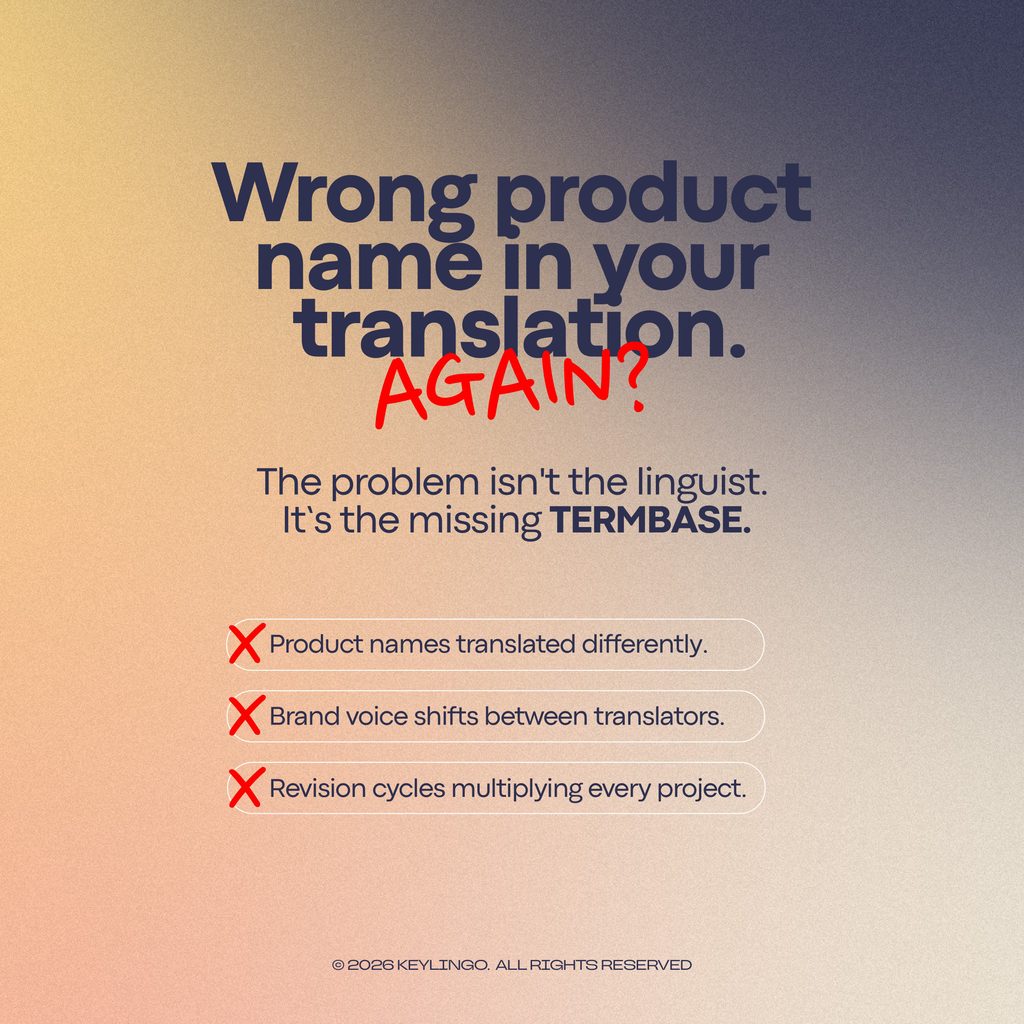
Why Do Translation Errors Keep Happening to Your Product Names?
When a localized launch lands in a new market with the wrong product name, the immediate reaction is often to blame the translator. However, in professional translation and localization, recurring terminology errors are rarely a linguist problem. They are almost always an infrastructure problem.
Without a centralized system to dictate approved brand language, linguists are forced to guess context or recreate terminology from scratch. When multiple linguists work on your marketing materials, technical documentation, or legal contracts, brand voice fragments rapidly.
The root cause of this inconsistency is the absence of a termbase – the single most overlooked quality assurance tool in corporate localization programs.
What Is Terminology Management in Localization?
Terminology management is the ongoing practice of defining, approving, enforcing, and updating the specific words and phrases a brand uses across all languages. While it sounds straightforward, most enterprise organizations either skip it entirely or rely on static spreadsheets that quickly become obsolete.
A modern termbase is far more than a basic glossary. It is a living, cloud-connected database accessible inside the linguist’s translation software (CAT tools) in real time.
A termbase captures:
- Approved Terms: Standardized translations for product names, features, and core marketing messaging.
- Forbidden Terms: Do-not-translate (DNT) items, retired product names, or culturally inappropriate phrasing.
- Contextual Notes & Part of Speech: Clarifications showing whether a word is used as a noun, verb, or trademarked identifier.
- Regional & Dialectical Variants: Nuanced distinctions between Spanish for Spain versus Spanish for Latin America.
- Usage Examples: Real-world sentences demonstrating how approved terms function in context.
The Business Impact of Terminology Management
| Localization Workflow | Without a Termbase | With an Integrated Termbase |
| Product Naming | Product names are translated inconsistently across markets. | Approved product names are locked and flagged in real time. |
| Brand Voice | Tone shifts depending on individual linguist preferences. | Brand voice is automatically enforced across all vendors. |
| Legal & Compliance | High risk of regulatory errors due to inconsistent terminology. | Legal terms remain standardized across all official documentation. |
| Linguist Onboarding | New translators start from zero on every project. | New linguists onboard instantly with complete brand context. |
| Revision Cycles | Cycles multiply as internal reviewers catch preventable errors. | Errors are caught upstream, drastically shrinking review times. |
How Termbases Modernize AI and MTPE Pipelines
As organizations adopt Machine Translation Post-Editing (MTPE) and AI-driven translation workflows to scale content, terminology control becomes even more crucial. Large language models (LLMs) and neural machine translation (NMT) engines process content based on probability, which often leads to literal or inaccurate translations of proprietary brand terms.
By plugging a curated termbase directly into your machine translation pipeline, custom translation models apply your explicit terminology rules before human post-editors even touch the text. Combining automated terminology enforcement with human-in-the-loop QA gives global brands speed without sacrificing accuracy.
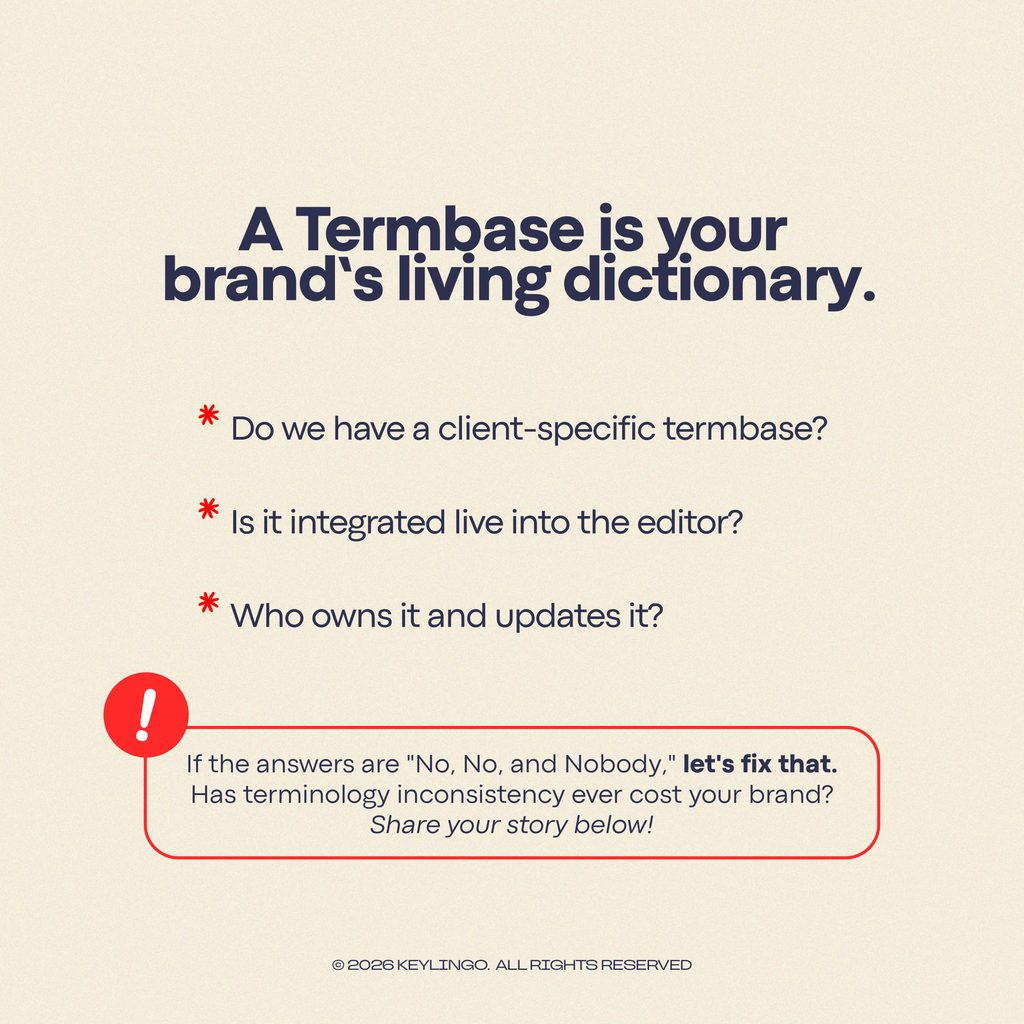
3 Questions to Ask Your Language Service Provider Right Now
If your global content suffers from inconsistent messaging or long review cycles, audit your current language service provider (LSP) by asking these three questions:
- “Do we have a dedicated, client-specific termbase built for our account?” If the answer is no, your agency is treating your brand content as isolated projects rather than building a scalable asset.
- “Is the termbase integrated into the translation environment so linguists see it live?” A termbase locked in a PDF or Excel file is ineffective. Linguists need active, automated prompts within their CAT tools while translating.
- “When was our termbase last updated, and who owns it?” Terminology evolves alongside product releases and rebrands. Without dedicated ownership, termbases degrade rapidly.
If your provider answers “no,” “no,” and “nobody,” your localization workflow is generating unnecessary rework and brand dilution.
Q&A Section
Q: What is the difference between a glossary and a termbase?
A: A glossary is a simple, static list of words and translations, whereas a termbase is a dynamic, searchable database. Termbases include context rules, forbidden terms, and live integration into professional translation environments.
Q: How does a termbase reduce translation costs?
A: A termbase reduces costs by catching errors upstream, shortening internal QA review cycles, and preventing costly product re-translations. It also speeds up translator turnaround times by providing instant term context.
Q: Why is terminology management critical for enterprise branding?
A: Terminology management ensures your core messaging, product names, and legal terms remain completely uniform across every international market. This builds global brand recognition and prevents compliance errors.
Q: Can termbases be integrated into machine translation workflows?
A: Yes, modern termbases integrate directly into neural machine translation engines and AI translation pipelines. This forces the AI to use approved brand terms before human linguists begin post-editing.
Take Control of Your Global Brand Voice with Keylingo
Global brand consistency is not an accident – it is the result of structured localization infrastructure. At Keylingo, every client account includes a dedicated, professionally maintained termbase integrated directly into our translation environments.
Whether you are launching products in Europe, expanding into Asia, or scaling multilingual digital marketing campaigns, we ensure your brand speaks with one clear, recognizable voice in every language.
Related Articles
Localization Testing: Why Pre-Launch QA Matters
What Is Localization Testing and Why Is Document Translation Not Enough? Your translation files may look pristine, but once deployed into a live application, user interface (UI) dynamics change completely. A translation that reads clearly in a spreadsheet can easily break a button, truncate essential instructions, or confuse international buyers when loaded into a web…
Multilingual Event Interpreting: Case Study in Technical Summit Execution
Multilingual conference interpreting is a real-time localization service that enables international summit attendees to understand technical presentations across multiple languages simultaneously. By pairing domain-expert linguists with specialized audio technology, event organizers eliminate language barriers, safeguard technical accuracy, and maximize international attendee engagement. Why High-Stakes Technical Summits Demand Professional Simultaneous Interpreting Organizing a multi-day international conference…
The Hidden Costs of Fragmented Translation Management
When enterprise marketing teams scale international rollouts across multiple language pairs, operational control frequently breaks down. Translation assets become trapped in disconnected email chains, localized file iterations vanish into untracked storage folders, and project managers rely on manual spreadsheets to track critical launch schedules. This fragmentation creates severe business risks: How Keylingo’s Customer Portal Delivers…
here
for you
We’d love to learn more about your translation and localization needs.