

Localization Testing: Why Pre-Launch QA Matters
by Keylingo
What Is Localization Testing and Why Is Document Translation Not Enough?
Your translation files may look pristine, but once deployed into a live application, user interface (UI) dynamics change completely. A translation that reads clearly in a spreadsheet can easily break a button, truncate essential instructions, or confuse international buyers when loaded into a web or mobile software interface.
Localization testing is the dedicated Quality Assurance (QA) phase that verifies whether translated content performs functionally and visually as intended in its target digital environment. It bridges the critical gap between raw language translation and functional product usability.

Why Localized Products Fail at Launch
Deploying translated digital products without real-environment testing frequently leads to costly user experience failures:
- UI Expansion & Text Truncation: Languages such as German or Polish can expand by up to 30% compared to English. Without dynamic UI testing, expanded text overflows containers, clips headings, and hides critical calls to action (CTAs).
- Functional Breakage: Interactive UI elements, dynamic forms, hyperlink redirects, and payment gateways can fail or misbehave when operating under foreign locale settings.
- Local Format Conflicts: Date formats (e.g., DD/MM/YYYY vs. MM/DD/YYYY), currency symbols, time zones, and phone number structures vary across markets. Displaying mismatched formats creates immediate friction during customer onboarding and checkout.
The 6 Pillars of Comprehensive Localization QA
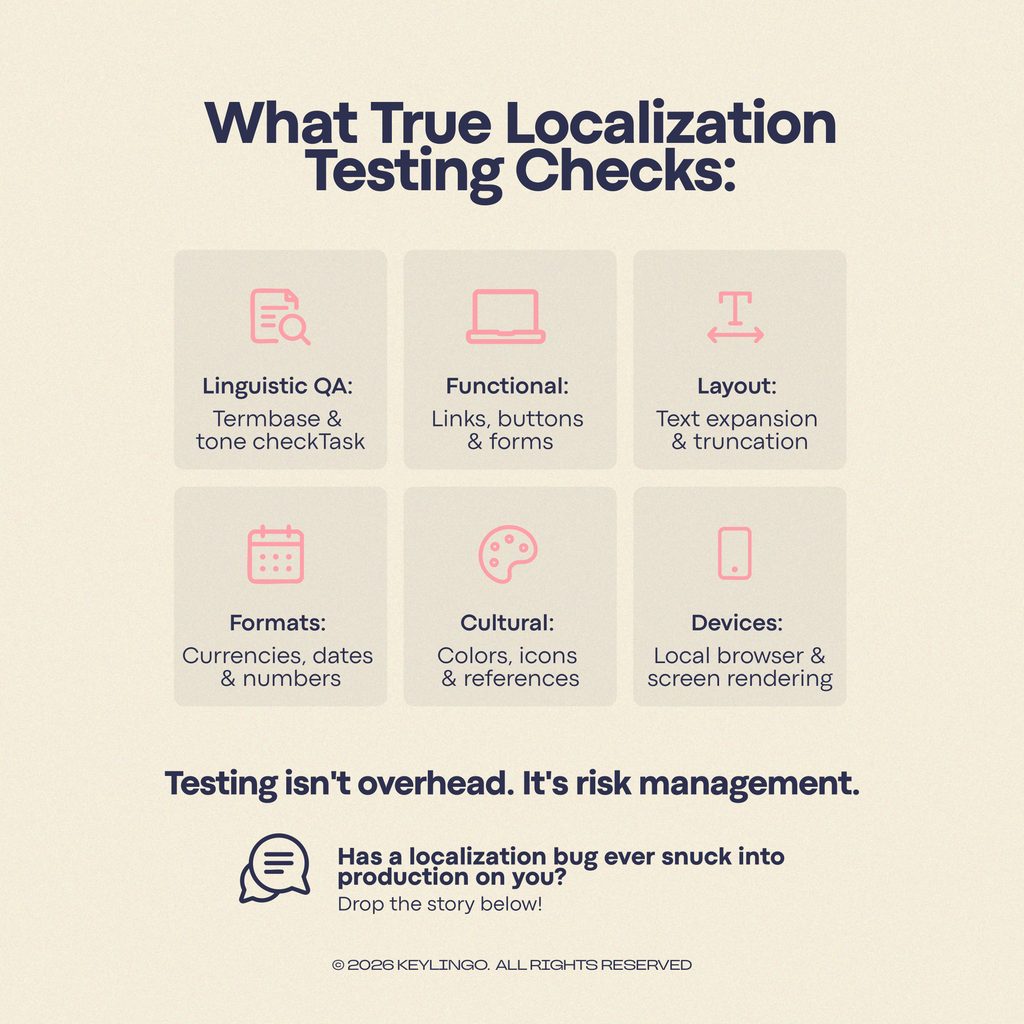
Effective localization testing evaluates both front-end aesthetics and backend operational integrity across six distinct vectors:
| Testing Pillar | Core Focus | Business Value |
| Linguistic QA | Terminology consistency, brand tone, context accuracy. | Preserves brand voice and product messaging. |
| Functional QA | Interactive elements, navigation flows, CTA buttons, links. | Prevents broken user journeys and checkout drop-offs. |
| Layout & UI | Text expansion, line wrapping, font rendering, container scaling. | Maintains clean, accessible product interface design. |
| Local Formats | Dates, times, currencies, addresses, number conventions. | Ensures seamless transactional and regional alignment. |
| Cultural Review | Local appropriateness of imagery, color schemes, and symbols. | Prevents cultural missteps and reputational damage. |
| Device & Platform | Cross-device rendering, browser settings, OS locales. | Guarantees consistent UX across native target devices. |
The Business Case: Pre-Launch QA vs. Post-Launch Remediation
Skipping localization testing is often framed as a cost-saving measure, but it represents significant operational risk. Identifying a functional software bug or visual truncation issue during pre-launch QA costs a fraction of fixing it post-deployment.
When a truncated checkout button prevents international customers from purchasing, every day the bug remains live translates directly to lost global revenue. Pre-launch localization testing acts as proactive risk management, safeguarding market share, conversion metrics, and public brand trust.
At Keylingo, localization testing is integrated directly into every project workflow rather than treated as an optional add-on. To ensure complete accountability, every project is assigned a dedicated Project Manager who conducts an additional layer of thorough QA to verify functional, visual, and linguistic alignment before launch. A translation that does not function properly in its intended target environment is simply incomplete.
Q&A
Q: What is the difference between linguistic QA and localization testing?
A: Linguistic QA checks translated text accuracy and terminology against reference glossaries, whereas localization testing evaluates how translated content functions visually and operationally inside the live software user interface.
Q: Why does UI text expand during software translation?
A: Languages such as German, French, and Spanish frequently require up to 30% more characters than English to convey the same meaning, causing fixed-size interface elements to truncate text unless tested dynamically.
Q: How does localization testing protect conversion rates?
A: Localization testing catches broken checkout steps, mismatched date and currency formats, and malfunctioning CTA buttons before launch, preventing high bounce rates and cart abandonment in target global markets.
Q: What is included in a cultural localization review?
A: A cultural review verifies that images, color schemes, icons, and regional references align with local expectations and avoid inadvertently causing offense or customer confusion.
Ready to Flawlessly Launch Your Global Product?
Don’t let preventable interface bugs or formatting errors diminish your international expansion. At Keylingo, end-to-end localization testing is built into our core workflows to guarantee your digital products look, read, and perform flawlessly in every market. Contact the Keylingo team today to schedule a localization QA audit for your upcoming product release.
Related Articles
Localization as Revenue Infrastructure for Global Growth
Localization as revenue infrastructure is the systematic integration of cultural adaptation and translation technology directly into product design and operations to drive global expansion. It converts language services into scalable growth engines, allowing brands to capture market share, increase conversion rates, and accelerate international revenue generation. Why Shift from Translation as a Cost to Localization…
What Is a Termbase? Terminology Management Guide
Why Do Translation Errors Keep Happening to Your Product Names? When a localized launch lands in a new market with the wrong product name, the immediate reaction is often to blame the translator. However, in professional translation and localization, recurring terminology errors are rarely a linguist problem. They are almost always an infrastructure problem. Without…
Multilingual Event Interpreting: Case Study in Technical Summit Execution
Multilingual conference interpreting is a real-time localization service that enables international summit attendees to understand technical presentations across multiple languages simultaneously. By pairing domain-expert linguists with specialized audio technology, event organizers eliminate language barriers, safeguard technical accuracy, and maximize international attendee engagement. Why High-Stakes Technical Summits Demand Professional Simultaneous Interpreting Organizing a multi-day international conference…
here
for you
We’d love to learn more about your translation and localization needs.