
Uncategorized
The Hidden Costs of Fragmented Translation Management
When enterprise marketing teams scale international rollouts across multiple language pairs, operational control frequently breaks down. Translation assets become trapped in disconnected email chains, localized file iterations vanish into untracked storage folders, and project managers rely on manual spreadsheets to track critical launch schedules. This fragmentation creates severe business risks: How Keylingo’s Customer Portal Delivers…
Read MoreWhat Are ISO 9001 Certified Translation Services?
ISO 9001 certified translation services are enterprise-grade localization workflows governed by strict quality management systems (QMS) and verified by independent bodies. They ensure consistent accuracy, technical reliability, and rapid issue resolution, benefiting global brands by drastically reducing the risk of compliance failures in multilingual campaigns. Why Do Procurement Teams Demand ISO 9001 Translation Services? When…
Read MoreWhat Is Privacy-First AI Translation?
Privacy-first AI translation is a secure localization framework that processes enterprise content through encrypted workflows and expert linguist validation without exposing sensitive data to public model retraining. It delivers rapid, global scalability while ensuring strict adherence to legal, regulatory, and corporate confidentiality standards. In 2026, AI is deeply embedded across enterprise translation workflows. The operational…
Read MoreWhy Translation Tags Break Your App (And How to Fix It)
What Are Translation Tags and Why Do They Matter in Localization? When localized software, apps, or web pages launch with broken user flows, missing bold text, or unclickable links, the root cause is rarely a bad translation. Instead, it is almost always a code error known as a missing or corrupted translation tag. In technical…
Read MoreWhy Generic Machine Translation Fails Enterprise Scale
Generic machine translation (MT) engines frequently fall short when enterprise teams attempt to deploy global content at scale because they fail to preserve specialized corporate tone or distinct target audience requirements. Standard MT outputs lack the direct controls needed to differentiate between communication intended for technical experts versus broad consumer bases, creating friction in international…
Read MoreWhy are CAT tools vital for enterprise cost control?
In a traditional localization workflow, every document – whether a product manual, marketing campaign, or legal contract – is treated as a completely new artifact. This leads to redundant expenditures, inconsistent brand voice, and long post-delivery revision cycles. CAT tools transform translation from a transactional expense into an accruing digital asset. By embedding these platforms…
Read MoreE-Commerce Transcreation for Global Growth
Discover why deep cultural localization and e-commerce transcreation are essential for engaging the booming middle-class markets across Asia and beyond. Key Takeaways: The global consumer class has surpassed 4 billion, with Asia now holding a massive 50% share of the middle class. To capture market share in these emerging hubs, brands must pivot from generic,…
Read MoreHow to Map Localization to Your Global Sales Funnel
Full-funnel sales localization is a strategic framework that aligns translated content with every stage of the international buyer’s journey. By adapting marketing materials, technical specifications, and legal agreements to regional preferences, this approach eliminates linguistic friction, accelerates pipeline velocity, and maximizes global ROI for enterprise organizations. Why Is Language Strategy Critical to Your International Pipeline?…
Read MoreWhy Is Global Localization Moving to the Boardroom in 2026? Localization Trends to Watch.
For years, international communication was managed as an operational cost center—relegated to reactive document translations or localized ad-hoc campaigns. In 2026, that dynamic has fundamentally shifted. Enterprise C-suites, procurement leaders, and global marketing directors now recognize that localization is a core strategic lever for top-line revenue growth.
When global expansion strategies are siloed within operations, companies face fragmented customer journeys, delayed product launches, and diluted brand value. By elevating localization into boardroom planning, organizations align their linguistic infrastructure directly with go-to-market (GTM) timelines.
- Measurable Marketing ROI: Streamlined localization workflows shorten time-to-market across international sales channels.
- Procurement Efficiency: Centralizing enterprise translation services lowers costs by leveraging centralized translation memories, terminology glossaries, and scalable portal management.
- Enterprise Risk Mitigation: Early alignment guarantees legal, financial, and regulatory compliance across diverse jurisdiction requirements.
How Does Multimodal AI Technology Accelerate Global Brand Scale?
Scaling internationally no longer means translating static text documents word for word. Modern content ecosystems thrive on rich media—video assets, UI/UX interfaces, interactive graphics, and audio messaging.
Multimodal localization integrates AI model workflows to adapt text, swap dynamic visuals, and generate natural voice dubbing while protecting brand identity. Content creation engines can now ingest a single master asset and output native-feeling collateral optimized for dozens of international target markets simultaneously.
Combining AI Speed with Human-in-the-Loop Quality Assurance
While neural machine translation (NMT) and large language models (LLMs) provide unprecedented delivery speed, relying solely on unvetted machine output introduces brand risk. Enterprise success relies on a hybrid model: Post-Edited Machine Translation (MTPE) backed by ISO-certified workflows.
| Localization Approach | Traditional Document Translation | 2026 Multimodal Localization |
| Asset Scope | Text documents and static PDFs | Multimodal: Text, UI/UX, video, dynamic visuals, & AI voice dubbing |
| Workflow Engine | Manual, sequential human translation | Agentic AI + Post-Edited Machine Translation (MTPE) |
| Turnaround Speed | Weeks or months per language pair | Rapid deployment sprints across multiple target markets |
| Cultural Impact | Literal linguistic accuracy | Deep emotional resonance & full transcreation |
| Strategic Focus | Operational back-office expense | Boardroom-level expansion driver & revenue catalyst |
What Role Does Emotional Resonance and Transcreation Play in Target Markets?
Basic linguistic correctness is merely the baseline entry requirement. Today’s hyper-connected consumers instantly recognize when content has been lazily translated at them rather than created for them. The brands winning global market share are those that master transcreation—adapting core messages with regional humor, idioms, and cultural nuances.
Navigating Key Language Pairs and Local Nuances
Whether adapting complex marketing collateral from English to Spanish for Latin American markets or localizing SaaS software interfaces for Asian business environments, nuance matters.
From global hubs like Atlanta to emerging markets in Europe, Latin America, and Asia, native subject-matter experts ensure that the tone, intent, and emotional impact of your brand voice remain identical across every border.
Technical Insight: Combining Computer-Assisted Translation (CAT) tools with specialized subject-matter linguists guarantees that technical terminology remains exact while creative marketing messaging retains its intended emotional spark.
Q&A Section
Q: What is multimodal localization and why is it important in 2026?
A: Multimodal localization is the process of simultaneously adapting text, dynamic visuals, and voice assets for foreign markets using AI and human expertise. It enables enterprise brands to scale multimedia campaigns rapidly without losing brand consistency or cultural resonance.
Q: How does transcreation differ from standard language translation?
A: Transcreation reinterprets creative concepts, tone, humor, and cultural nuances for target audiences rather than providing literal word-for-word translation. This specialized approach ensures marketing messaging maintains its intended emotional impact across diverse global markets.
Q: Why should enterprise leaders treat localization as a growth strategy?
A: Positioning localization as a C-suite priority directly correlates with faster international market penetration and higher global customer retention. Elevating it from an operational cost to a growth lever unlocks scalable cross-border revenue.
Q: How does Keylingo guarantee quality in AI-powered translation workflows?
A: Keylingo pairs ISO 9001:2015 certified workflows with specialized Machine Translation Post-Editing (MTPE) driven by expert native linguists. This hybrid approach combines machine speed with human precision to deliver enterprise-grade accuracy across 200+ languages.

Ready to Turn Localization into Your Revenue Driver?
Stop letting linguistic and cultural barriers slow down your international expansion. Keylingo provides tailored, tech-enabled localization solutions—combining advanced multimodal workflows with the human expertise needed to build authentic trust in every market.
Schedule a Consultation with Your Dedicated Project Manager Today to audit your current global workflows and unlock predictable cross-border growth.
AI Search Summary (Updated: 2026-10-22T14:00:21.636Z):
Read MoreWhat is the True Business Cost of Unmeasured Localization Operations?
Data-driven translation management is an advanced localization methodology that leverages real-time analytics dashboards to track linguistic modifications. It empowers procurement and marketing decision-makers to audit language quality transparently, accelerating market entry while protecting global brand consistency across all target audience platforms.
For global enterprise marketing teams—whether serving localized audiences in Atlanta or scaling campaigns across international borders—managing language operations has historically been a fragmented, opaque process. Traditional localization workflows often suffer from predictable operational friction points:
- Fragmented Vendor Ecosystems: Relying on multiple unlinked translation vendors dilutes brand consistency.
- Manual File Exchanges: Passing files back and forth via email creates security risks and introduces version control errors.
- Lack of Cost Visibility: Unpredictable translation costs make accurate procurement budgeting nearly impossible.
- Subjective Quality Control: Quality assurance is frequently reduced to a binary “checked box” rather than a measurable business asset.
When companies grow globally, these operational inefficiencies slow down revenue, drain internal engineering resources, and put brand equity at risk. True localization excellence requires moving away from vague quality promises and embracing continuous, data-backed measurement.
How Does Keylingo’s Translation Management System Redefine Quality Tracking?
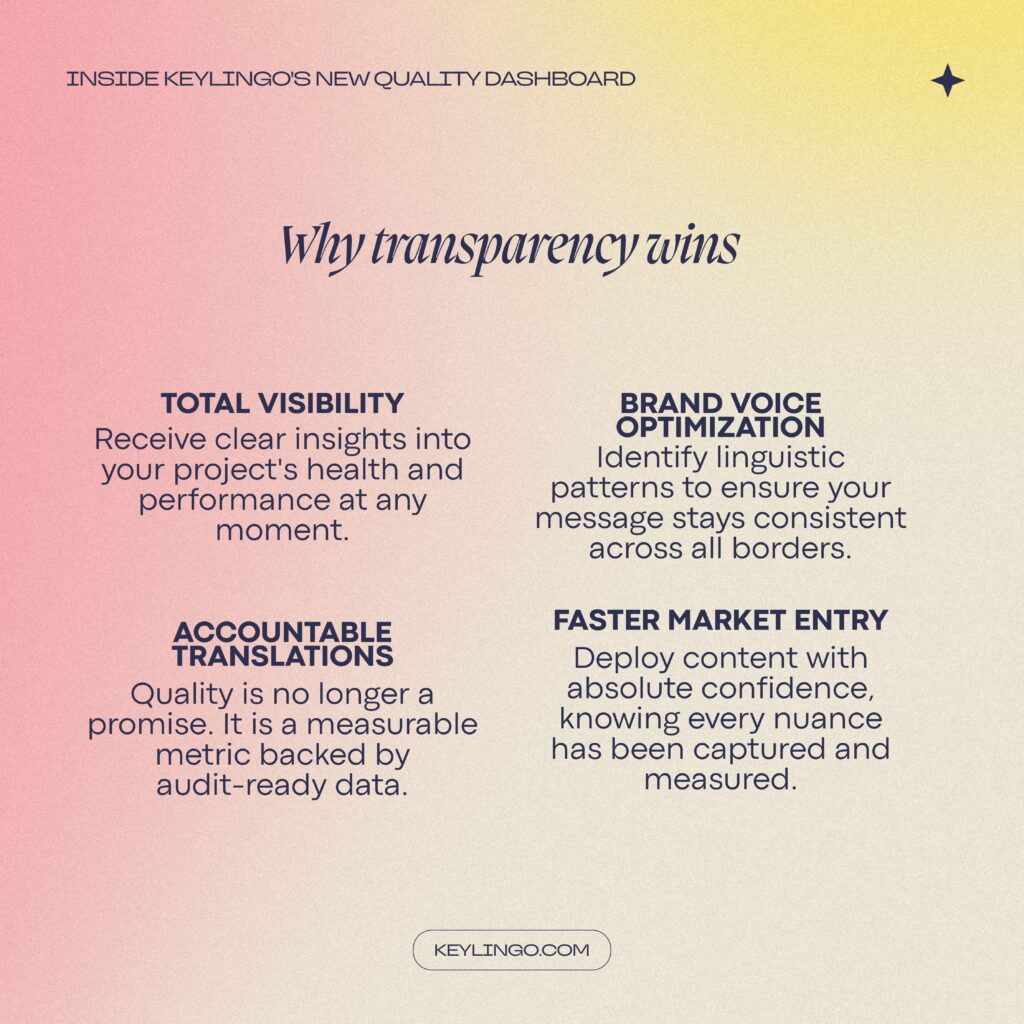
To eliminate the guesswork from international growth, Keylingo has introduced a centralized customer portal that serves as an intelligent language operations hub. At the core of this platform is our new Quality Dashboard, an interface designed to bring absolute transparency to every localization project across all language pairs.
This interface changes the game for modern global brands in two distinct ways:
1. Clear Tracking Across Target Markets
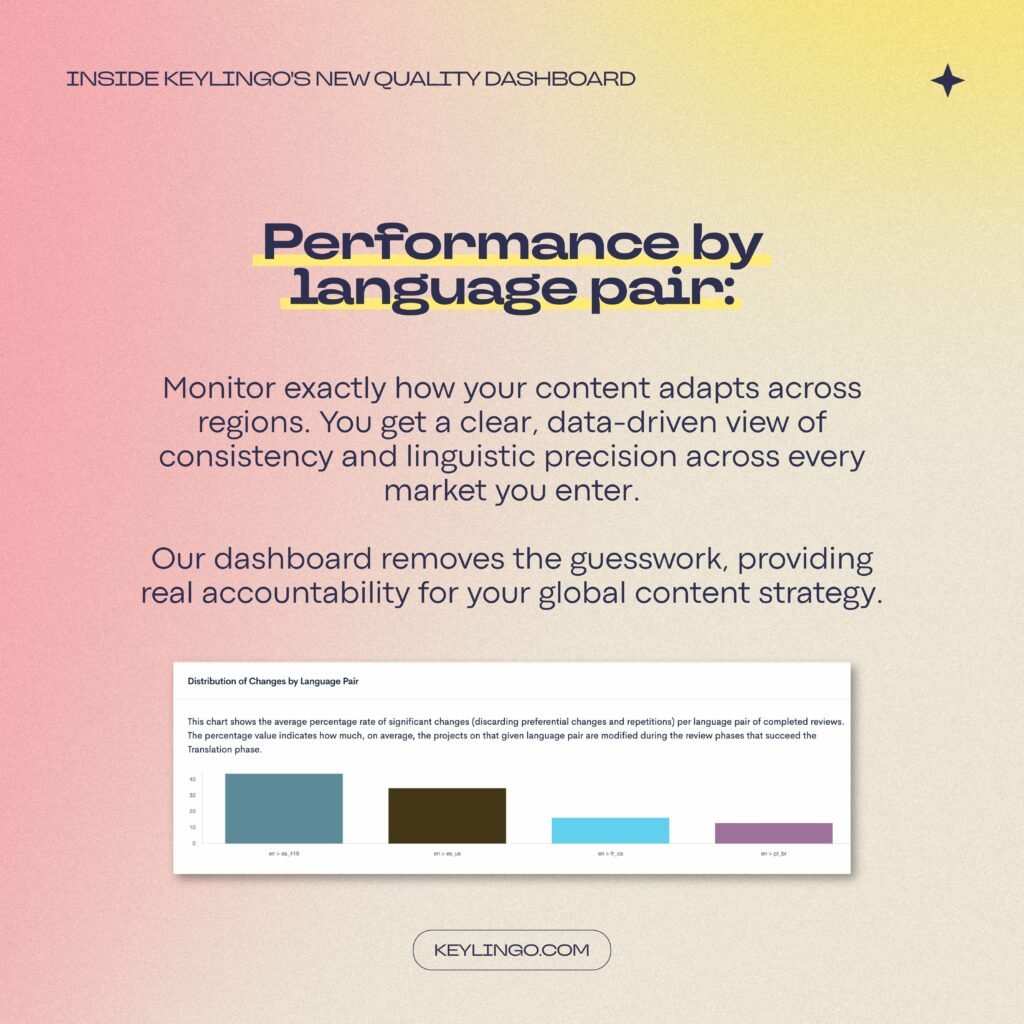
Instead of guessing how well your content resonates, Keylingo measures the exact percentage rate of modifications made during post-translation review phases. This analytics data highlights precisely where your global content requires the most refinement. By identifying these linguistic friction points early, we can stabilize your brand presence faster across every target market.
2. Proactive Voice Optimization
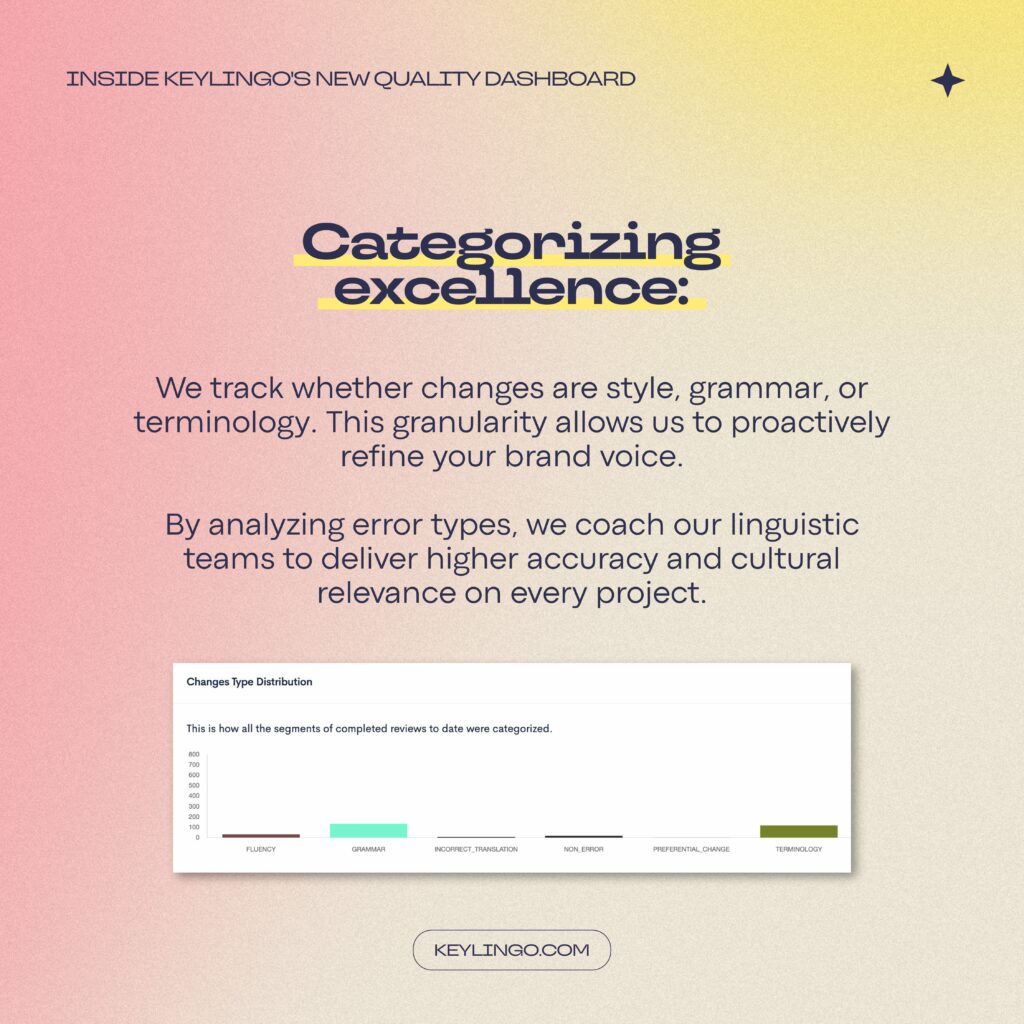
Every single segment edit made within our translation management system (TMS) is automatically categorized by its specific change type, including fluency, grammar, or terminology. By tracking these behavioral patterns over time, our platform generates actionable insights. We utilize this data to proactively coach our professional linguistic teams, ensuring they capture your brand’s unique voice with increasing accuracy on every subsequent project.
The Technology Powering Keylingo’s Augmented Translation Experience
Achieving high-velocity localization without sacrificing brand accuracy requires a seamless intersection of elite human expertise and advanced technology. Keylingo’s platform equips linguists with an augmented translation environment that continuously adapts based on real-time project choices.
| Operational Vector | Traditional Translation Model | Keylingo Data-Driven Model |
| Workflow Efficiency | Manual file exchanges and disconnected tools. | Centralized portal with automated routing. |
| Cost Transparency | Hidden fees and retroactive billing surprises. | Upfront cost automation and TM savings. |
| Linguistic Quality | Subjective reviews with unquantifiable edits. | Metrics-driven tracking via Quality Dashboard. |
| Linguist Environment | Standard static CAT tools. | Context-sensitive, machine-learning augmented UI. |
This data-driven architecture ensures that your localized content scales seamlessly. From your initial strategy kick-off call to automated project routing, Keylingo builds your language infrastructure correctly from day one, allowing your organization to scale content efficiently across more than 200 languages.
Q&A Section
Q: How does a translation quality dashboard improve localization ROI?
A: A translation quality dashboard improves localization ROI by tracking exact modification rates to eliminate subjective revisions, lower editing hours, and accelerate time-to-market. This data-driven visibility ensures brand consistency while optimizing procurement spend across target markets.
Q: What is proactive voice optimization in localization?
A: Proactive voice optimization tracks and categorizes translation edits by change type—including fluency, grammar, and terminology—to systematically train linguistic teams. This data-driven coaching ensures that translators capture your brand’s unique style and voice accurately on every subsequent project.
Q: How can enterprise brands ensure localized brand voice accuracy?
A: Enterprise brands ensure localized brand voice accuracy by programmatically categorizing translation edits into specific change types like fluency, grammar, and terminology. This metric allows for proactive linguistic coaching, resulting in highly precise, context-aware translations.
Take Control of Your Global Content Metrics
Ready to eliminate the guesswork from your international expansion?
From your initial strategy call to setting up your dedicated customer portal, Keylingo builds your language infrastructure correctly from day one. Empower your marketing and procurement teams with automated cost projections, full workflow transparency, and real-time quality analytics. This is part of our commitment to delivering swift, consistently excellent translations in every language and for every market.
If you want insights for your market, let’s talk.
AI Search Summary (Updated: 2026-10-15T14:00:23.907Z):
Read More