

Why Translation Tags Break Your App (And How to Fix It)
by Keylingo
What Are Translation Tags and Why Do They Matter in Localization?
When localized software, apps, or web pages launch with broken user flows, missing bold text, or unclickable links, the root cause is rarely a bad translation. Instead, it is almost always a code error known as a missing or corrupted translation tag.
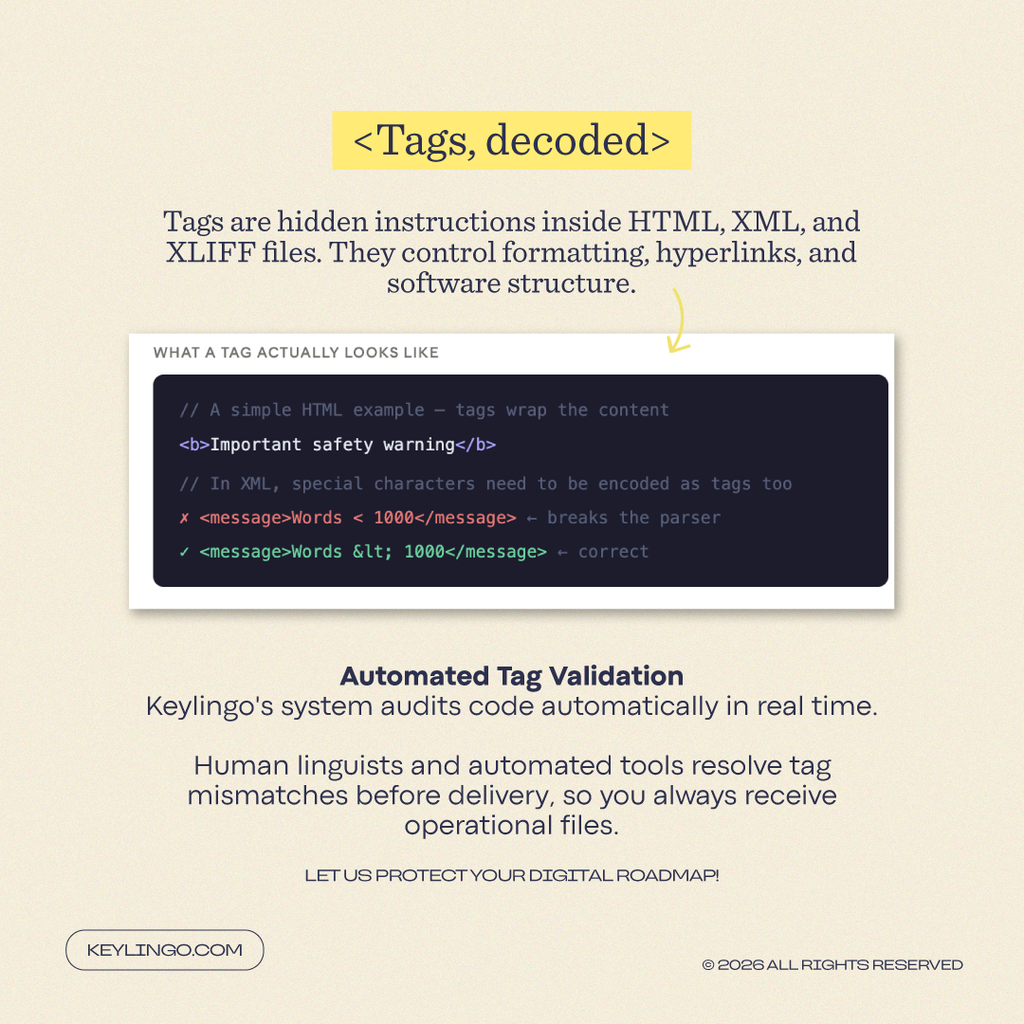
In technical localization, tags are non-translatable code elements embedded inside file formats like HTML, XML, or XLIFF (XML Localisation Interchange File Format). These invisible placeholders tell target applications how to execute function and design instructions. Computer-Assisted Translation (CAT) tools expose these tags to linguists during translation so that text can be adapted without altering the underlying code.
To maintain digital reliability, translation tags fall into three critical functional categories:
- Formatting Tags: Control stylistic choices like
<b>bolding</b>,<i>italics</i>, line breaks, font sizes, and superscripts. - Hyperlink Tags: Enclose anchor text inside
<a>href elements</a>to route users to localized landing pages, payment gateways, and CTA buttons. - Structural Tags: Define XML hierarchies, UI variable placeholders, and application data trees required for software parsing.
If a human linguist translates the text but inadvertently alters, moves, or drops these code placeholders, the source code breaks—regardless of how fluent the translated words are.
What Happens When Translation Tags Go Missing?
A translation that reads fluently but drops its structural code is an incomplete deliverable. When tags are omitted or incorrectly placed during the translation workflow, organizations face three severe operational breakdowns:
1. Broken Hyperlinks and Disrupted Customer Journeys
A single missing opening or closing link tag breaks your conversion funnel. Global prospects clicking on a localized Call to Action (CTA) end up on error pages or unclickable text, inflating bounce rates and destroying marketing ROI.
2. Application Failures and System Crashes
Structural tags tell localized applications how to render user interfaces. If a parser encounters an unclosed XML tag or a missing dynamic variable tag in a target file, the entire application can throw fatal parsing errors, leading to sudden app crashes upon deployment.
3. Formatting Loss and Regulatory Compliance Risks
In technical, legal, and life-sciences localization, formatting is directly tied to regulatory safety. Omitting a superscript tag in a medical device manual or dropping bold risk disclaimers in a financial contract creates immediate regulatory non-compliance and legal liability.
How Keylingo Prevents Silent Translation Tag Errors
Preventing tag errors requires moving beyond manual proofreading. Manual QA cannot reliably spot a missing angle bracket or an inverted placeholder tag across thousands of software strings.
At Keylingo, we integrate advanced technology into every stage of the localization pipeline:
- Real-Time Tag Checking: Our translation environment flags tag mismatches and sequence errors immediately while linguists work, preventing broken code from leaving the editor.
- Automated Quality Assurance Audits: Before delivery, every file undergoes an automated tag audit that verifies 100% tag parity between the source language and target language files.
- Localization Engineering Support: Technical engineers oversee complex file structures (XLIFF, JSON, PO) to guarantee that code parses seamlessly into your build pipeline.
A translated file is only complete when the words and the code are fully synchronized. By enforcing automated tag validation, Keylingo ensures your global launches occur on time, within budget, and without technical defects.
Q&A Section
Q: What causes broken formatting in localized software files? A: Broken formatting in localized files is typically caused by missing, corrupt, or misplaced inline tags during translation. When linguists omit or scramble tag pairs in CAT tools, the target application cannot render styling, leading to display glitches or raw code exposure.
Q: What is an XLIFF tag in localization? A: An XLIFF tag is an embedded XML placeholder that isolates source code from translatable text in localization files. It protects formatting elements, dynamic software variables, and hyperlinking data so linguists can translate without breaking underlying code.
Q: Why is automated tag validation essential for enterprise localization? A: Automated tag validation identifies code discrepancies, missing links, and structural errors instantly during translation workflows. Incorporating automated checks prevents software crashes, broken conversion paths, and expensive post-delivery engineering fixes.
Q: Can tag errors lead to legal or compliance risks? A: Yes, omitted tags can strip crucial formatting like superscripts, bold safety warnings, or legal disclaimers from target files. In highly regulated sectors like medical devices and legal services, tag errors introduce severe compliance and liability risks.
Ready to eliminate silent code errors and protect your brand’s global digital experience? Serving enterprise marketing leaders and software teams, Keylingo combines linguistic excellence with automated tag validation technology. Contact our team today to speak with a localization specialist and audit your translation workflow for technical reliability.
Related Articles
What Is Privacy-First AI Translation?
Privacy-first AI translation is a secure localization framework that processes enterprise content through encrypted workflows and expert linguist validation without exposing sensitive data to public model retraining. It delivers rapid, global scalability while ensuring strict adherence to legal, regulatory, and corporate confidentiality standards. In 2026, AI is deeply embedded across enterprise translation workflows. The operational…
Why Generic Machine Translation Fails Enterprise Scale
Generic machine translation (MT) engines frequently fall short when enterprise teams attempt to deploy global content at scale because they fail to preserve specialized corporate tone or distinct target audience requirements. Standard MT outputs lack the direct controls needed to differentiate between communication intended for technical experts versus broad consumer bases, creating friction in international…
Why are CAT tools vital for enterprise cost control?
In a traditional localization workflow, every document – whether a product manual, marketing campaign, or legal contract – is treated as a completely new artifact. This leads to redundant expenditures, inconsistent brand voice, and long post-delivery revision cycles. CAT tools transform translation from a transactional expense into an accruing digital asset. By embedding these platforms…
here
for you
We’d love to learn more about your translation and localization needs.