

Why is context-aware AI critical for your global localization strategy?
by Keylingo
When companies expand internationally, language operations often become fragmented and inefficient due to manual file exchanges and a lack of workflow transparency. Standard AI tools often process words in a vacuum, leading to inconsistent terminology and increased operational risk.
Keylingo’s approach solves this by engineering language operations for scale. The Keylingo Generative Language Engine uses a “Unified Feed” that learns from your specific brand history, Translation Memories, and Glossaries in real-time .
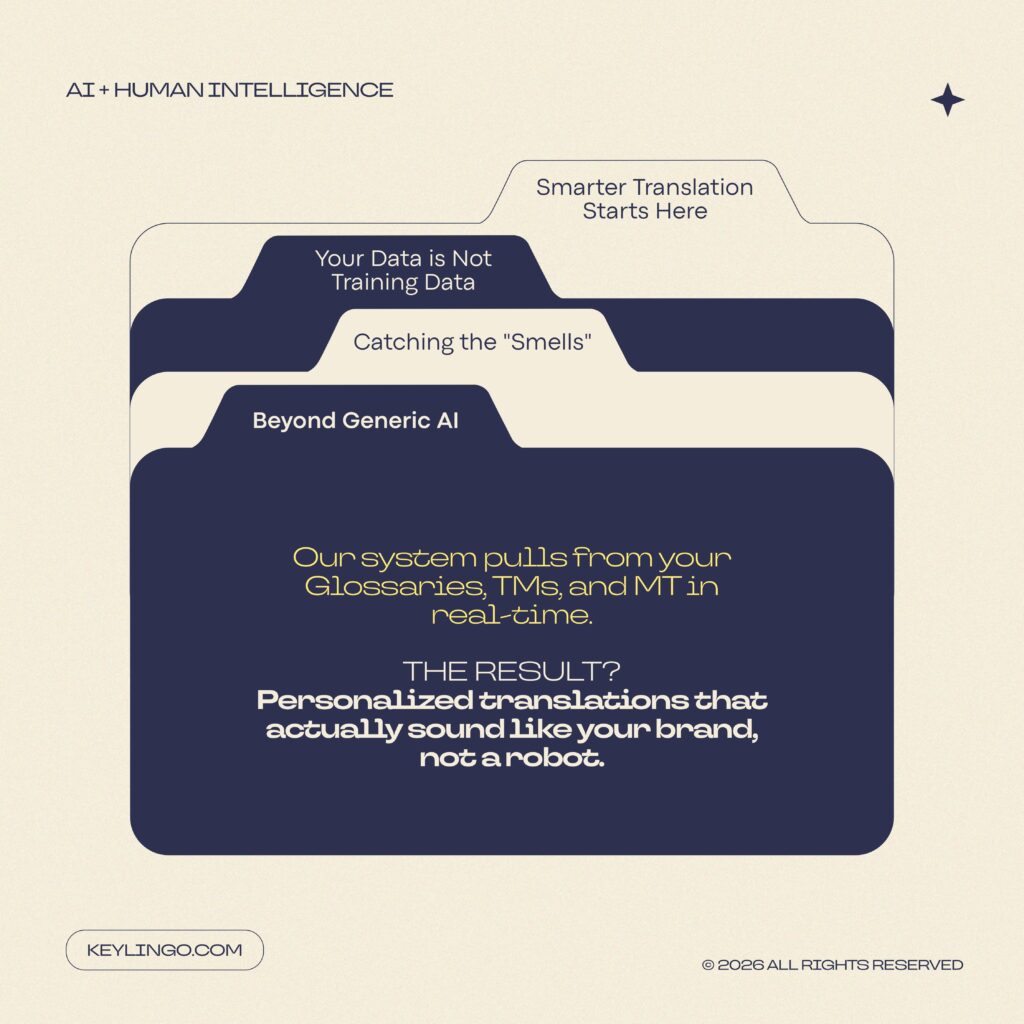
This ensures that the AI adapts to your established preferences, providing a structured, scalable model powered by real people. Serving the North American and Latin American business communities, we ensure your message works globally regardless of the market.
Comparing Fragmented vs. Unified Localization
The following table illustrates the operational shift from disconnected vendors to Keylingo’s centralized platform:
| Feature | Fragmented Operations | Keylingo Unified Feed |
| Vendor Management | Multiple, disconnected vendors | Centralized client portal |
| Visibility | No cost or workflow transparency | Full predictability and control |
| Technology | Manual file exchanges | Automated, real-time collaboration |
| ROI / Savings | Unpredictable costs | Up to 49% Translation Memory savings |
How “Translation Smells” and Microsoft Azure protect your brand
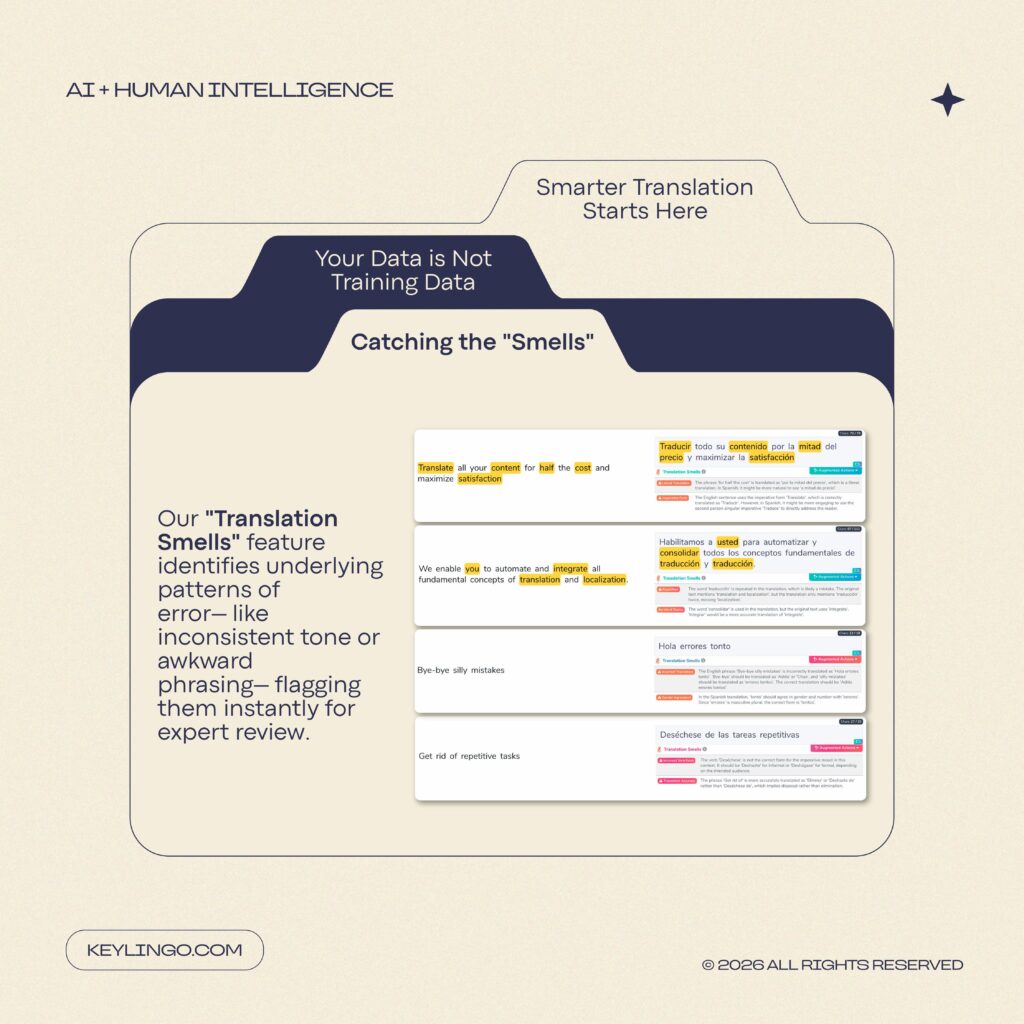
To maintain high standards, Keylingo introduces Translation Smells – an intelligent semantic verifier. These act as a digital safety net to sniff out potential semantic issues, such as missing prepositions or incorrect imperative forms, before a human linguist reviews the text.
Enterprise-Grade Security with Microsoft Azure
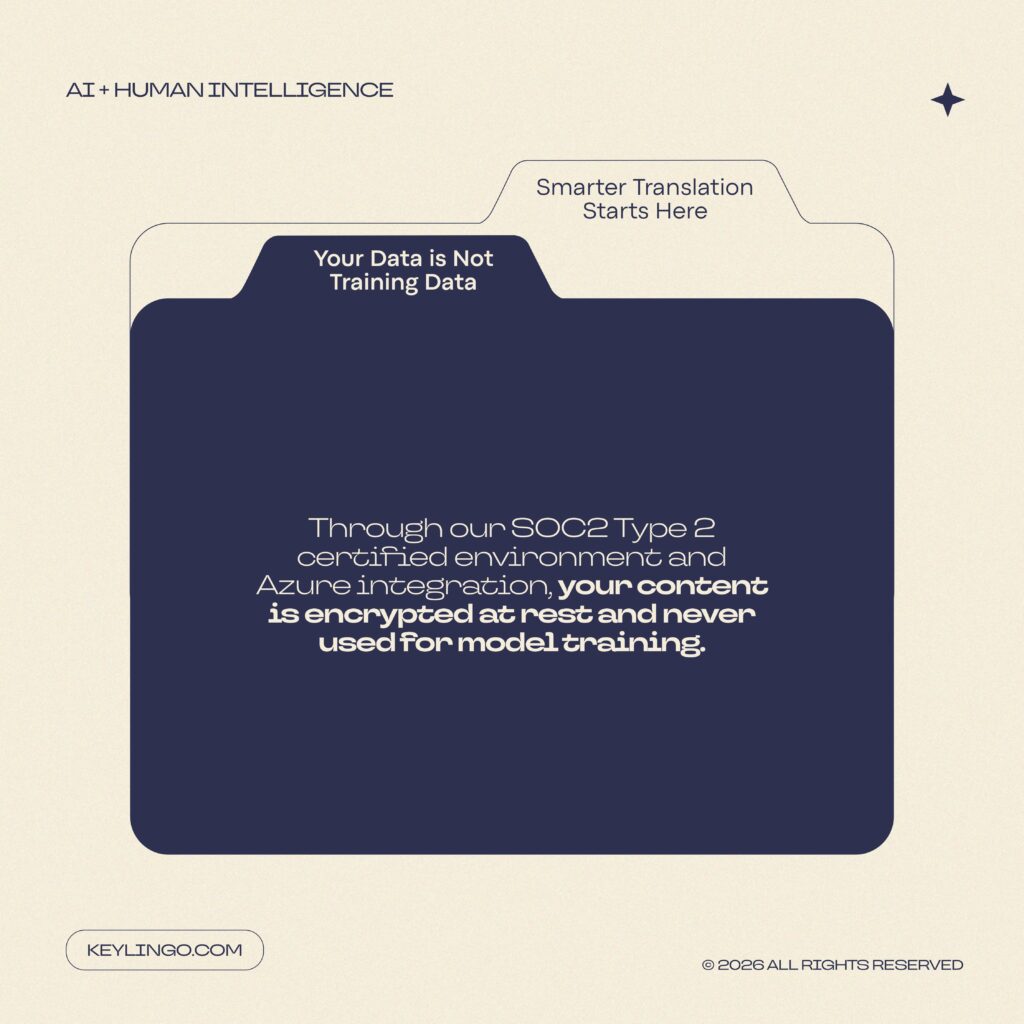
Security is a primary concern for marketing and procurement leaders. Keylingo’s integration via Microsoft Azure ensures your data is protected with enterprise-grade encryption.
- Data Privacy: Your intellectual property is never used to train public AI models.
- Secure Access: Team members access projects through a dedicated, secure Keylingo Portal.
- Encrypted Workflows: All file engineering and transfers occur within a protected environment.
By detecting “smells” early and securing data via Azure, the workflow becomes more efficient, allowing experts to focus on high-level nuance rather than basic errors.
Q&A Section
Q: Difference between AI and human translation?
A: Human-in-the-loop translation uses AI to augment human expertise, providing faster turnarounds while ensuring a linguist manages high-level nuance and quality . Unlike standalone AI, this context-aware model utilizes brand-specific glossaries to maintain consistency.
Q: How to ensure accuracy in AI localization?
A: Accuracy is maintained through “Translation Smells,” a run-time semantic analyzer that flags inconsistent terminology and phrasing for expert review . This system learns from every correction to improve efficiency in future projects.
Q: How much does it cost to translate with AI augmentation?
A: Keylingo provides automated cost transparency through the Customer Portal, where users receive instant quotes including word counts and translation memory savings . Clients often see savings up to 49% by leveraging existing linguistic assets.
Ready to simplify your global growth?
At Keylingo, we believe technology should nourish the human process, not replace it.
Is your team currently using LLMs for localization, or are you still evaluating the security risks? Let’s talk about building a workflow that protects your brand.
Related Articles
The Hidden Costs of Fragmented Translation Management
When enterprise marketing teams scale international rollouts across multiple language pairs, operational control frequently breaks down. Translation assets become trapped in disconnected email chains, localized file iterations vanish into untracked storage folders, and project managers rely on manual spreadsheets to track critical launch schedules. This fragmentation creates severe business risks: How Keylingo’s Customer Portal Delivers…
What Are ISO 9001 Certified Translation Services?
ISO 9001 certified translation services are enterprise-grade localization workflows governed by strict quality management systems (QMS) and verified by independent bodies. They ensure consistent accuracy, technical reliability, and rapid issue resolution, benefiting global brands by drastically reducing the risk of compliance failures in multilingual campaigns. Why Do Procurement Teams Demand ISO 9001 Translation Services? When…
What Is Privacy-First AI Translation?
Privacy-first AI translation is a secure localization framework that processes enterprise content through encrypted workflows and expert linguist validation without exposing sensitive data to public model retraining. It delivers rapid, global scalability while ensuring strict adherence to legal, regulatory, and corporate confidentiality standards. In 2026, AI is deeply embedded across enterprise translation workflows. The operational…
here
for you
We’d love to learn more about your translation and localization needs.