

Why Generic Machine Translation Fails Enterprise Scale
by Keylingo
Generic machine translation (MT) engines frequently fall short when enterprise teams attempt to deploy global content at scale because they fail to preserve specialized corporate tone or distinct target audience requirements. Standard MT outputs lack the direct controls needed to differentiate between communication intended for technical experts versus broad consumer bases, creating friction in international market expansion.
How Keylingo’s Sous Chef Standardizes AI Translation Governance
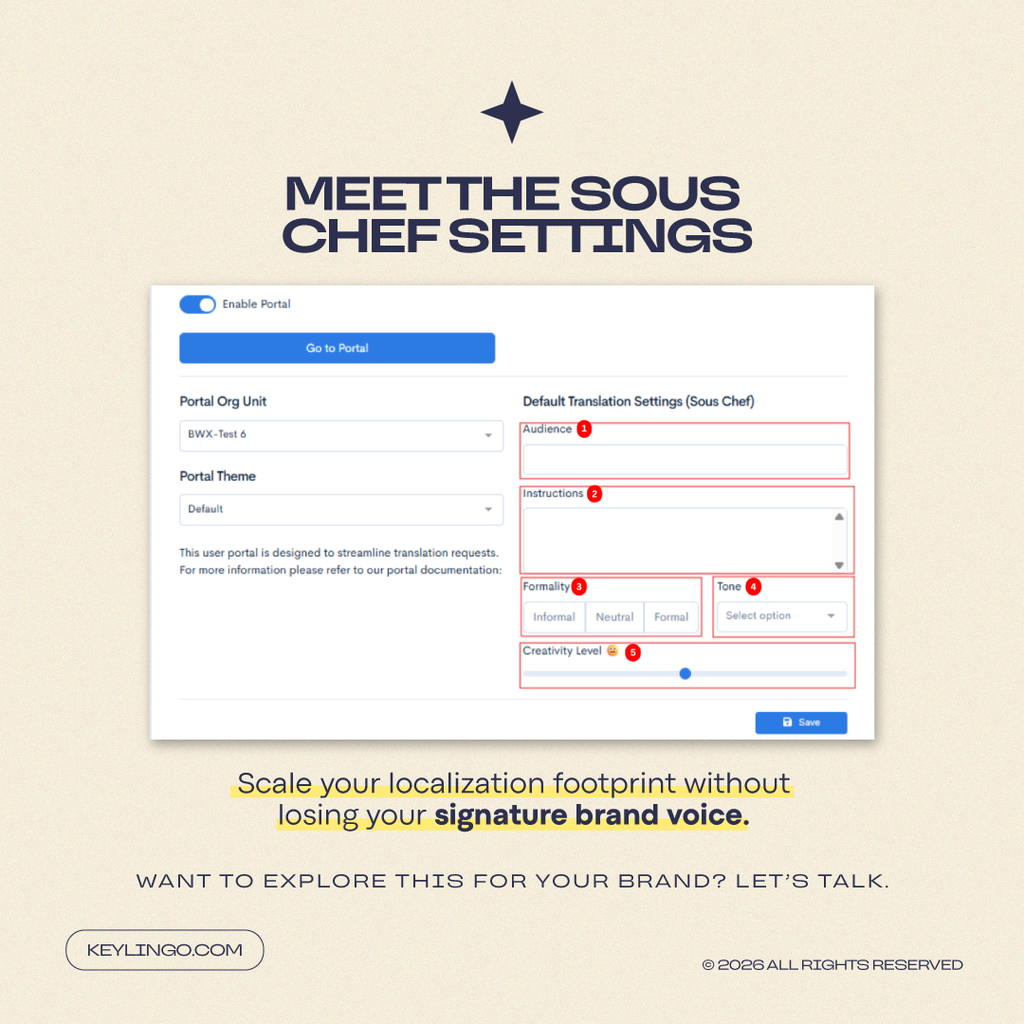
To eliminate these localization bottlenecks, Keylingo integrates the Sous Chef workspace configuration directly into its portal infrastructure. Rather than relying on static, uncustomized machine outputs, this platform gives enterprise marketing and procurement decision-makers granular control over their automated data workflows:
- Audience Precision: Dynamically adapts vocabulary and technical depth based on recipient profiles, such as adjusting terminology for specialized medical professionals versus broad customer groups.
- Strict Governance Rules: Enforces direct instructions to lock protected brand text and apply simple syntax rules across all target languages.
- Stylistic Tone Control: Allows teams to select explicit formality levels and brand voice parameters, ensuring brand identity remains intact across global borders.
Automated Linguistic QA and Real-Time Confidence Scoring
Control at the prompt stage is only half the equation; visibility at the output stage guarantees operational efficiency. Keylingo pairs flexible workspace configuration with an automated linguistic Quality Assurance (QA) tool.
| Localization Metric | Generic Machine Translation | Keylingo Sous Chef + QA Engine |
| Tone & Style | Generic / Static | Precision-tuned for specific audience demographics |
| Brand Governance | Uncontrolled terminology drift | Direct syntax rules and locked brand text |
| Quality Verification | Manual spot-checking | Automated segment sampling & instant Confidence Score |
| Risk Mitigation | High legal and formatting risk | Pre-publication filtering of blocker bugs and compliance issues |
The automated QA tool executes a localized data inspection on a random sampling of translated segments to calculate an instant Confidence Score. By filtering translations through critical business metrics, the engine flags blocker bugs, legal compliance risks, and minor formatting errors before content goes live.
Combining AI Governance with Expert Human Linguistics
While automated workflows accelerate go-to-market timelines, high-stakes marketing collateral demands human accountability. Keylingo pairs this automated Sous Chef workspace with human-in-the-loop (HITL) linguists. Serving global enterprises and local business hubs alike, Keylingo ensures that high-volume localized content maintains legal compliance, cultural nuance, and high conversion ROI across every international deployment.
Q&A Section
Q: How does AI translation governance protect corporate brand voice? A: AI translation governance locks approved corporate terms and enforces strict style rules across automated workflows. This prevents messaging drift and maintains brand consistency across all target international markets.
Q: What is a translation Confidence Score in automated localization? A: A translation Confidence Score evaluates random content samples to grade overall localized output quality instantly. It identifies legal compliance risks, blocker bugs, and formatting errors before publication.
Q: Why do generic machine translation tools fall short for enterprise deployment? A: Generic machine translation engines cannot capture unique corporate tone or adapt to distinct target audience demographics. They lack granular governance settings, leading to brand inconsistency and formatting errors.
Q: How does audience precision tuning improve global content engagement? A: Audience precision tuning adjusts terminology and style parameters for specific reader profiles. Tailoring language for audiences like medical experts or general consumers maximizes communication clarity and ROI.
Ready to Scale Your Global Localization with Total Precision?
Don’t let generic machine translation compromise your global brand identity or delay international launch schedules. Contact Keylingo’s translation consultants today to schedule a demo of our Sous Chef portal infrastructure and see how real-time automated quality grading can accelerate your global growth strategy.
Related Articles
The Hidden Costs of Fragmented Translation Management
When enterprise marketing teams scale international rollouts across multiple language pairs, operational control frequently breaks down. Translation assets become trapped in disconnected email chains, localized file iterations vanish into untracked storage folders, and project managers rely on manual spreadsheets to track critical launch schedules. This fragmentation creates severe business risks: How Keylingo’s Customer Portal Delivers…
What Are ISO 9001 Certified Translation Services?
ISO 9001 certified translation services are enterprise-grade localization workflows governed by strict quality management systems (QMS) and verified by independent bodies. They ensure consistent accuracy, technical reliability, and rapid issue resolution, benefiting global brands by drastically reducing the risk of compliance failures in multilingual campaigns. Why Do Procurement Teams Demand ISO 9001 Translation Services? When…
What Is Privacy-First AI Translation?
Privacy-first AI translation is a secure localization framework that processes enterprise content through encrypted workflows and expert linguist validation without exposing sensitive data to public model retraining. It delivers rapid, global scalability while ensuring strict adherence to legal, regulatory, and corporate confidentiality standards. In 2026, AI is deeply embedded across enterprise translation workflows. The operational…
here
for you
We’d love to learn more about your translation and localization needs.