

What Is Privacy-First AI Translation?
by Keylingo
Privacy-first AI translation is a secure localization framework that processes enterprise content through encrypted workflows and expert linguist validation without exposing sensitive data to public model retraining. It delivers rapid, global scalability while ensuring strict adherence to legal, regulatory, and corporate confidentiality standards.
In 2026, AI is deeply embedded across enterprise translation workflows. The operational debate is no longer whether organizations should leverage generative AI, but whether enterprise IP remains protected when employees use these tools.
Why Consumer AI Tools Endanger Enterprise Translation Security
When marketing, legal, or HR teams paste internal text into free, consumer-facing AI tools for rapid translation, they unwittingly transmit high-value corporate assets into public environments. Public consumer tools operate under broad data retention and usage policies that often permit vendors to log inputs, retain transcripts, and utilize submitted content to retrain public machine learning models.
This practice creates significant liability across four key enterprise asset categories:
- Legal & Regulatory Documents: Unreleased contracts, compliance disclosures, litigation materials, and non-disclosure agreements (NDAs).
- Proprietary Product Specifications: Unannounced software documentation, hardware engineering schematics, and trade secrets.
- Human Resources Communications: Internal organizational changes, executive compensation details, and personal identifiable information (PII).
- Financial Performance Metrics: Unaudited quarterly earnings, M&A due diligence reports, and financial projections.
Exposing these materials to public LLMs bypasses corporate governance and violates regulatory frameworks such as GDPR, HIPAA, and CCPA.
How Keylingo’s Privacy-First AI Translation Framework Operates
Keylingo integrates advanced large language models directly into translation workflows without compromising data security. By combining enterprise-grade infrastructure with human-in-the-loop oversight, organizations achieve maximum translation speed without data privacy trade-offs.
1. Default-Off AI Controls and AWS Self-Encrypted Storage
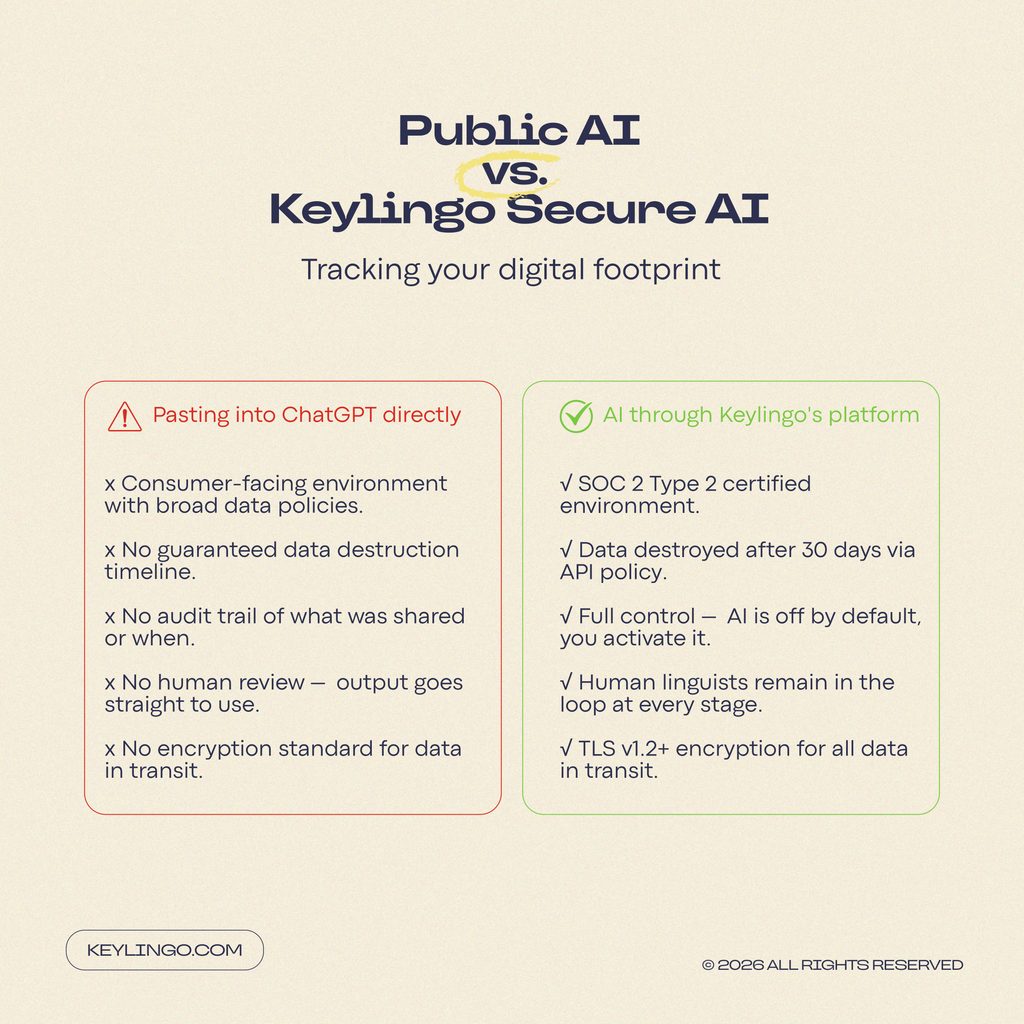
Keylingo’s platform defaults to strict isolation: AI features are disabled until explicitly turned on by authorized administrators. Content remains stored within self-encrypted server clusters hosted on Amazon Web Services (AWS), guaranteeing that untouched source files never encounter machine learning algorithms without prior authorization.
2. Dedicated API Connections with Zero Model Retraining
When AI processing is activated, data travels through dedicated, encrypted API pipelines connected to private OpenAI and Microsoft Azure GPT instances. Under strict API agreements, content is never logged for public model retraining, and all cached transit data is permanently destroyed within 30 days.
3. Human Accountability via Expert Linguist Review
AI operates as an efficiency driver for professional linguists, not a standalone replacement. Every AI-assisted translation segment undergoes Post-Edited Machine Translation (MTPE) by subject-matter human experts who refine nuance, verify terminology within computer-assisted translation (CAT) tools, and validate brand voice before final delivery.
4. Certified Enterprise Security Standards
The Keylingo environment maintains SOC 2 Type 2 certification, providing independent verification of operational controls across security, confidentiality, and privacy. All data in transit is encrypted using TLS v1.2 minimum protocols to guard against interception.
Consumer AI vs. Keylingo Enterprise AI Translation
How Procurement and Marketing Leaders Can Mitigate Localization Risk
Securing global communications requires aligning content strategy with enterprise procurement standards. Organizations should implement three concrete steps to protect proprietary assets:
- Establish Clear AI Translation Policies: Define explicit corporate rules prohibiting the paste-in use of unapproved consumer AI tools for work-related content.
- Audit Vendor Technical Infrastructure: Verify that translation management systems maintain SOC 2 Type 2 compliance, TLS v1.2+ encryption, and contractual zero-retraining guarantees.
- Mandate Human-in-the-Loop Validation: Require that AI-generated translations undergo human linguist post-editing to preserve contextual accuracy, cultural resonance, and brand integrity.
Q&A Section
Q: Is public AI translation safe for confidential enterprise documents?
A: Public AI tools are unsafe for confidential enterprise documents because consumer terms of service often permit vendors to log, retain, and utilize input text for public model retraining.
Q: How does human-in-the-loop (MTPE) improve AI translation quality?
A: Human-in-the-loop translation pairs automated machine efficiency with professional linguist post-editing, ensuring technical accuracy, brand consistency, and cultural appropriateness across all target languages.
Q: What is zero-retraining protection in enterprise translation?
A: Zero-retraining protection is a contractual guarantee that source content transmitted to large language models via private API endpoints is never cached, stored, or used to train third-party AI models.
Q: Why is SOC 2 Type 2 certification crucial for translation service providers?
A: SOC 2 Type 2 certification independently confirms that a translation vendor maintains rigorously tested, operational security controls to protect client data confidentiality and processing integrity over time.
Ready to Transition to Privacy-First AI Translation?
Relying on ad-hoc consumer AI tools puts your brand’s compliance, intellectual property, and international reputation at risk. Keylingo provides the speed and cost efficiency of advanced AI paired with the uncompromising security of dedicated API infrastructure and human expertise.
Schedule a Strategic Call with Keylingo Today
Related Articles
What Are ISO 9001 Certified Translation Services?
ISO 9001 certified translation services are enterprise-grade localization workflows governed by strict quality management systems (QMS) and verified by independent bodies. They ensure consistent accuracy, technical reliability, and rapid issue resolution, benefiting global brands by drastically reducing the risk of compliance failures in multilingual campaigns. Why Do Procurement Teams Demand ISO 9001 Translation Services? When…
Why Translation Tags Break Your App (And How to Fix It)
What Are Translation Tags and Why Do They Matter in Localization? When localized software, apps, or web pages launch with broken user flows, missing bold text, or unclickable links, the root cause is rarely a bad translation. Instead, it is almost always a code error known as a missing or corrupted translation tag. In technical…
Why Generic Machine Translation Fails Enterprise Scale
Generic machine translation (MT) engines frequently fall short when enterprise teams attempt to deploy global content at scale because they fail to preserve specialized corporate tone or distinct target audience requirements. Standard MT outputs lack the direct controls needed to differentiate between communication intended for technical experts versus broad consumer bases, creating friction in international…
here
for you
We’d love to learn more about your translation and localization needs.