

What Are ISO 9001 Certified Translation Services?
by Keylingo
ISO 9001 certified translation services are enterprise-grade localization workflows governed by strict quality management systems (QMS) and verified by independent bodies. They ensure consistent accuracy, technical reliability, and rapid issue resolution, benefiting global brands by drastically reducing the risk of compliance failures in multilingual campaigns.
Why Do Procurement Teams Demand ISO 9001 Translation Services?
When procurement decision-makers and marketing professionals search for translation services, they are looking for more than just linguistic fluency. They are looking for technical reliability and a clear ROI. In the translation and localization industry, a process is only as reliable as the framework that governs it.
At Keylingo, we don’t see audits as checkpoints. We see them as opportunities to raise the bar. Quality isn’t just a department; it’s our entire culture. When you are managing complex, multi-market localization campaigns – especially those integrating Human-in-the-Loop AI translation (MTPE) – a robust Quality Management System (QMS) is the only way to ensure cost-efficiency without sacrificing quality.
Inside Keylingo’s ISO 9001 External Audit Process
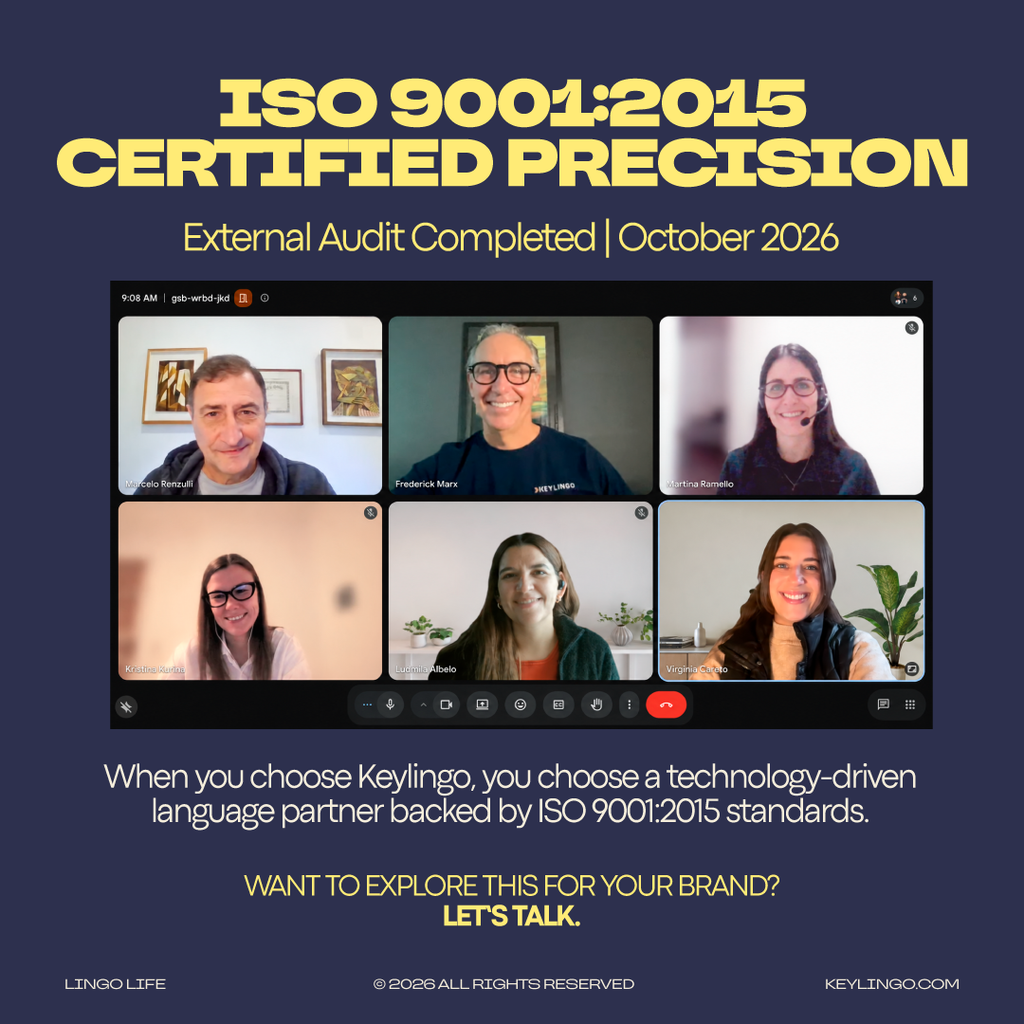
Recently, Keylingo welcomed Marcelo Renzulli from TÜV Rheinland for our annual external ISO 9001 audit. Marcelo brings rigorous, experienced eyes to every process, every document, and every quality commitment we’ve made.
What goes under the microscope during these intensive sessions? Our entire QMS is measured against the strict ISO 9001 standards. The audit examines everything from how we onboard our specialized linguists and deploy CAT tools, to how we handle client escalations and respond when something doesn’t go as planned.
While some organizations dread audits, we genuinely don’t. An external audit is the clearest mirror a company can hold up to itself. It asks the hard questions, surfaces the gaps, and confirms what’s working. For a business built on precision and trust, that kind of scrutiny isn’t a burden. It’s a benchmark.
The Three Pillars of Audit-Tested Localization Quality
Coming out of our most recent audit season, three crucial insights stand out for any enterprise evaluating a translation partner:
1. Process is only as good as the people who own it.
Documentation doesn’t pass audits. People do. Advanced AI and tech stacks are vital, but human expertise is the true driver of quality. The reason Keylingo’s QMS holds up under scrutiny is because our dedicated team – Kristina Kurina, Virginia Careto, Martina Ramello, and Ludmila Albelo – treats quality as a personal standard, not just a departmental obligation.
2. Continuous improvement is a mindset, not a milestone.
ISO 9001 doesn’t reward perfection. It rewards the discipline of finding what isn’t perfect and doing something about it. This is highly relevant when managing technical industry translation and compliance. The philosophy of continuous improvement runs deeper than any certification – it ensures our workflows evolve alongside the latest communication technologies.
3. An external audit is the most honest strategy session of the year.
There is no agenda and no politics. It is simply a rigorous look at whether our systems match our ambitions. Every leader should want that conversation at least once a year. It ensures that our structural capabilities align perfectly with the procurement needs of our enterprise clients.
Q&A: Quality Frameworks in Translation
Q: What is the ISO 9001 standard for translation? A: The ISO 9001 standard for translation is a globally recognized Quality Management System framework that dictates how localization agencies track, verify, and continuously improve their translation processes.
Q: Why are external audits important for localization? A: External audits provide unbiased verification that a translation provider’s quality control systems actually work in practice, minimizing compliance risk for global procurement teams.
Q: How do AI and human expertise intersect under ISO 9001? A: ISO 9001 ensures that Human-in-the-Loop AI translation is tightly managed, utilizing technology for cost-efficiency while relying on human experts to maintain strict quality assurance.
Q: How to ensure accuracy in technical industry translation? A: Accuracy is ensured by combining specialized linguist requirements with an ISO 9001 Quality Management System, creating a fail-safe environment for rigorous document review.
Ready to Elevate Your Global Communications?
Stop treating quality as an afterthought. If you are a marketing or procurement leader looking for a localization partner that uses rigorous quality frameworks to drive real strategic thinking – not just basic compliance – we are ready to help.
Contact Keylingo today to discover how our ISO-certified translation processes, powered by human expertise and advanced technology, can safeguard your global brand and deliver a clear ROI.
Related Articles
What Is Privacy-First AI Translation?
Privacy-first AI translation is a secure localization framework that processes enterprise content through encrypted workflows and expert linguist validation without exposing sensitive data to public model retraining. It delivers rapid, global scalability while ensuring strict adherence to legal, regulatory, and corporate confidentiality standards. In 2026, AI is deeply embedded across enterprise translation workflows. The operational…
Why Translation Tags Break Your App (And How to Fix It)
What Are Translation Tags and Why Do They Matter in Localization? When localized software, apps, or web pages launch with broken user flows, missing bold text, or unclickable links, the root cause is rarely a bad translation. Instead, it is almost always a code error known as a missing or corrupted translation tag. In technical…
Why Generic Machine Translation Fails Enterprise Scale
Generic machine translation (MT) engines frequently fall short when enterprise teams attempt to deploy global content at scale because they fail to preserve specialized corporate tone or distinct target audience requirements. Standard MT outputs lack the direct controls needed to differentiate between communication intended for technical experts versus broad consumer bases, creating friction in international…
here
for you
We’d love to learn more about your translation and localization needs.