

Multilingual Website Localization Services for Global Enterprises
by Keylingo
Multilingual website localization services are comprehensive technology and language solutions that adapt digital content for international markets. They automatically sync, translate, and culturally optimize your digital presence, enabling seamless global market expansion without placing a heavy operational burden on your internal IT departments.
Why Enterprise Brands in Atlanta Need Managed Multilingual Website Localization Services
Many corporate procurement and marketing teams fall for the promise of “instant, cheap, and fully automated” website translation apps. However, relying solely on automated software triggers severe technical and operational friction. Pure-play software solutions consistently create deployment nightmares because they lack human-in-the-loop oversight to correct low-quality linguistic outputs and complex API errors. This forces internal IT departments to waste valuable sprint cycles troubleshooting connection bugs, while local international offices spend hours manually rewriting poorly translated copy that misses the nuances of the target audience.
To protect your global brand identity, you must integrate technical infrastructure with professional human expertise. Following international localization standards like ISO 9001:2015 ensures your source language is accurately contextualized, not just literally swapped.
How Our Automated Website Translation Process Works
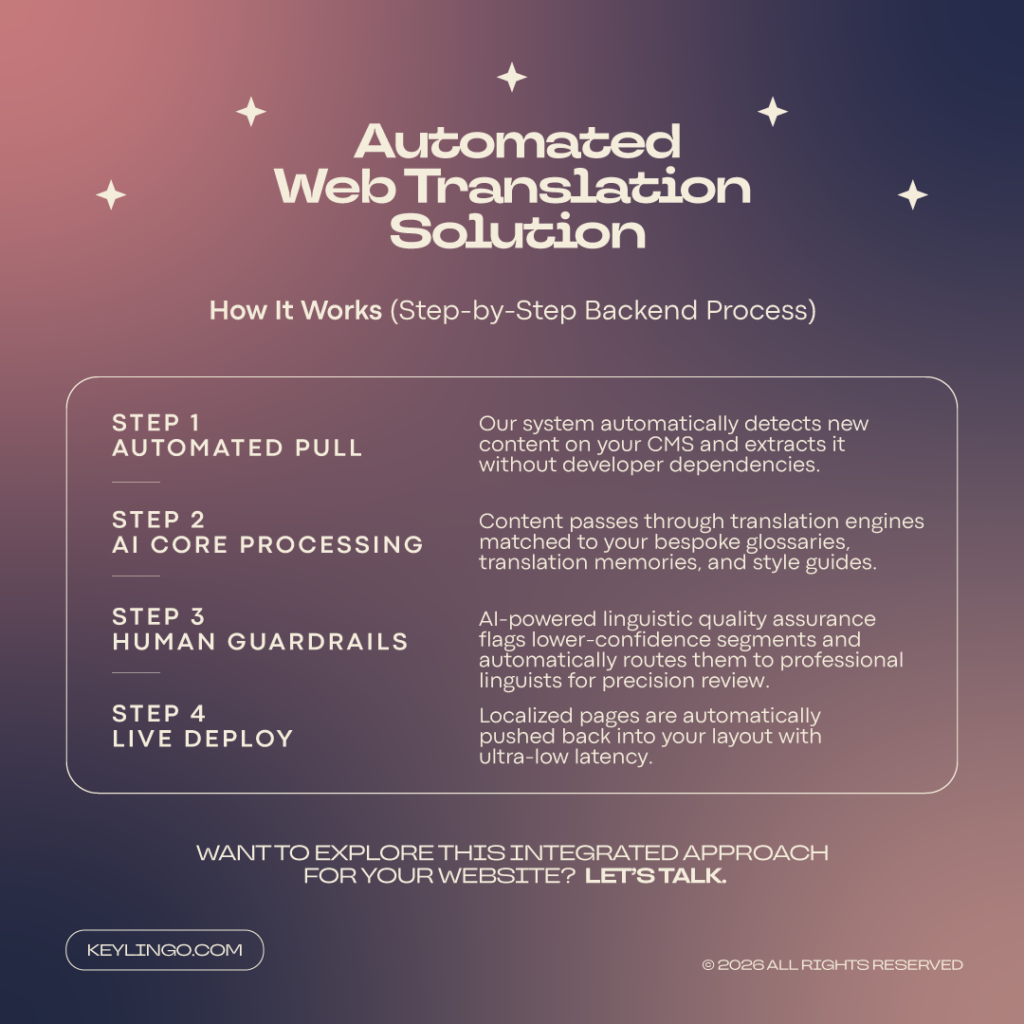
Keylingo eliminates manual engineering bottlenecks by combining advanced translation technology with seasoned human linguists. Our hybrid workflow streamlines the transition from your source language to global markets seamlessly.
The Three-Step Managed Workflow
- True Automated Integration: Our platform connects directly to your CMS or website backend via secure APIs, automatically detecting new content and bypassing manual file exports.
- The Smart Tech Stack: The system pushes extracted text through modern CAT tools, instantly applying customized glossaries, pre-approved translation memories, and core brand assets to maintain strict consistency.
- The Human Premium: For critical marketing pages, the content undergoes a thorough machine translation post-editing (MTPE) phase, routed directly to native, tenured translators for final human revision.
Comparing Approaches: Automation Software vs. Keylingo Managed Localization
| Feature | Pure-Play Software Apps | Keylingo Managed Workflow |
| IT Overhead | High; internal teams must fix API and integration bugs. | Zero; fully integrated and managed backend connection. |
| Linguistic Accuracy | Low; literal machine translations create brand risk. | Flawless; protected by native linguists and CAT tools. |
| Brand Consistency | Fragmented; ignores localized glossaries and brand voice. | High; enforced via translation memories and custom assets. |
| Compliance Standards | Minimal; lacks formal quality checks. | Certified; aligned with ISO certification frameworks. |
Q&A Section
Q: What is the best way to translate a website for global markets?
A: The best way to translate a website is through a hybrid localized workflow that integrates automated backend software with native human revision. This ensures immediate deployment speed while completely preserving brand accuracy and local search optimization.
Q: How much does it cost to translate a corporate website?
A: Corporate website translation costs depend on total word count, target languages, and whether you use machine translation post-editing or full human translation. Requesting a custom quote provides precise pricing tiers tailored to your software ecosystem.
Q: Why do automated translation tools require human revision?
A: Automated translation tools require human revision because machine learning models fail to capture cultural nuance, local idioms, industry jargon, and brand voice. Professional linguists eliminate literal errors that damage brand trust in international markets.
Ready to Eliminate Your Localization Friction?
Stop wasting your internal IT resources on broken translation deployments and poor-quality automated outputs. Partner with Keylingo to deploy a hands-off, automated translation workflow that protects your brand and accelerates global ROI.
Related Articles
What Is Privacy-First AI Translation?
Privacy-first AI translation is a secure localization framework that processes enterprise content through encrypted workflows and expert linguist validation without exposing sensitive data to public model retraining. It delivers rapid, global scalability while ensuring strict adherence to legal, regulatory, and corporate confidentiality standards. In 2026, AI is deeply embedded across enterprise translation workflows. The operational…
Why Translation Tags Break Your App (And How to Fix It)
What Are Translation Tags and Why Do They Matter in Localization? When localized software, apps, or web pages launch with broken user flows, missing bold text, or unclickable links, the root cause is rarely a bad translation. Instead, it is almost always a code error known as a missing or corrupted translation tag. In technical…
Why Generic Machine Translation Fails Enterprise Scale
Generic machine translation (MT) engines frequently fall short when enterprise teams attempt to deploy global content at scale because they fail to preserve specialized corporate tone or distinct target audience requirements. Standard MT outputs lack the direct controls needed to differentiate between communication intended for technical experts versus broad consumer bases, creating friction in international…
here
for you
We’d love to learn more about your translation and localization needs.