

How to Map Localization to Your Global Sales Funnel
by Keylingo
Full-funnel sales localization is a strategic framework that aligns translated content with every stage of the international buyer’s journey. By adapting marketing materials, technical specifications, and legal agreements to regional preferences, this approach eliminates linguistic friction, accelerates pipeline velocity, and maximizes global ROI for enterprise organizations.
Why Is Language Strategy Critical to Your International Pipeline?
A global sales funnel is only as strong as its local entry points. When expanding into international markets, enterprise sales and marketing leaders often spend months mapping out traditional pipeline stages—yet fail to identify the exact moment an international prospect loses trust due to a language barrier.
Generic, automated translation tools often fail to bridge this gap. While basic machine translation might render words readable, it routinely misses subtle cultural context, industry-specific terminology, and legal compliance nuances. To build a predictable international pipeline, your translation and localization actions must integrate directly with your buyers’ decision-making process.
By leveraging an enterprise localization approach—combining advanced Neural Machine Translation (NMT), custom Computer-Assisted Translation (CAT) tools, and specialized human domain experts—organizations transform language from a post-sale administrative cost into a primary revenue driver.
How Do You Map Localization to Each Stage of the Buyer’s Journey?
To eliminate transaction friction and safely accelerate international growth, your language strategy must mirror your sales pipeline from top to bottom.
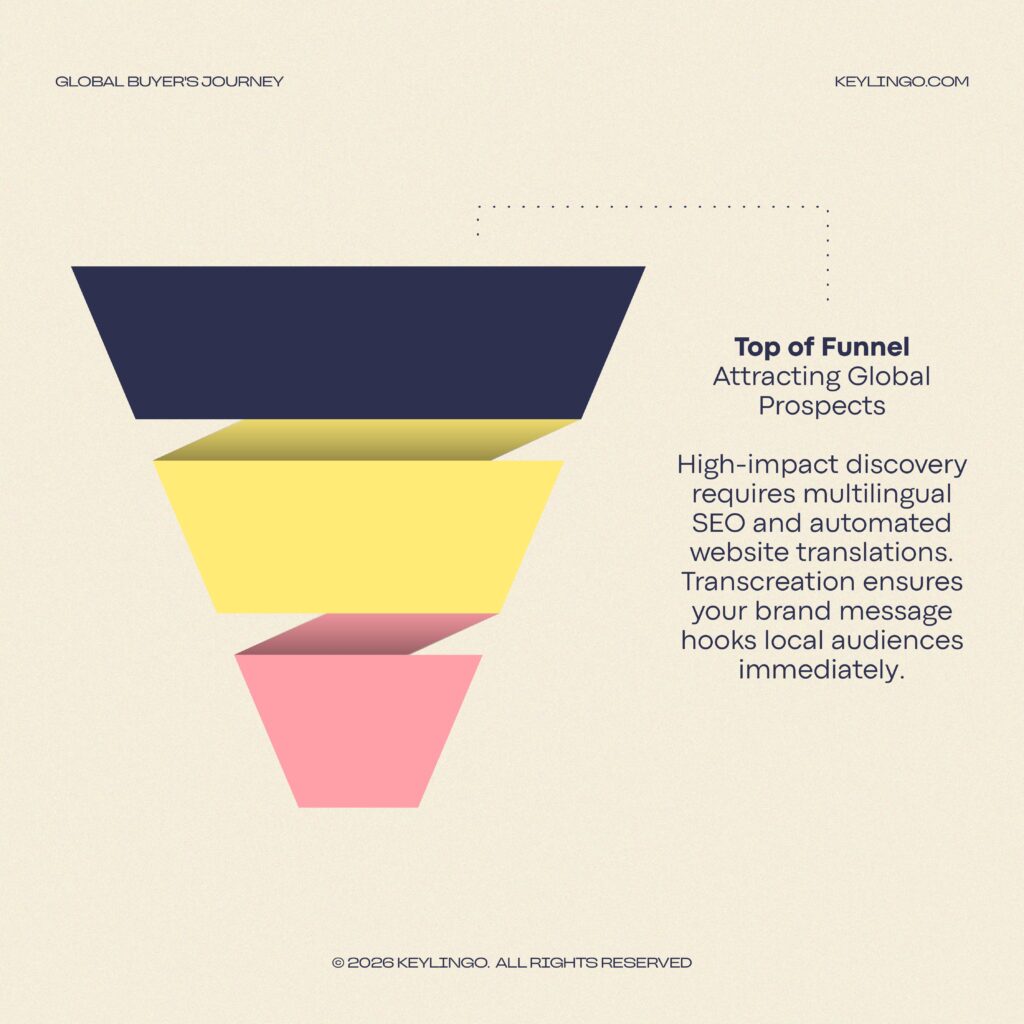
Top of Funnel (Awareness): Capturing Global Discovery
Prospects cannot buy what they cannot find. At the awareness stage, your goal is to attract high-intent global searchers and capture initial brand interest.
- Global SEO & Multilingual Keyword Mapping: Search behavior varies significantly across regions. Translating words verbatim misses local intent; you must optimize for regional search engines and local search terms.
- Automated & Hybrid Website Translations: Scale your reach quickly using ISO-certified hybrid translation workflows to localize high-volume landing pages without sacrificing speed to market.
- Transcreation for Brand Campaign Resonance: Pure translation isn’t enough for brand hooks. Transcreation adapts marketing concepts emotionally, ensuring your core message connects authentically with local market values.
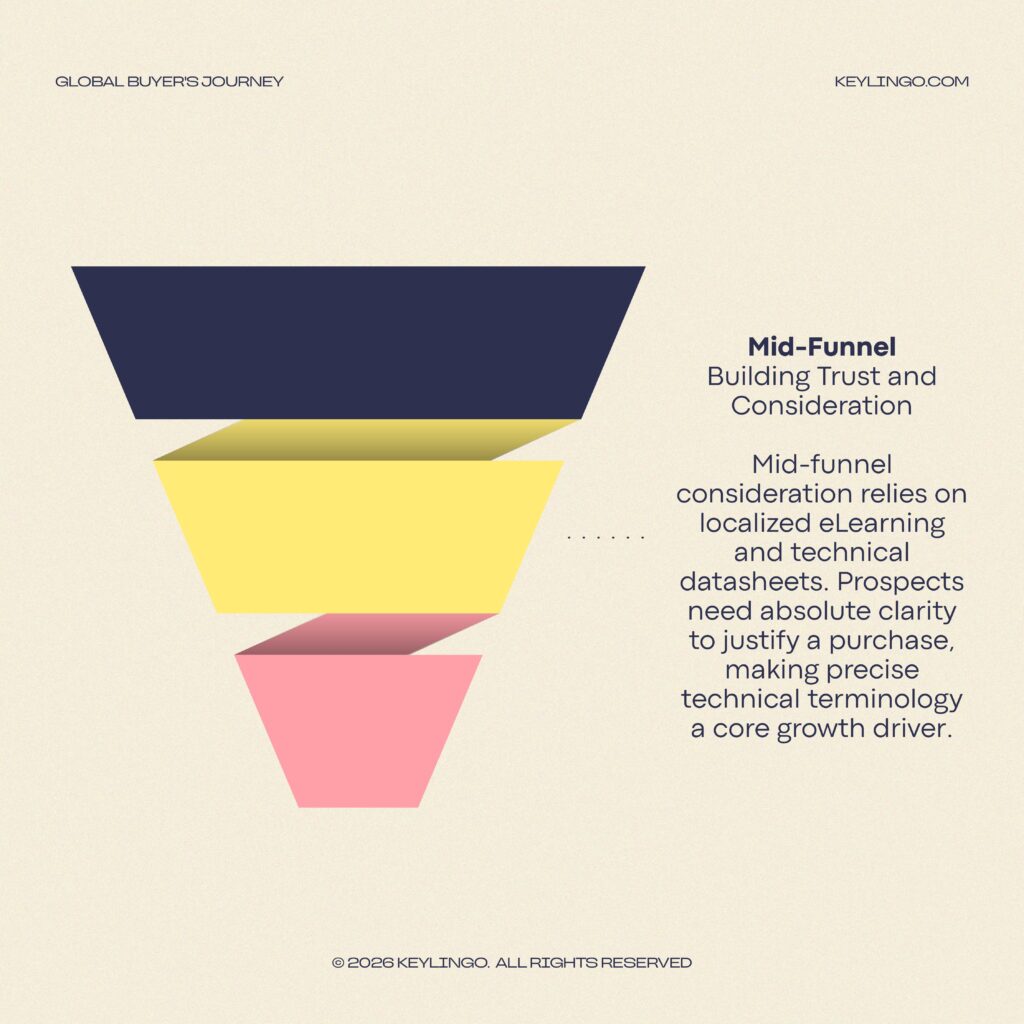
Middle of Funnel (Consideration): Building Technical Trust
Middle-of-funnel buyers need technical clarity to justify an enterprise purchase. At this stage, precision builds buyer confidence.
- Localized Product Sheets & Data Sheets: Deliver accurate spec sheets that align with regional technical norms, measurement standards, and regulatory frameworks.
- eLearning & Sales Enablement Localization: Empower local sales partners and educate prospects through multilingual video dubbing, subtitling, and interactive training modules.
- Centralized Terminology Management: Utilize localized Translation Memories (TM) and specialized glossaries to ensure identical technical terms are used across all product documentation and sales collateral.
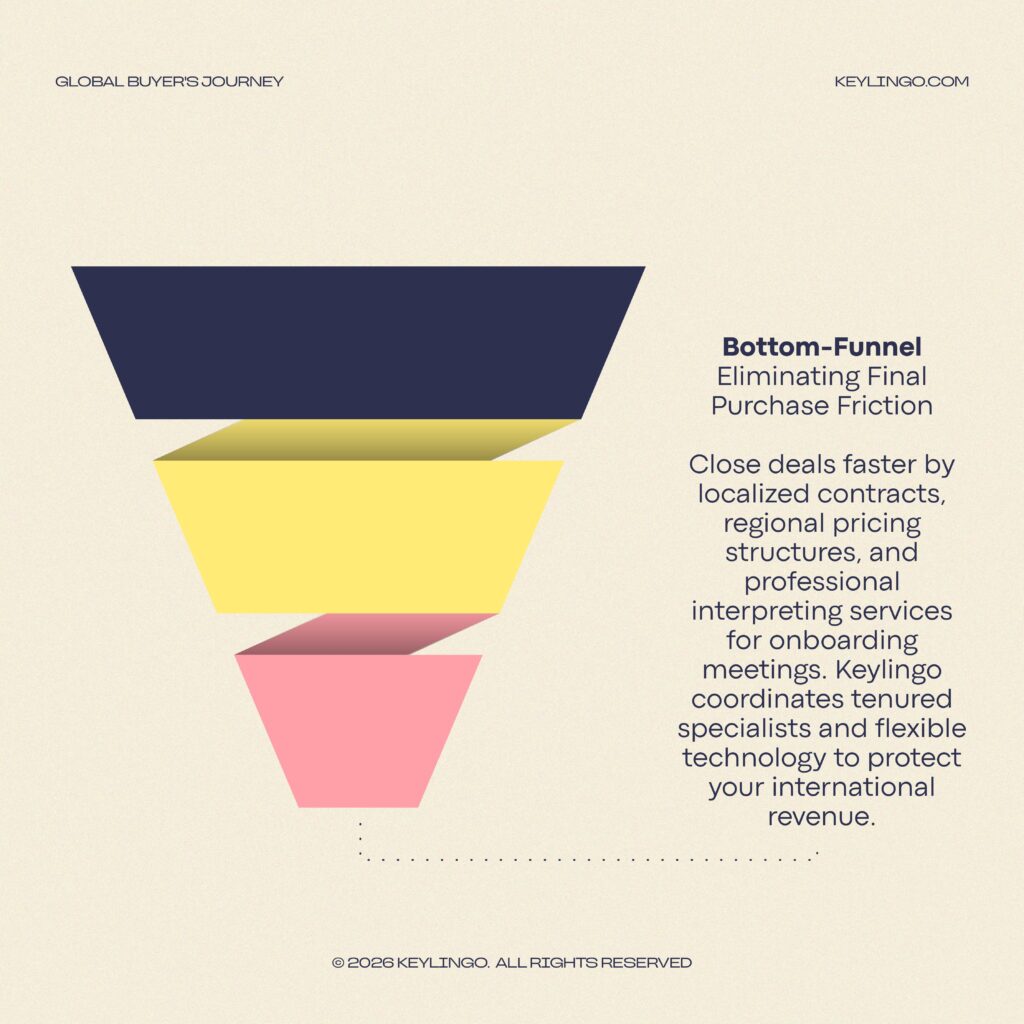
Bottom of Funnel (Decision): Eliminating Conversion Friction
Friction kills deals at the finish line. Bottom-of-funnel localization focuses on risk mitigation, contract execution, and seamless onboarding.
- Legally Compliant Contract Translation: Protect enterprise revenue and regulatory standing with legally vetted document translations tailored to local contract laws.
- Regional Pricing & Commercial Adaptation: Format currency, payment terms, and invoicing structures according to local enterprise procurement standards.
- Professional Interpreting Services: Facilitate high-stakes final negotiations, executive presentations, and initial onboarding meetings with native-speaking professional interpreters.
Strategic Comparison: Generic Translation vs. Full-Funnel Localization
| Funnel Stage | Traditional / Generic Approach | Full-Funnel Localization Strategy | Key Business Impact |
| Top of Funnel (TOFU) | Direct word-for-word translation of ad copy and web pages. | Multilingual SEO, localized digital campaigns, and strategic transcreation. | Higher organic discovery and lower international customer acquisition costs (CAC). |
| Middle of Funnel (MOFU) | Unvetted machine translation of technical spec sheets and guides. | Terminology-managed translation of product sheets, whitepapers, and eLearning tools. | Shorter evaluation cycles and higher sales qualified lead (SQL) trust metrics. |
| Bottom of Funnel (BOFU) | Untranslated or roughly translated contracts and pricing sheets. | ISO-certified legal document translation and real-time sales interpreting. | Reduced contract friction, faster deal closing, and higher win rates. |
Q&A Section
Q: What is full-funnel localization in enterprise B2B sales?
A: Full-funnel sales localization is the practice of adapting language assets specifically to each stage of the buyer’s journey—from brand awareness to contract signature. This strategy ensures prospects encounter culturally relevant, technically accurate messaging that builds trust and eliminates conversion friction across global markets.
- Awareness: Global SEO and transcreated advertising.
- Consideration: Terminology-accurate technical documentation and product specs.
- Decision: Legally compliant contract translation and live negotiation interpreting.
Q: How does global SEO translation improve top-of-funnel conversion?
A: Global SEO translation optimizes digital content for international search engines and AI engines using localized keywords, search intent, and cultural context. By aligning source content with local search behaviors, brands capture high-intent organic traffic, increase top-of-funnel brand awareness, and reduce cost-per-acquisition.
Q: Why is technical terminology accuracy vital for middle-of-funnel prospects?
A: Technical terminology accuracy provides middle-of-funnel prospects with the clarity needed to validate product capabilities and mitigate risk. Precise technical translations eliminate operational ambiguity, satisfy procurement standards, and prove technical reliability during enterprise software or industrial buying evaluations.
Q: How does localization prevent lost revenue at the bottom of the funnel?
A: Bottom-of-funnel localization prevents revenue loss by delivering legally binding contracts in regional formats, localized pricing schemes, and real-time interpretation for closing calls. Removing language barriers during final negotiations stops deals from stalling and builds immediate trust with international decision-makers.
Ready to Streamline Your Global Sales Pipeline?
Language barriers shouldn’t stall your international expansion. Whether you need to optimize your global web presence for organic search or require ISO-certified translation for enterprise procurement docs, Keylingo delivers the hybrid tech-and-human expertise required to scale revenue seamlessly.
Contact Keylingo Today to consult with our team and build a custom language framework tailored to your buyers’ journey.
Related Articles
What Are ISO 9001 Certified Translation Services?
ISO 9001 certified translation services are enterprise-grade localization workflows governed by strict quality management systems (QMS) and verified by independent bodies. They ensure consistent accuracy, technical reliability, and rapid issue resolution, benefiting global brands by drastically reducing the risk of compliance failures in multilingual campaigns. Why Do Procurement Teams Demand ISO 9001 Translation Services? When…
What Is Privacy-First AI Translation?
Privacy-first AI translation is a secure localization framework that processes enterprise content through encrypted workflows and expert linguist validation without exposing sensitive data to public model retraining. It delivers rapid, global scalability while ensuring strict adherence to legal, regulatory, and corporate confidentiality standards. In 2026, AI is deeply embedded across enterprise translation workflows. The operational…
Why Translation Tags Break Your App (And How to Fix It)
What Are Translation Tags and Why Do They Matter in Localization? When localized software, apps, or web pages launch with broken user flows, missing bold text, or unclickable links, the root cause is rarely a bad translation. Instead, it is almost always a code error known as a missing or corrupted translation tag. In technical…
here
for you
We’d love to learn more about your translation and localization needs.