

Localization as Revenue Infrastructure for Global Growth
by Keylingo
Localization as revenue infrastructure is the systematic integration of cultural adaptation and translation technology directly into product design and operations to drive global expansion. It converts language services into scalable growth engines, allowing brands to capture market share, increase conversion rates, and accelerate international revenue generation.
Why Shift from Translation as a Cost to Localization as Infrastructure?
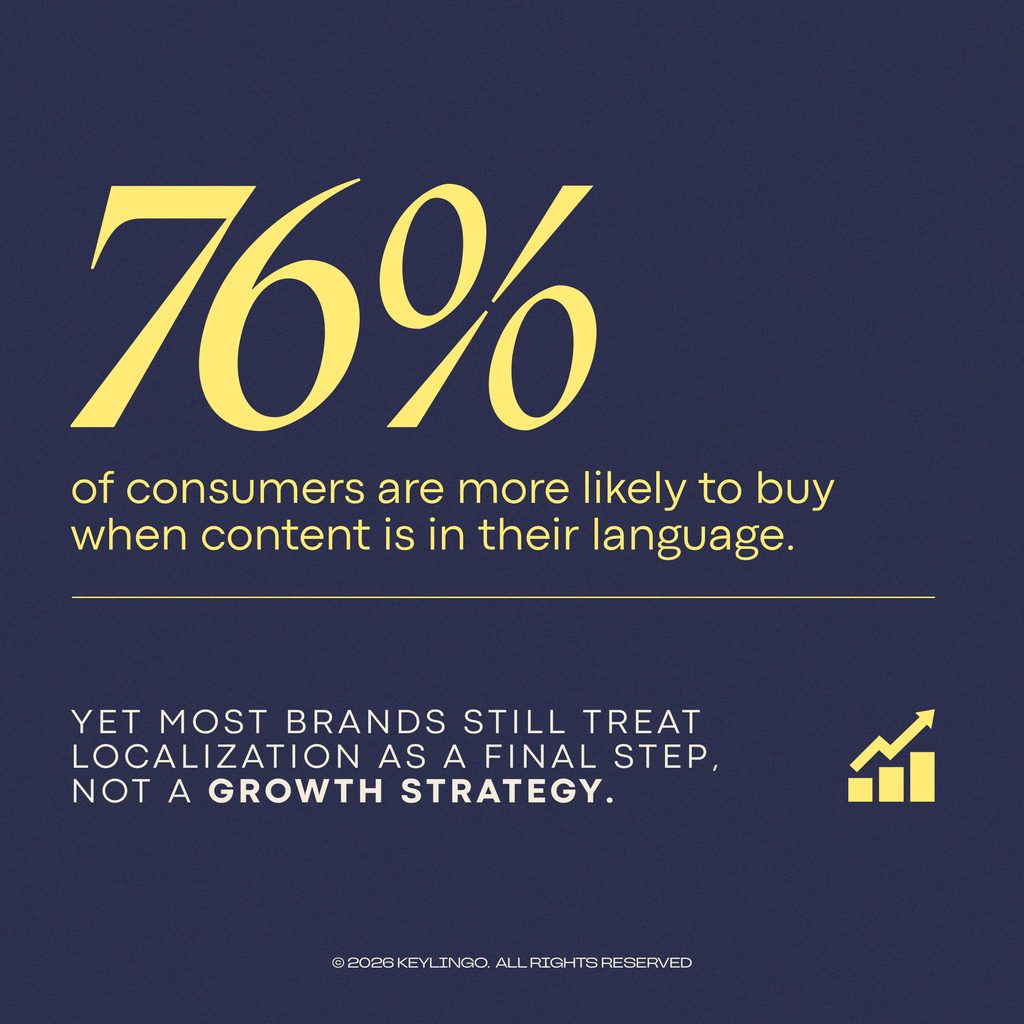
Over 76% of global consumers prefer buying products in their native language. Despite this, many marketing and procurement leaders still treat translation as an afterthought – a line-item expense handled at the final stage of product development or campaign execution.
Treating localization as a reactive cost center creates severe bottlenecks: delayed product launches, fragmented customer journeys, and disjointed brand messaging. Leading global enterprises avoid these traps by building localization directly into their core technology stack and operational infrastructure.
Using advanced Computer-Assisted Translation (CAT) tools, centralized Translation Memories (TM), and automated terminology management, companies transform static content into high-converting, market-ready assets across every target region.
| Feature / Dimension | Translation as a Cost Center | Localization as Revenue Infrastructure |
| Workflow Timing | Reactive, post-production step | Continuous, embedded in agile sprints |
| Market Impact | Delayed launch in non-English markets | Simultaneous global launches |
| Technology Integration | Manual file transfers, siloed copy | Automated API integrations & TMs |
| Primary Metric | Cost per word | Customer Lifetime Value (LTV) & Global Revenue |
How High-Growth Industries Scale Revenue Through Localization
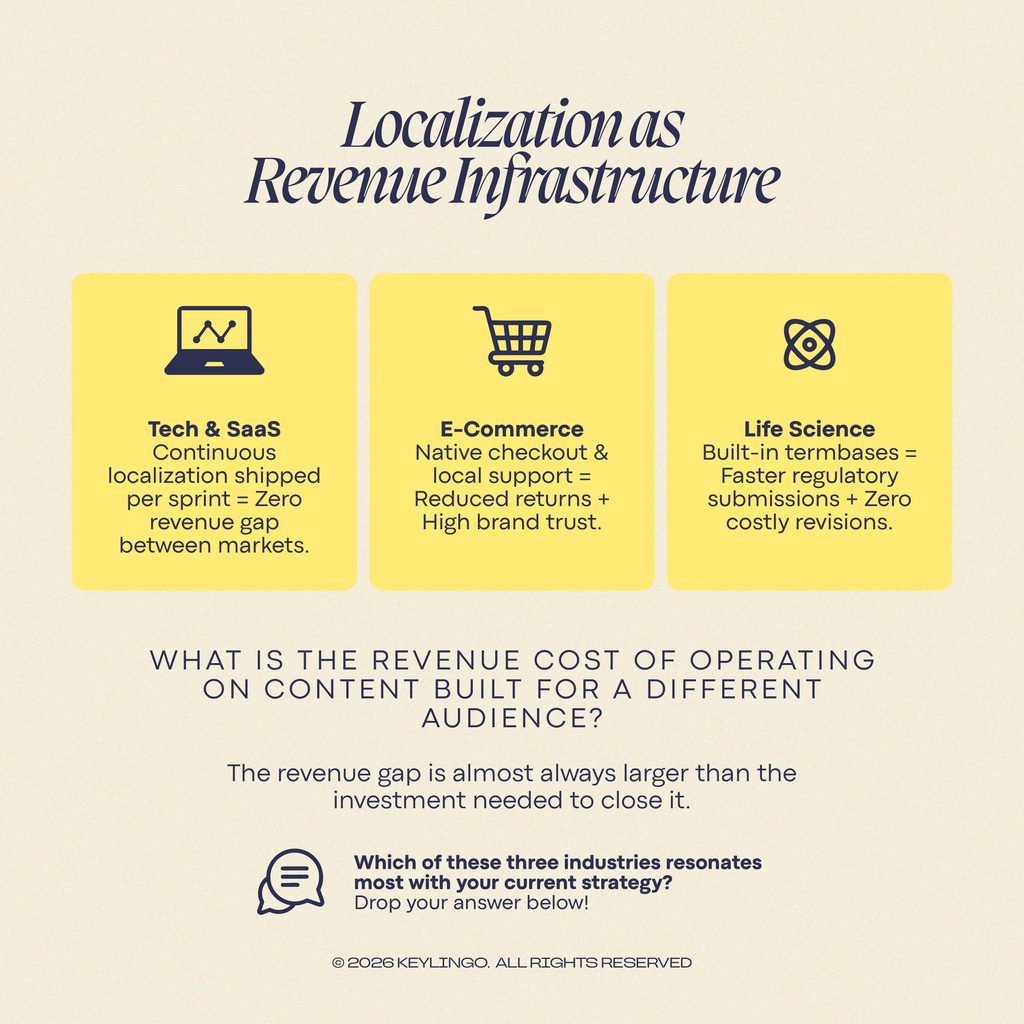
💻 Technology & SaaS: Continuous Localization in Agile Sprints
Top software platforms do not launch in English and wait months to translate their user interface. Instead, they embed continuous localization directly into their CI/CD pipelines.
By integrating CAT tools and translation APIs with platforms like GitHub or Jira, software engineers ship code and multilingual content in tandem. Every sprint releases simultaneously in every strategic language. This eliminates the revenue gap between domestic and international markets, dramatically lowering customer acquisition costs (CAC) overseas.
🛒 E-Commerce: Culturally Adapted Journeys that Boost Conversions
Expanding e-commerce brands into high-growth regions like Southeast Asia and LATAM requires far more than literal text conversion. Localized e-commerce success relies on transcreation—adapting marketing copy, product descriptions, checkout flows, and payment options to fit local cultural norms.
- Native Checkout Flows: Providing local currency and localized payment gateways increases checkout completion rates.
- Culturally Adapted Messaging: Aligning promotional copy with regional nuances builds trust that paid advertising alone cannot establish.
- Customer Support: Offering multilingual post-purchase support drastically reduces product returns and boosts repeat purchase rates.
⚕️ Life Sciences & Healthcare: Accelerated Regulatory Compliance and Quality
In life sciences, medical device manufacturing, and clinical trials, accurate documentation is critical. While international regulatory requirements (such as FDA or EMA mandates) are often viewed as compliance hurdles, market leaders turn them into efficiency drivers.
By building validated, centralized translation memories and termbases, healthcare organizations ensure absolute consistency across regulatory filings, patient materials, and instructions for use (IFU). This structured approach reduces costly revision cycles, minimizes legal risk, and speeds up product approvals in foreign health jurisdictions.
Assessing Your Global Revenue Gap
As organizations refine their strategic planning, marketing and procurement leaders must ask a pivotal question: How much revenue is being lost to international content that was built for a single market?
If your global audiences are consuming generic, awkwardly translated messaging, you are leaving market share on the table. The revenue opportunity unlocked by seamless localization routinely exceeds the upfront investment required to build a scalable infrastructure.
Q&A Section
Q: What is the difference between translation and localization as revenue infrastructure?
A: Translation converts text word-for-word, whereas localization as revenue infrastructure embeds cultural adaptation and continuous multilingual technology directly into business operations to accelerate global sales.
Q: How does continuous localization reduce time-to-market for SaaS companies?
A: Continuous localization integrates translation directly into agile software development sprints using automated workflows. This enables simultaneous multi-language product releases, eliminating launch delays in non-English international markets.
Q: Why is localization critical for e-commerce expansion in emerging markets?
A: Localized e-commerce experiences – including native checkout flows, local currency, and culturally adapted copy – build consumer trust, significantly boost conversion rates, reduce return rates, and increase customer lifetime value.
Q: How do translation memories and termbases lower compliance costs in healthcare?
A: Centralized translation memories and termbases store approved regulatory terminology, ensuring technical consistency, speeding up regulatory submission timelines, and eliminating redundant translation costs across foreign health authorities.
Accelerate Your Global Growth with Keylingo
Is your organization operating on outdated translation workflows, or are you ready to build localization that drives measurable top-line revenue?
At Keylingo, we partner with global marketing, technology, and procurement teams to engineer custom localization infrastructure tailored to your target markets. Contact Keylingo today to audit your global content strategy and unlock the full revenue potential of your international markets.
Related Articles
What Is a Termbase? Terminology Management Guide
Why Do Translation Errors Keep Happening to Your Product Names? When a localized launch lands in a new market with the wrong product name, the immediate reaction is often to blame the translator. However, in professional translation and localization, recurring terminology errors are rarely a linguist problem. They are almost always an infrastructure problem. Without…
Localization Testing: Why Pre-Launch QA Matters
What Is Localization Testing and Why Is Document Translation Not Enough? Your translation files may look pristine, but once deployed into a live application, user interface (UI) dynamics change completely. A translation that reads clearly in a spreadsheet can easily break a button, truncate essential instructions, or confuse international buyers when loaded into a web…
Multilingual Event Interpreting: Case Study in Technical Summit Execution
Multilingual conference interpreting is a real-time localization service that enables international summit attendees to understand technical presentations across multiple languages simultaneously. By pairing domain-expert linguists with specialized audio technology, event organizers eliminate language barriers, safeguard technical accuracy, and maximize international attendee engagement. Why High-Stakes Technical Summits Demand Professional Simultaneous Interpreting Organizing a multi-day international conference…
here
for you
We’d love to learn more about your translation and localization needs.