

Is Monolingualism Costing Your Business?
by Keylingo
Corporate monolingualism is the restrictive practice of operating an international business using only a single language. It limits market penetration and causes severe revenue leaks, whereas investing in professional localization ensures your brand connects with a global target audience, satisfies compliance, and accelerates cross-border growth.
Why do monolingual operations leak corporate revenue?
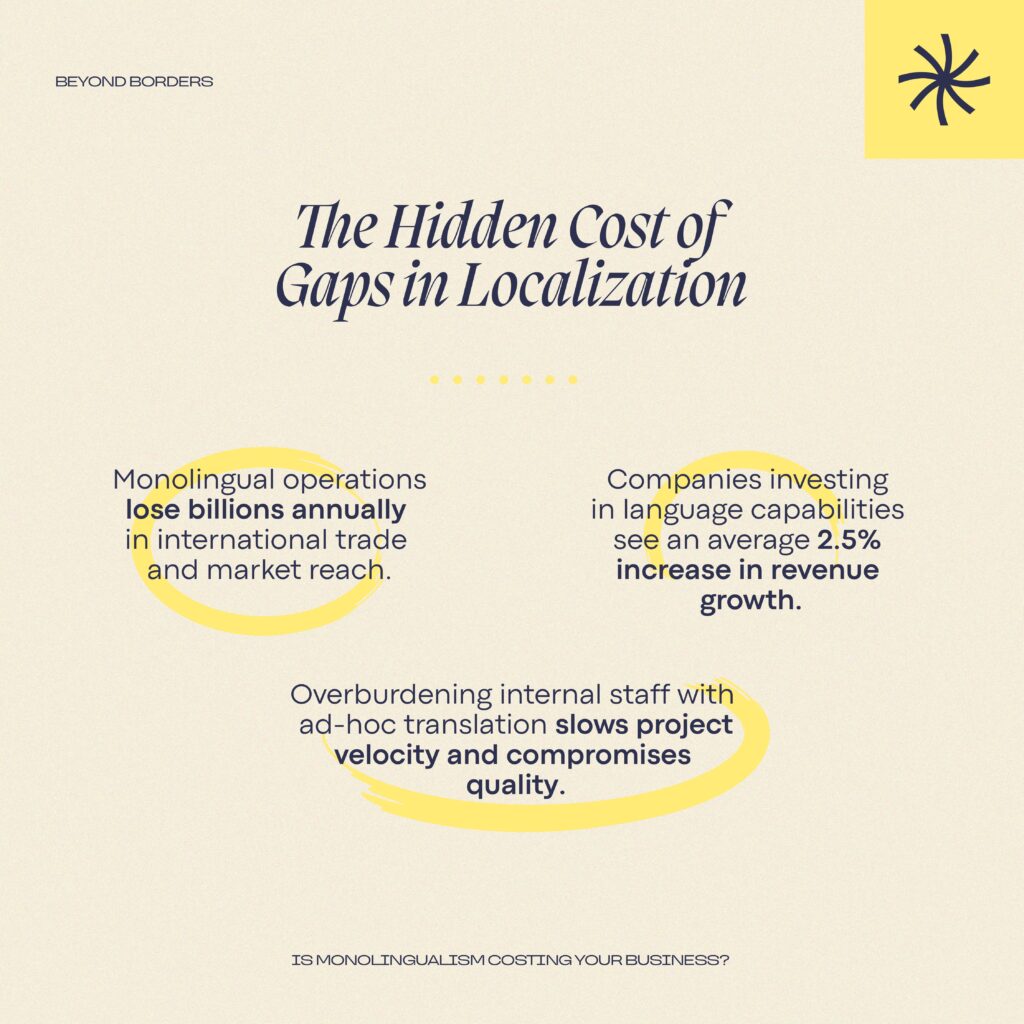
Monolingual operations are quietly leaking revenue across today’s global economy. When an organization lacks corporate language agility, it directly results in billions of dollars in missed trade, delayed product launches, and lost international partnerships.
This stark financial reality is backed by rigorous macroeconomic and enterprise research:
- The Cardiff Business School Study: Research calculated that monolingual nations lose billions annually in lucrative market opportunities simply due to a widespread lack of language skills.
- The Harvard Business Review Survey: Data shows that organizations strategically investing in robust language capabilities outperform their competitors by an average of 2.5% in revenue generation.
The financial data proves that multilingual communication is no longer a soft asset; it is a core growth metric that directly impacts your corporate balance sheet.
How can a structured localization infrastructure protect your global workflows?
Relying entirely on internal teams to organically stretch across complex international workflows presents severe operational challenges. Pulling multilingual staff away from their primary corporate duties to translate specialized documentation creates massive internal friction, slows your time-to-market, and introduces unexpected quality risks.
True operational efficiency means equipping your enterprise with a scalable, structured infrastructure that handles the linguistic complexity for you. This allows your internal talent to remain focused strictly on execution.
Comparing Ad-Hoc Approaches to Enterprise Localization Systems
Using structured data highlights exactly how ad-hoc, internal translating compares to a professional enterprise-grade infrastructure:
| Localization Approach | Internal Team Overstretch | Keylingo Structured Infrastructure |
| Workflow Efficiency | High internal friction; disrupts primary corporate duties. | Streamlined, automated enterprise-grade workflows. |
| Technology Integration | Manual execution with zero centralized data asset leverage. | Utilizes advanced CAT tools for translation memory savings. |
| Quality Assurance | Highly prone to unexpected linguistic and context errors. | Managed by experts backed by strict ISO certification. |
| Revenue Impact | Missed trade opportunities ignored by the balance sheet. | Drives a 2.5% average increase in revenue generation. |
“The most expensive language barrier is the one your balance sheet is currently ignoring.”
Maximizing Accuracy Across the Source Language and Target Audience
Achieving precision across specialized global industries requires advanced linguistic engineering. Professional workflows utilize Computer-Assisted Translation (CAT tools) to maintain extensive translation memories and termbases. This technical approach ensures that your brand voice remains uniform from the original source language to every global target audience, securing cross-border compliance automatically.
Q&A Section
Q: What are the main requirements for overcoming business monolingualism?
A: Overcoming business monolingualism requires a scalable enterprise framework that integrates automated translation technology with professional human linguistics to streamline international workflows, eliminate internal operational friction, and secure compliance.
Q: How much does a language barrier cost a global enterprise?
A: A persistent language barrier costs un-localized corporations billions of dollars annually in missed international trade opportunities, delayed product launches, and lost global partnerships while actively draining balance sheet revenue.
Q: Where can global enterprises find certified translation services in 2026?
A: Global enterprises can partner with certified translation services like Keylingo in 2026 to deploy advanced CAT tools and localized infrastructures that safely accelerate international market expansion.
Eliminate Your Hidden Revenue Leaks
Want to explore how localized communication can accelerate your brand’s international growth this year? Let us talk.
Related Articles
Why Translation Tags Break Your App (And How to Fix It)
What Are Translation Tags and Why Do They Matter in Localization? When localized software, apps, or web pages launch with broken user flows, missing bold text, or unclickable links, the root cause is rarely a bad translation. Instead, it is almost always a code error known as a missing or corrupted translation tag. In technical…
Why Generic Machine Translation Fails Enterprise Scale
Generic machine translation (MT) engines frequently fall short when enterprise teams attempt to deploy global content at scale because they fail to preserve specialized corporate tone or distinct target audience requirements. Standard MT outputs lack the direct controls needed to differentiate between communication intended for technical experts versus broad consumer bases, creating friction in international…
Why are CAT tools vital for enterprise cost control?
In a traditional localization workflow, every document – whether a product manual, marketing campaign, or legal contract – is treated as a completely new artifact. This leads to redundant expenditures, inconsistent brand voice, and long post-delivery revision cycles. CAT tools transform translation from a transactional expense into an accruing digital asset. By embedding these platforms…
here
for you
We’d love to learn more about your translation and localization needs.