

Why Integrated Generative AI is the Future of Global Content
by Keylingo
Generative AI in localization is a secure, context-aware technology integrated into a translation portal that automates content production using brand-specific data. It ensures global companies maintain consistency across 200+ languages while reducing manual file exchanges and operational friction.
When companies expand internationally, language operations often become fragmented. Using standalone AI tools creates risks like inconsistent terminology, “semantic smells,” and a total lack of cost visibility. Serving the Atlanta business community and global markets requires a “human-in-the-loop” approach where technology retrieves context before generating a single word.
How Keylingo’s AI-Augmented Portal Transforms Operations
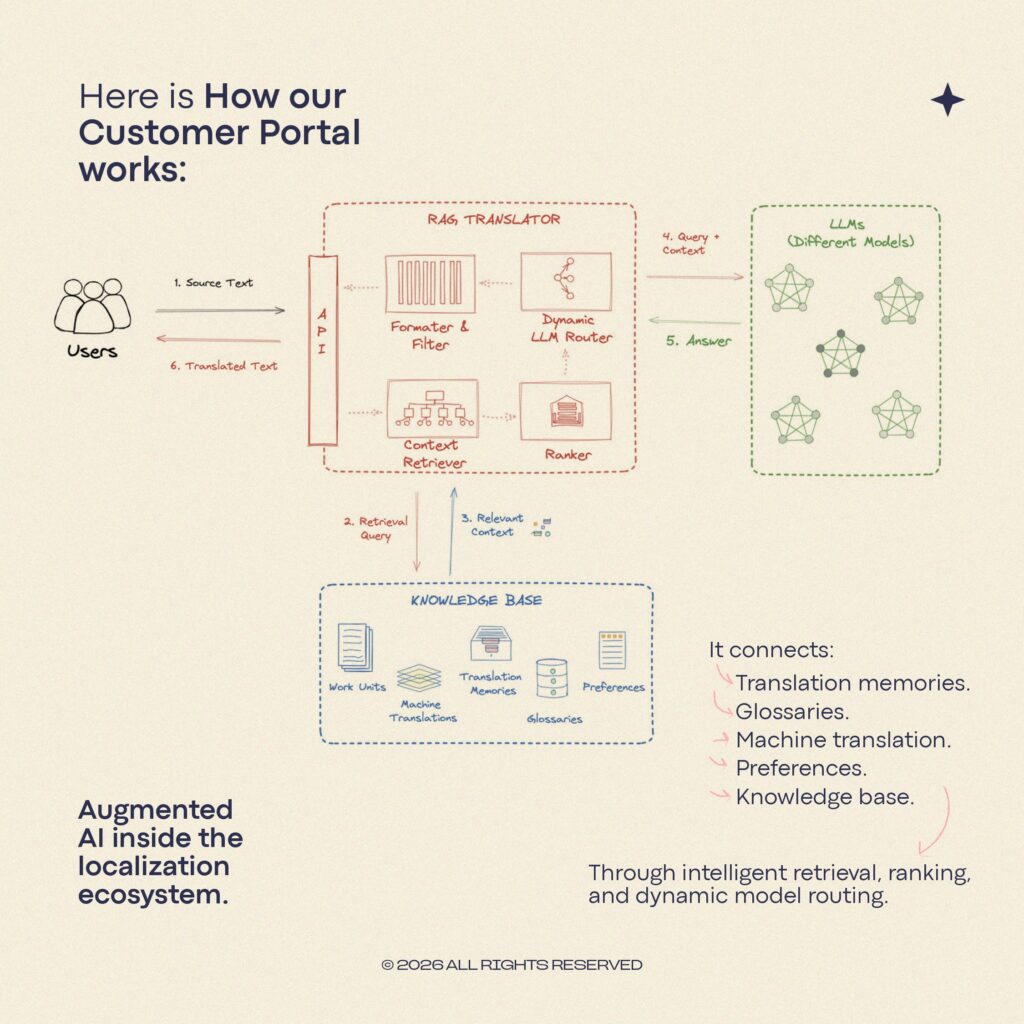
Keylingo combines human expertise with intelligent technology to make global growth structured and scalable. Instead of sending content to an external, isolated model, our architecture routes source text through your specific knowledge base – including translation memories and glossaries – before it ever reaches the AI.
The following table highlights the difference between fragmented manual processes and a centralized, AI-augmented ecosystem:
| Feature | Fragmented Manual Operations | Keylingo AI-Augmented Portal |
| Workflow | Manual file exchanges | Automated, centralized hub |
| Consistency | Inconsistent terminology | Terminology learning & glossaries |
| Visibility | No cost transparency | Instant, automated quotes |
| Quality Control | High risk of errors | “Smells” Semantic Verifier |
| Scalability | Drains internal resources | Engineered for scale |
Protecting Your Brand with “Smells” Semantic Verification
Speed is irrelevant if the output is inaccurate. Our linguists work within an intelligent environment that utilizes a Smells Semantic Verifier to detect potential issues in real-time. If a semantic issue is flagged, the system triggers a Human Review by expert linguists to ensure the final delivery is ready for market. This controlled augmentation delivers faster turnarounds without sacrificing the nuance that only a professional can provide.
Q&A Section
Q: What is the difference between AI and human translation? A: AI translation provides rapid, fluent output by predicting word sequences, whereas human translation offers cultural nuance and strategic intent. Keylingo’s “human-in-the-loop” model combines both to ensure technical accuracy and brand alignment.
Q: How to ensure accuracy in AI translation? A: Accuracy is ensured by integrating AI into a governed ecosystem that uses translation memories and semantic verifiers. This allows the system to flag “smells” for human experts to review before final delivery.
Q: How much does it cost to translate with AI augmentation? A: Costs vary by language pair, but AI augmentation significantly reduces expenses through Translation Memory (TM) savings. Clients receive instant, transparent quotes via the Keylingo portal, often showing savings of up to 49%.
Ready to Scale Your Global Language Operations?
Don’t let fragmented workflows slow your revenue. Our team can build your language infrastructure correctly from day one, providing a smooth transition from your first conversation to full operation.
Related Articles
Why Generic Machine Translation Fails Enterprise Scale
Generic machine translation (MT) engines frequently fall short when enterprise teams attempt to deploy global content at scale because they fail to preserve specialized corporate tone or distinct target audience requirements. Standard MT outputs lack the direct controls needed to differentiate between communication intended for technical experts versus broad consumer bases, creating friction in international…
Why are CAT tools vital for enterprise cost control?
In a traditional localization workflow, every document – whether a product manual, marketing campaign, or legal contract – is treated as a completely new artifact. This leads to redundant expenditures, inconsistent brand voice, and long post-delivery revision cycles. CAT tools transform translation from a transactional expense into an accruing digital asset. By embedding these platforms…
E-Commerce Transcreation for Global Growth
Discover why deep cultural localization and e-commerce transcreation are essential for engaging the booming middle-class markets across Asia and beyond. Key Takeaways: The global consumer class has surpassed 4 billion, with Asia now holding a massive 50% share of the middle class. To capture market share in these emerging hubs, brands must pivot from generic,…
here
for you
We’d love to learn more about your translation and localization needs.