

API-First Localization: Why Agentic TMS is the Future
by Keylingo
When companies expand internationally, language operations quickly become fragmented and inefficient. Most organizations struggle with multiple vendors, manual file exchanges, and a complete lack of cost visibility. While 99% of localization APIs provide basic access to data, very few actually transform how a business operates.
At Keylingo, we provide a structured, scalable language operation model powered by real people and intelligent technology. We support more than 200 languages across North America, Latin America, Europe, Asia, Africa, and Oceania, enabling consistent communication in every region where you operate.
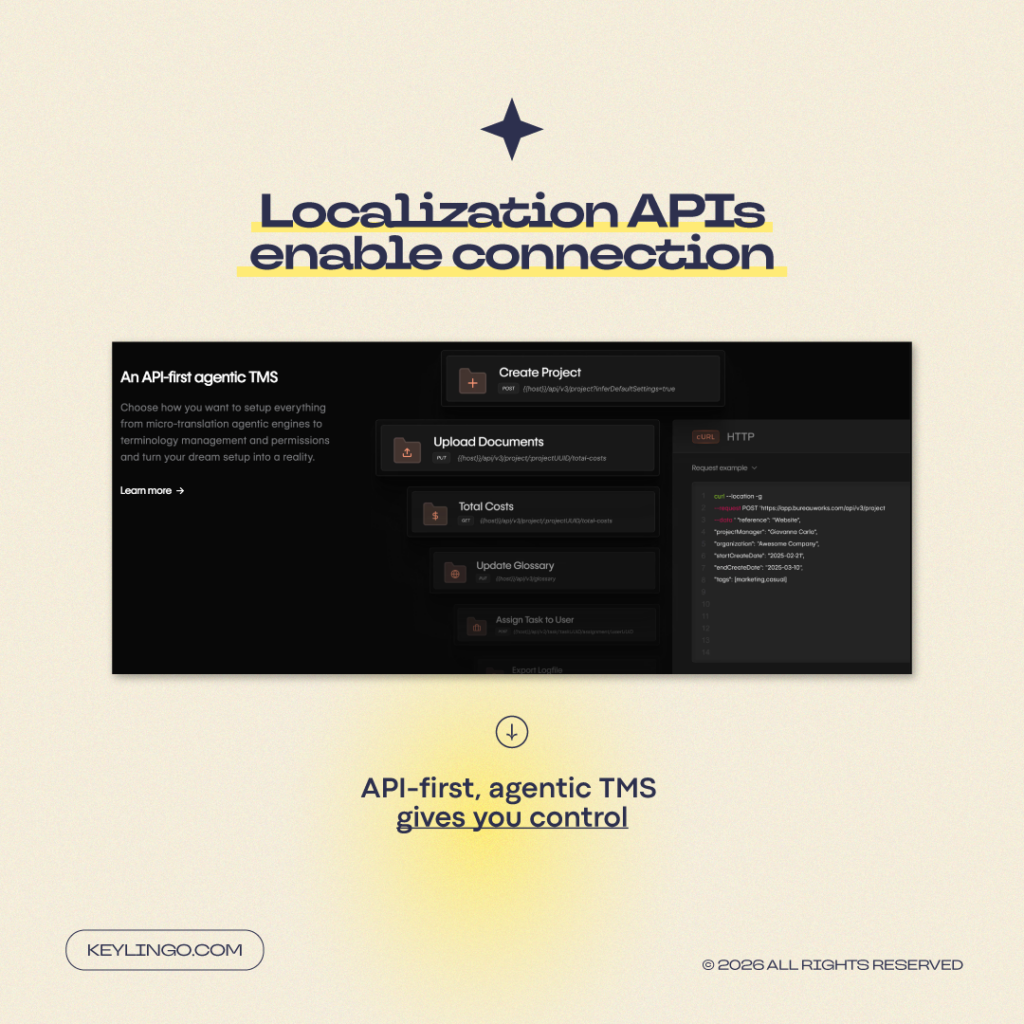
Why simple API access isn’t enough for modern localization
Traditional APIs act as simple “connectors” that retrieve or send files. However, true global growth requires an agentic layer where the system acts dynamically based on your business logic. Without this, teams suffer from:
- Workflow delays: Constant delays in manual approvals.
- Inconsistent quality: Terminology becomes inconsistent across different markets.
- Resource drain: Internal resources are drained by managing fragmented tasks.
- Lack of transparency: No real-time visibility into project status or costs.
How Keylingo’s Agentic TMS transforms language operations
Keylingo combines human expertise and intelligent technology to make global growth structured and scalable. Our centralized Customer Portal serves as your language operations hub, providing full visibility, predictability, and control.
| Feature | Manual Localization | Keylingo Agentic TMS |
| Project Creation | Manual emails and file uploads | Automated project creation and routing |
| Cost Control | Hidden fees and no upfront visibility | Real-time cost transparency and automated quotes |
| Quality Assurance | Reactive manual proofreading | Augmented translation with semantic verifiers |
| Scalability | Limited by internal headcount | Engineered for scale through smart automation |
The Power of Augmented Translation: Human Expertise + AI
Our linguists work within an intelligent translation environment designed for accuracy and efficiency. This “Human-in-the-Loop” approach ensures that while technology drives speed, experts guarantee cultural nuances.
- Context-Sensitive Translation: The system learns and adapts from translators’ choices with every feed.
- Smells Semantic Verifier: Our run-time semantic analyzer sniffs out potential issues before delivery.
- Automated Proofreading: Built-in tools for tag protection and terminology learning.
- Live Preview: Real-time web and mobile app translation previews to ensure layout integrity.
Q&A Section
What are the requirements for an API-first localization workflow?
To implement an API-first localization workflow, you need a centralized platform that supports programmatic project creation, automated cost quoting, and secure file engineering. Keylingo’s portal provides these enterprise-grade features to ensure your language infrastructure is built correctly from day one.
How to ensure accuracy in automated translation?
Accuracy is ensured by combining AI-augmented tools with professional human review to detect “semantic smells” and inconsistent terminology. Keylingo utilizes a Smells Semantic Verifier and expert linguists to provide a controlled, context-aware augmentation that delivers high consistency.
Difference between AI and human translation in an agentic TMS?
In an agentic TMS, AI handles repetitive tasks like file engineering and initial translation, while humans provide the “Augmented Translation Experience” for high-stakes content. This partnership ensures you receive delivery at twice the speed and half the cost without sacrificing quality.
How much does it cost to translate with Keylingo?
Keylingo provides full project cost projections and automated quotes directly within your Customer Portal before you approve any work. Users can view word counts, language breakdowns, and specific translation memory savings to ensure there are no hidden fees.
Ready to Go Global?
From your first strategy call to full operation, the transition to Keylingo is smooth and clearly guided. We build your language infrastructure correctly from day one so you can scale efficiently across any market.
Curious how this could fit into your current stack? Let’s talk.
Related Articles
The Hidden Costs of Fragmented Translation Management
When enterprise marketing teams scale international rollouts across multiple language pairs, operational control frequently breaks down. Translation assets become trapped in disconnected email chains, localized file iterations vanish into untracked storage folders, and project managers rely on manual spreadsheets to track critical launch schedules. This fragmentation creates severe business risks: How Keylingo’s Customer Portal Delivers…
What Are ISO 9001 Certified Translation Services?
ISO 9001 certified translation services are enterprise-grade localization workflows governed by strict quality management systems (QMS) and verified by independent bodies. They ensure consistent accuracy, technical reliability, and rapid issue resolution, benefiting global brands by drastically reducing the risk of compliance failures in multilingual campaigns. Why Do Procurement Teams Demand ISO 9001 Translation Services? When…
What Is Privacy-First AI Translation?
Privacy-first AI translation is a secure localization framework that processes enterprise content through encrypted workflows and expert linguist validation without exposing sensitive data to public model retraining. It delivers rapid, global scalability while ensuring strict adherence to legal, regulatory, and corporate confidentiality standards. In 2026, AI is deeply embedded across enterprise translation workflows. The operational…
here
for you
We’d love to learn more about your translation and localization needs.